

Short answer: A good puppy schedule is a simple daily loop. Wake, potty, eat, potty, play, nap. Repeat until bedtime, plus a night trip if needed.
The anchors: take her out when she wakes, after meals and play, and at least every two hours by day. That’s how often to go out. How long she can hold it is longer, and it also grows with age. Meals then drop from four a day to three between 3 and 6 months.
You printed a chart from one site. Your partner follows an app. Your teenager goes by memory. She napped at ten yesterday and not at all today, and nobody’s sure who took her out last.
A puppy schedule is a set daily order of potty trips, meals, play, training and naps. It also needs to be the same for everyone. The puppy feeding schedule breaks down meal timing by age.
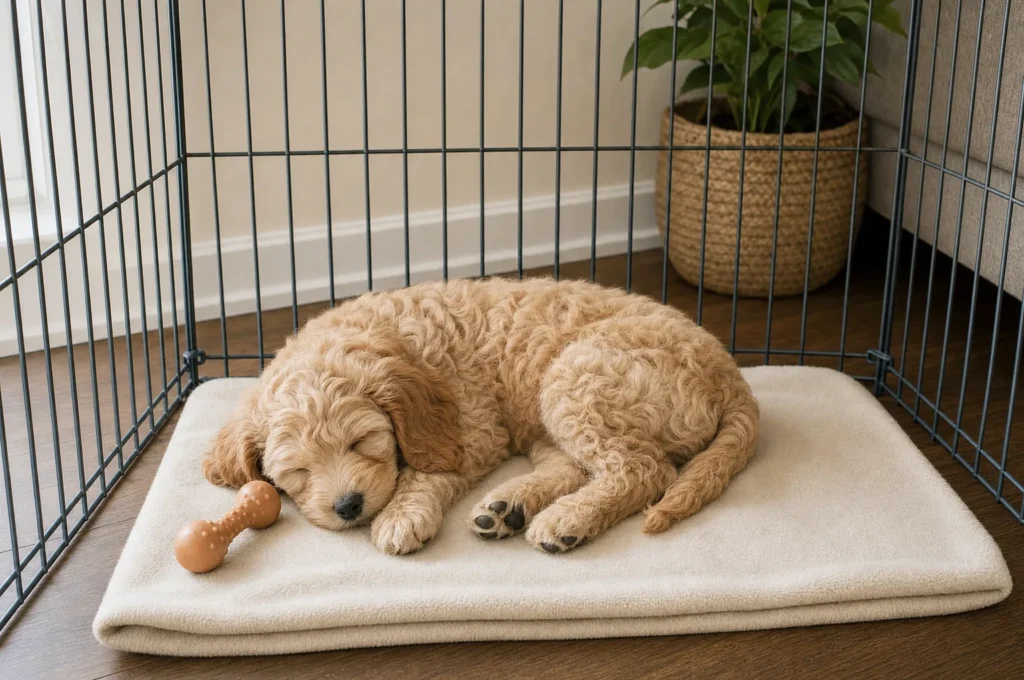
Leave the day loose, and she runs until she crashes. Too much stimulation and exhaustion can lead to unfortunate behavior (AKC).
No affiliate links. This page links two things we sell: our First 14 Days Kit and 3 to 6 Month Puppy Plan.
What does a puppy daily schedule look like?
This sample day condenses the AKC’s sample puppy schedule. Then hang it on your own breakfast, lunch and dinner.
- First thing in the morning. Straight outside to potty, then a little play.
- Breakfast. She’ll usually need to go within minutes, so out again. Then play, a little training and a potty chance.
- Mid-morning nap. Ideally in a crate or pen, even when you’re home.
- Noon. Out the moment she wakes. Lunch, out, play and training, then potty before her nap.
- Mid-afternoon. The same loop.
- Dinner. Feed her around your own meal, then straight out. A chew toy in her crate keeps her from under the table.
- Evening. Potty, family play time and an evening stroll.
- Bedtime. One last potty right before bed, then into her crate to settle.
- Night. If she can’t last until morning yet, a quick, boring trip out.
Sleep in a day: 18 to 20 hours (AKC)
Night without a bathroom break: about 7 hours, for most puppies (Humane World)
One nap: 30 minutes to 2 hours (AKC)
Sources: AKC, Humane World. Green is the low end of each range; orange is the rest of it.
Sleep fills most of her 24 hours, so naps shape her whole schedule.
Why one shared puppy schedule beats a stack of charts
A story from Michael Northcutt, our founder: When our puppy came home, I downloaded every free chart I could find. A potty chart. A feeding chart. A checklist. I printed them all and felt organized for about a day.
By day five, however, I saw what was missing. The potty chart didn’t say who was taking her out at noon. It didn’t stop two of us from each thinking the other had done the 9 p.m. trip. The household handoff guide explains six gaps to check when more than one person shares puppy care.
So I taped three of them together on the fridge and scribbled all over them. Arrows. Names. “WHO?!” in the margin. It worked, sort of. It also looked like a ransom note.
Standing there, tape in hand, I finally got it. I didn’t need more information. I needed one sheet that tied the day together, including who was on duty and the night plan.
So whatever you use, write the loop above on one page everyone sees, with a name beside each trip. The new puppy checklist helps organize the supplies and first-week jobs around that routine.
Puppy schedule by age: how her day changes
The loop stays the same while the gaps between trips grow. The AKC has two numbers. About 1 hour per month of age is the normal stretch, up to about 9 months to a year. Her age in months plus one hour is the outer limit.
| Her age | Normal stretch | Outer limit | What shifts in her day |
|---|---|---|---|
| 8 weeks | About 2 hours | About 3 hours | Most come home now, with bladder control at its weakest (AKC). |
| 10 to 12 weeks | About 2 to 3 hours | About 3 to 4 hours | She may start to be consistent between 12 and 16 weeks (WebMD). |
| 4 months | About 4 hours | About 5 hours | Most puppies can make it through the night by about now (Purina). |
| 6 months | About 6 hours | About 7 hours | Usually dependable most of the time, if training began early (AKC). |
Tip: These are hold limits, not trip spacing. By day, she still goes out at least every two hours, and after waking, eating and play.
Trip times by age live in our puppy potty training schedule.
“…it depends on the puppy and the schedule you keep.”
Dr. Jerry Klein, Chief Veterinarian, American Kennel Club
Bringing home an 8-week-old? Our 8 week old puppy schedule goes deeper. Not sure when her next trip is due? Our free Potty Break Timer takes her age and last trip, then shows her next trip time and a countdown.
A young puppy may need a dozen or more trips outside a day. As a result, her first week is 84 trips or more. Each one needs a name, because otherwise two people assume and nobody goes.
What goes into a new puppy schedule?
A new puppy schedule has five pieces: meals, potty trips, naps, play and bedtime.
Meals: how many times a day?
The AKC’s feeding guide gives most puppies four meals a day from 6 to 12 weeks. Three follow from 3 to 6 months, then two. VCA gives 2 to 3 measured meals a day, based on body condition and age. Ask your vet which fits her.
In any case, feed at the same times each day. Fixed meals also mean predictable potty times. Pick the bowl up after 15 minutes at most (AKC). If she stiffens or growls when someone walks past her bowl, our guide to food aggression in puppies shows what to do.
Naps: how long, and where?
Your puppy may nap every hour or so. She’ll most likely be ready for a nap after play or a walk.
Give naps a quiet spot, such as a crate in a calm corner, and let her sleep undisturbed. Our crate training schedule walks through adding crate time.
Tip: Even on days you’re home, plan some crate or pen time. It helps her learn to be alone when she has to be (AKC).
Play, training and the evening witching hour
Play matters, but the AKC keeps it gentle. However, long runs and jumping are not good for puppies. Instead, toys, a walk and yard time are fine. Fold a little training into the play after each potty trip and meal. If she sleeps on your bed, the jump down counts too. Our dog stairs for bed guide covers steady steps sized to your mattress.
Early evening is the “witching hour” for many puppies. Zoomies are normal and common at night, especially after a day crated or short on exercise, writes trainer Stephanie Gibeault. Then the teeth come out. Sometimes a biting puppy is really an overtired puppy who needs a quiet nap. Teeth on your ankles after the run? Our puppy zoomies guide covers what to do that night.
The AKC’s plan for it:
- Guard the naps before dinner. Skip them, and she meets the evening overtired.
- Play early. Start play before the witching hour, and she may settle down.
- Redirect the teeth. When she nibbles fingers or toes, offer a chew toy instead.
- Still wild? Give her a treat and let her settle in the crate for a while.
Puppy bedtime routine and the night trip
The AKC says a set bedtime makes her adjustment and house training easier for everyone. It doesn’t matter if it’s 8 p.m. or midnight, as long as it becomes routine.
- Water up early. Humane World takes the bowl up about two and a half hours before bed.
- Quiet and dim. A crate in your bedroom lets you hear her if she needs out.
- Boring night trips. Set an alarm a little before she’d wake you. Out, then back to bed, no play.
Her night can outlast her daytime limit. Asleep and still, she can usually hold it longer than when she’s active.
Puppy schedule for working owners
Decide who can cover each break before leaving. Our guide to potty training while working full time helps you check care coverage.
A workday is longer than a young puppy can hold it. Set up a pen with a potty area, or have a pet sitter take her out (AKC). WebMD caps crate time at 3 to 4 hours.
Away more than four or five hours a day? Humane World asks you to consider if now is the right time for a puppy. Our 4 month old puppy schedule shows her longer gaps at that age.
Common puppy routine mistakes
Three slips the AKC, Humane World and VCA guides flag:
- Letting her fall asleep on you every nap. She can come to depend on you to fall asleep.
- Leaving food out all day. Free-choice feeding can raise the risk of extra body fat and weight gain.
- Changing the plan every day. Stick to a regular schedule, whoever is home.
Of course, nobody gets all of these right in week one. So pick the one that bit your house hardest and fix just that. The full potty method is in how to potty train a puppy.
Puppy schedule FAQ
When can puppies sleep through the night?
Most puppies can make it through the night by about four months of age, according to Purina. Until then, plan a quiet night trip.
How much exercise does a puppy need?
The AKC’s sample day allows 30 to 60 minutes of morning play, socializing and a walk. Several short sessions beat one long one.
Why does my puppy bite so much in the evening?
Biting is normal for a teething puppy, and the AKC sees it as part of development. By evening, she may also be overtired. Offer a toy instead of your hand, or settle her for a nap in a quiet crate.
When should her last meal be before bed?
Avoiding food within 2 hours of bedtime will help, according to the AKC’s potty training timeline. Take her out after that meal, then once more right before bed.
How we made this guide: In October 2026 we read schedule, sleep, feeding, potty and biting guides from five sources. Nobody at LoveMyPuppy is a veterinarian.
Sources
- American Kennel Club: Setting Schedules, Puppy Sleep, by Jan Reisen, Potty Training Timeline, Dr. Jerry Klein, How to Potty Train, Puppy Feeding Fundamentals, How to Stop Puppy Biting, Puppies Wild at Night, by Stephanie Gibeault, MSc, CPDT
- Humane World for Animals: How to Potty Train Your Dog or Puppy
- WebMD: House Train Your Puppy, by Julie Edgar, reviewed by Amy Flowers, DVM
- VCA Animal Hospitals: Feeding Growing Puppies, by Caitlin Grant, DVM, DVSc, Dip ECVCN, and colleagues
- Purina: Puppy Schedules, by the Purina Pet Expert Team