

Short answer: Make the crate the best spot in the house first. Treats and meals go inside with the door open. Then close it for seconds, then minutes.
Under 6 months, keep daytime crate stretches to 3 or 4 hours at most. At night, keep her crate near your bed.
We sell a printable puppy schedule kit, and we link to it below. We don’t sell crates.
It’s 2:14 a.m. and she’s been crying for twenty minutes.
You’ve read that if you go to her, you teach her to cry. You’ve also read that leaving her to cry is cruel. Your alarm goes off in five hours. In an apartment, you’re also wondering what the neighbors think.
That’s exhausting, and it’s fixable. What you need is a plan you can trust at 2 a.m.
Crate training a puppy (some people call it kennel training) goes wrong in a few predictable ways. The door closes too soon. She’s in there too long. Or nobody can tell a potty cry from a protest cry.
The experts don’t fully agree on that last one. We’ll show you where they split.
✓ Built on guidance from the American Kennel Club, Humane World for Animals, Dogs Trust and Preventive Vet.
Is crate training a puppy cruel?
Not when it’s done slowly and kept short. It turns cruel when the crate becomes a jail or a punishment.
A crate keeps a young puppy safe when nobody can watch her. The AKC says a well-sized crate also helps potty training by limiting chances for accidents.
When should you start crate training a puppy?
The day she comes home. Humane World says you can start as early as 8 weeks old.
What size crate does a puppy need?
Big enough to stand up, turn around and lie down. Not much bigger, or she’ll pee in one end and sleep in the other.
The AKC suggests buying for her adult size and adding a divider so it can grow with her.
Dogs Trust adds that she should be able to stretch out fully lying down. Check that every few weeks as she grows.
| Situation | Better choice |
|---|---|
| Short naps and quick errands | Crate |
| Nights in the first weeks | Crate by your bed, or a pen with the crate inside |
| Gone longer than she can hold it | Pen with a bed, water and a potty spot, or a walker |
| She panics in any small space | Pen or gated room, plus a trainer |
A story from Michael Northcutt, our founder: The first time we put a puppy in a crate, we did it the way you’d park a car. Pick her up. Put her in. Close the door. Walk away.
She screamed like we’d betrayed her. That crate had been her home for about four seconds, and she already hated it.
So the next time around, we slowed it down. Way down. Treats just inside the door. Breakfast at the back. Naps with the door open.
Some days we went back a step. Three people were working on that crate, and every one of us was in a hurry.
So we kept a little card on top of the crate that said which step we were on. Nobody skipped ahead on a busy morning and undid a week of patience.
How do you crate train a puppy, step by step?
Small steps, each one pleasant. Humane World says the whole process can take days or weeks, depending on the dog. Most days, it takes her meals plus about ten minutes of practice.
1. Put the crate where your family spends time
Pick a calm spot in a room you use, not a far-off laundry room. AKC trainer Rachel Lane says it’s unfair to expect rest in the middle of a lot of commotion.
Add a soft bed and a safe chew. Take her collar off before she goes in, as the AKC advises for safety.
2. Make it the best spot in the house, door open
Drop treats near the crate, then just inside, then all the way in. Let her walk in and back out. That’s a win.
“Start by sitting next to their crate and tossing treats in without closing the door.”
Rachel Lane, M.Sc., CPDT-KA, CBCC-KA, in the AKC’s crate training guide
Humane World says this step may take a few minutes or several days. Don’t rush it.
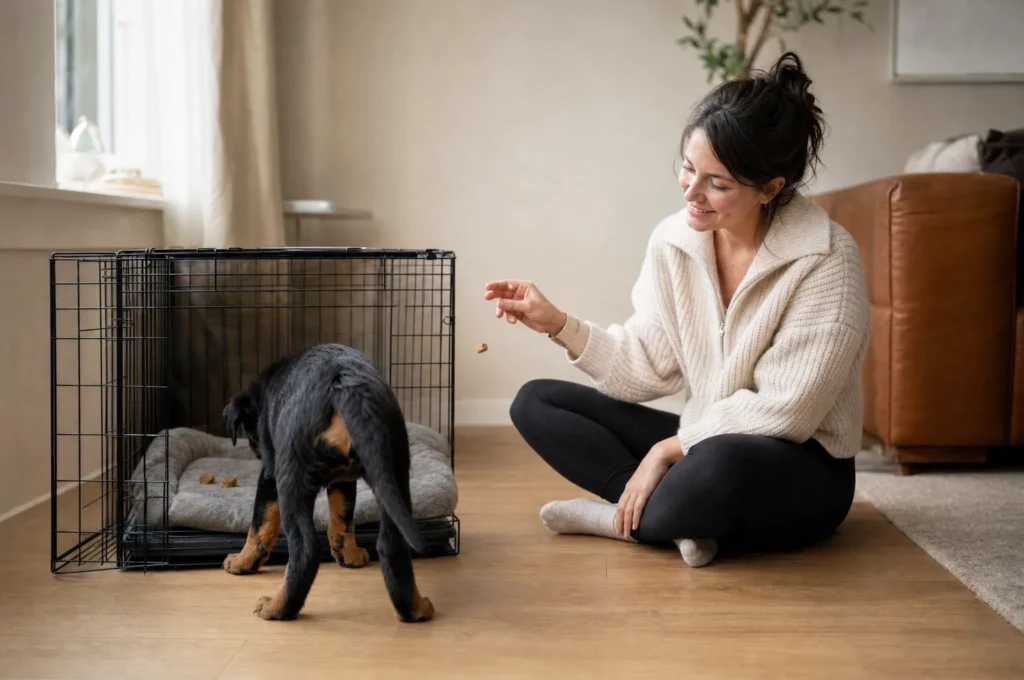
3. Feed her meals in the crate
Put the bowl just inside, then a little farther back each meal. Once she eats calmly at the back, close the door while she eats.
Open it the second she finishes. If she whines to get out, Humane World says you may have increased the time too quickly.
Tip: If she eats three meals a day, one week of crate meals is 21 easy wins.
4. Close the door for seconds, then minutes
Give her a stuffed chew, close the door and sit nearby. Open it before she fusses. Then stretch the time a little.
Next, step out of sight for a moment and come back. Humane World’s marker is about 30 minutes of quiet with you mostly out of sight. After that, short outings and crated nights can start.
5. Leave without a big goodbye
Take her out to potty first. Then a treat for going in, brief praise and leave quietly.
6. Crate her near you at night
Put the crate in your bedroom or just outside it. Humane World says you’ll want to hear your puppy when they whine for a potty trip. The night section below covers the rest.
What does a crate training schedule look like?
A simple loop you repeat all day: potty, food or play, a short crate session, potty, nap.
A typical morning for a young puppy:
- Wake up: straight outside to potty.
- Breakfast: in the crate. Door open at first, closed once she eats calmly.
- Play: a short session, then potty again.
- Crate time: a stuffed chew and a few quiet minutes, door closed.
- Nap: in the crate after another potty trip.
Repeat it all day, within the hours in the chart below.
Working all day? The AKC’s Lane suggests a dog walker or sitter for long days. Daycare or a puppy-proofed pen with space to sleep and potty works too.
Want the clock-by-clock version for her exact age? That’s what the kit’s schedules are for.
What mistakes make crate training harder?
Most setbacks come from six habits, and most are easy to fix.
- Closing the door on day one. Earn the closed door with treats and meals first.
- Using the crate as punishment. Humane World and Dogs Trust both say never.
- A crate that’s too big. She’ll pee in one end. Use the divider.
- Long stretches inside. Stay within the hours in the chart below.
- Opening the door mid-bark. It teaches her that barking opens doors.
- Leaving her collar on. The AKC says take it off in the crate, for safety.
Should you let a puppy cry it out in the crate?
Not for long, and not before you rule out a potty need. This is where trusted sources disagree, so here are both sides.
The AKC guide is firm. It says never force a dog inside or leave them to cry it out. Early crying, in its view, means the crate work went too fast.
Humane World takes a softer line. If you’re convinced she doesn’t need to potty, it says ignore them until they stop whining. Both say never punish the crying.
The AKC says whining within minutes of going in is likely stress. Whining after she’s been settled a while points to boredom, hunger or a full bladder.
| What you hear | Likely meaning | What to do |
|---|---|---|
| Crying the minute the door closes | Stress. The steps went too fast | Go back a step in daytime practice |
| Wakes and cries after sleeping | A full bladder | Quiet potty trip, straight back in |
| Whining after a long, settled stretch | Boredom, hunger or potty | Check the clock and her last trip |
| Screaming, panting, drooling, clawing | Panic | Stop crating and see the panic section |
Preventive Vet trainer Cathy Madson adds one caution. Try not to let her out while she’s barking, so barking doesn’t become the key.
How do you stop a puppy whining in the crate?
When she wakes crying at night, wait for a short pause, then go. No pause in a minute or two? Go anyway. A quiet potty trip won’t make her hate the crate. One bad night won’t undo a week of good ones, either.
Whining the second you leave the room means she hasn’t learned to be alone yet. Practice short daytime exits, stepping out and back before she fusses.
Some puppies are quiet for a night or two, then start crying once the newness wears off. Normal adjustment gets smaller night by night. Distress stays the same or grows, with panting, drooling or clawing. If so, jump to the panic section.
What should the first night in the crate look like?
Daytime practice first, a calm evening, then the crate right beside your bed.
- Afternoon: a few short, happy crate sessions with the door open.
- Evening: dinner three to four hours before bed, then quiet play, not wild games.
- Bedtime: a last potty trip, then into the crate with a chew. Lights off.
- Night wake-ups: out to potty, straight back in, no talking or play.
Where should a puppy’s crate go at night?
In or near your bedroom for the first weeks. Preventive Vet says this can help them feel more secure.
Should you cover it? Many puppies settle better with a blanket over the top and sides. Dogs Trust says a cover can reduce sounds from outside. Leave the front open for air, and remove it if she chews it.
Apartment tip: Preventive Vet suggests a fan or sound machine near the crate. It muffles the building’s noises for her, and some of her noises for the neighbors.
How often does a puppy need out at night?
Many young puppies need one or two night trips at first. In Preventive Vet’s example, a puppy named Finnegan needed breaks one to two times a night in his first week.
Trainer Cathy Madson says night potty needs are common up to four or five months old. Small changes cut the wake-ups:
- Feed the last meal three to four hours before bedtime.
- Offer a potty trip about 10 minutes after she drinks.
- If she always wakes at 1:00, set an alarm for 12:45 and beat her to it.
Over time, Madson says the goal is 6 to 7 hours overnight without a break.
How long can a puppy stay in a crate by age?
Under 6 months, Humane World says no more than three or four hours at a time.
The same page also gives a rule of thumb: her age in months plus one hour. For older puppies, those two rules give different answers. Use the smaller one.
Max daytime crate stretch by age, in hours
Months-plus-one rule Under-6-months cap (use this)
Why is my puppy peeing in her crate?
Usually the crate is too big, she was in too long, or the last potty trip came too early. Sometimes it’s medical.
- Too big: move the divider in so there’s only room to lie down.
- Too long: check her stretch against the chart above.
- Pees right after a trip outside: stay out longer and wait for the second pee.
Never put a pee pad in the crate. Our puppy pad guide explains why. Clean every accident with an enzyme cleaner, or the smell can draw her back.
What if your puppy hates the crate or panics?
Stop closing the door and go back to step 2. If she truly panics, swap the crate for a pen and call a trainer.
Lane says some puppies fear the door itself. It clanks, or it swung shut and hit her once. A different crate style can fix that.
Real panic looks different from fussing. Think nonstop screaming, heavy panting, drooling, or clawing at the door. If she bends bars, breaks nails or hurts her mouth, stop crating and call your vet. The AKC says dogs with separation anxiety often panic in their crate and can hurt themselves trying to escape.
For those puppies, use a gated room or exercise pen instead. Work with a qualified trainer or behaviorist. Our guide to dog anxiety in the crate shows how to tell protest from panic.
When to call for help: a trainer if the crying isn’t easing night by night. Your vet if she suddenly starts peeing in the crate, or pees far more often than usual.
What should you do this week?
- Set the crate up today, door open, with treats and a chew inside.
- Feed every meal in the crate, moving the bowl farther back each time.
- Move the crate next to your bed for night one, and set a potty alarm.
For trips by age, see our puppy potty training schedule. Still shopping? Here are the five potty training supplies worth buying. Thinking about an app for the lessons? Our best puppy training app guide ranks six, with prices checked.
Crate training FAQ
How long should I let my puppy cry in the crate at night?
Sources differ. Rule out a potty need first. Crying right after the door closes means go slower in the daytime work, not wait it out.
What should I put in my puppy’s crate at night?
Start with a chew-proof bed and a sturdy chew or food-stuffed rubber toy too big to swallow. Add soft blankets once she stops having accidents and shredding fabric, as the AKC suggests.
Should I put water in the crate?
Dogs Trust and the AKC both say yes. Use a non-spill bowl, and plan a potty trip about 10 minutes after her last big drink before bed.
Is kennel training the same as crate training?
Yes. Both mean teaching her to rest calmly in a crate. Some people just say kennel.
Can you crate train an older puppy or rescue dog?
Yes, with the same slow steps. Go slower if she has bad crate history. A pen or gated room may suit her better.
Why does my puppy wake up at 5 a.m. in the crate?
Usually a full bladder. Take her out, then straight back in with no play or breakfast party. A last meal three to four hours before bed helps. Still awake? Keep the room dark and boring until your normal wake time.
Why does my puppy bite the crate bars?
Usually frustration or teething. Go back a step in the daytime work and give her a safe chew. Open the door only in a quiet moment. Hard bar chewing can damage teeth, so mention it to your vet.
When can a puppy stop sleeping in a crate?
There’s no set age. Most owners wait until she’s reliably dry at night and doesn’t chew things when unsupervised.
How we put this together: We checked current advice from Humane World for Animals, the AKC, Dogs Trust and a certified behavior consultant at Preventive Vet. Then we read what new owners say in reviews and video comments.
Sources
- Humane World for Animals: How to Crate Train Your Dog or Puppy
- American Kennel Club (AKC): Everything You Need to Know About Crate Training Your Dog, by Stephanie Gibeault, MSc, CPDT, quoting Rachel Lane, M.Sc., CPDT-KA, CBCC-KA
- Preventive Vet: Crate Training Your Puppy at Night, by Cathy Madson, MA, FDM, CBCC-KA, CPDT-KA
- Dogs Trust: Playpen and Crate Training a Puppy