
Short answer: Some food aggression in puppies is normal, since guarding comes naturally to dogs. Still, treat it as a warning. Never take her bowl away to test her, and never punish a growl.
Feed her behind a gate in a quiet spot, and keep kids away while she eats. Toss a better treat as you pass, then keep walking. If she growls, snaps or lunges, talk to your vet and a behavior professional before training.
You walk past while she eats. Then her body goes stiff, and her eyes go hard. Maybe a low growl follows.
Food aggression in puppies is scary, more so with kids at home. Brushing off that warning can backfire. When quiet signals get ignored, dogs learn to use a lunge or a bite instead, VCA’s veterinary behaviorists explain.
Is food aggression in puppies normal?
To a point. Guarding possessions is normal behavior for dogs, according to the ASPCA. In fact, young puppies often compete with littermates for food from one shared pan.
Food aggression means she guards her meal with a freeze, a growl or a snap. It’s one form of resource guarding, which also covers chews, toys and favorite spots.
It can start young. Humane World says resource guarding in puppies can happen as young dogs learn their world. It can escalate to air snaps or even bites, so don’t wait it out. Growling during tug or play is a separate issue with its own fixes.
What does food aggression in puppies look like?
So watch her body language as someone nears the dish. The first signs are quiet.
| What you see | What it means | What to do now |
|---|---|---|
| She eats faster, gulps or stops eating as you pass | She’s uneasy with you near her food | Feed her where nobody walks through. |
| She stiffens, freezes or stares at you | A clear “please don’t come closer” | Quietly walk away. Don’t reach for her or the bowl. |
| Ears back, lip-licking, a lifted lip or a growl | A louder warning | Walk away. See a behavior pro before training. |
| She snaps, lunges or bites | Her quieter signals stopped working | Feed her behind a barrier. Call your vet and a behaviorist now. |
Source: VCA food bowl guide; Humane World and AKC resource guarding signs; ASPCA calm signs.
In short, your goal is relaxed muscles, a normal eating pace and a wagging body.
We sell the First 14 Days Kit and link our free Puppy Week Check-In.
What should you do the moment she growls?
Your first job is to back off and give her room.
- Don’t scold, hit or reach for her or her bowl. Quietly walk away, as VCA advises.
- Never punish the growl. The ASPCA and the AKC both warn that yelling or intimidation can make guarding worse.
- Give her space at meals, and skip prized chews for now.
After all, a growl is her polite way of saying she’s worried about her food.
A story from Michael Northcutt, our founder: My friend’s rescue puppy ate like the bowl might vanish. Head down, whole body over it, food gone in seconds.
The first time my friend bent to straighten the bowl, the puppy froze, eyes hard. “I think she’s scared someone’s going to take it,” she said.
She asked her vet first, because gulping can sometimes have a health side too. The vet checked her over, then gave her the name of a qualified behavior professional.
Meanwhile, the puppy ate behind a gate in the laundry room. Nobody reached for the bowl. They switched to a slow-feeder bowl. Sometimes, passing the gate during dinner, they tossed in a piece of chicken without stopping.
It took weeks, and it’s still a work in progress. Last month she sent me a picture. The puppy was eating, tail wagging, while someone walked by.
Her order follows VCA’s advice. Rule out health problems, keep meals safe, then train with a professional’s help.
Could a health problem be behind food aggression in puppies?
Before training, VCA advises a vet check. It confirms a healthy weight and also rules out illnesses that raise hunger or irritability. Trainer Nicole Costanza tells the AKC that a change in behavior may point to a medical issue. Book a vet visit when:
- The guarding is new after weeks of calm meals, or it has changed.
- She seems hungrier or crankier than usual.
- You’re unsure whether her weight is right.
How do you fix food aggression in puppies?
Start before trouble shows. VCA calls calm management a good way to prevent bowl guarding. Its walk-by game is built for puppies with no warning signs yet.
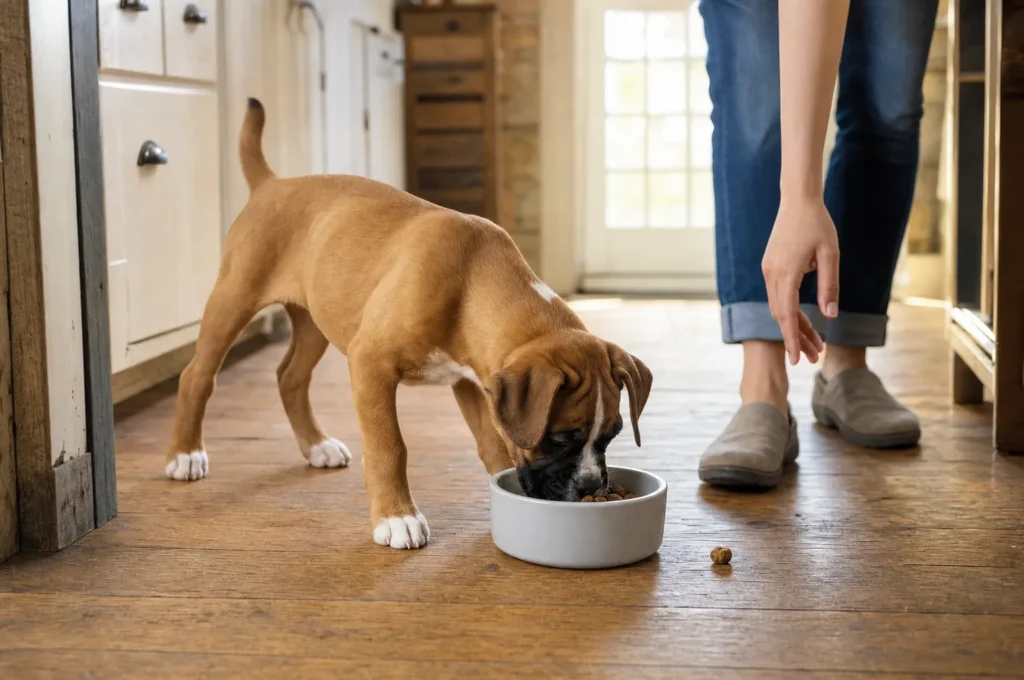
Set up a calm feeding spot
- Feed her behind a barrier, like a crate, a baby gate or a closed door.
- Choose a low-traffic spot where she won’t feel social pressure.
- Feed at set times. Our puppy schedule by age shows where meals fit her day.
- Pick up the bowl once it’s empty. Never remove the bowl, or its food, while she eats.
- Change foods with care. A new food can seem more valuable to her.
- Ban the “test.” Nobody reaches for her mid-meal to see if she means it.
Play the walk-by bonus game
VCA calls this the “All Good Things” game. Use it for a puppy who isn’t warning anyone at the dish yet.
- While she eats, walk past far enough away that she shows no warning signs.
- Roll a treat she likes more than her food toward the bowl. Say “bonus” as you toss.
- Keep walking. Don’t stop or hover.
- If she stays relaxed, repeat a few times a week. Pass a little closer each time.
- In time, toss the treat right into her dish, then walk on.
If she gulps her meal too fast for many tosses, the ASPCA’s fix is a slow-feeder dish.
“Puppies should not be disturbed while they are eating.”
Ellen Lindell, VMD, DACVB, and co-authors, VCA Animal Hospitals
Stiffening or staring means you got too close. Stop and ask a behavior professional.
When she already guards, go slowly with a pro
For a puppy who already guards, VCA recommends professional guidance. For example, the ASPCA’s plan uses desensitization and counterconditioning. Your approach starts to predict something better than her kibble.
Source: ASPCA, Food Guarding. Stages 1 to 5 each need 10 relaxed meals in a row. Stage 6 lifts the bowl. In stage 7, every adult starts over.
Nobody touches her bowl until at least 40 relaxed meals in. Plan on weeks, because food aggression in puppies fades slowly. Stop and call a pro if she seems stressed, won’t eat or stops progressing.
Tip: Save one treat she loves for these moments only, like small bits of chicken. The ASPCA’s plan uses treats she never gets at other times.
Trade, don’t take: chews, bones and toys
Puppy resource guarding can spread to chews, toys and beds. Humane World offers three fixes.
- Teach “give” and “leave it” by pairing each one with a treat.
- Always offer a trade when you need something back.
- Put a problem toy away if one item keeps causing tension.
Good chews to trade with are in our teething puppy chew toys guide.
The ASPCA’s plan ends with every adult in the family doing the same steps. Otherwise, four people with four habits can confuse her.
If she’s older than about 4 months, see our 3 to 6 Month Puppy Plan instead.
Hand-feeding and taking the bowl: where do experts split?
Hand-feeding. The ASPCA suggests hand-feeding a new dog several meals. VCA’s behaviorists see no scientific evidence it helps, and the wait can frustrate her.
Taking the bowl to show who’s boss. The ASPCA and Humane World both say don’t. In fact, the ASPCA calls it dangerous and unnecessary. She then learns that an approaching person means her meal will disappear.
If she already stiffens or growls, skip both. Stick to the walk-by game, with a professional’s guidance.
What if your puppy came from a shelter or a rough start?
Former street dogs often guard food after foraging for every meal. Even so, that drive can stay in a home with plenty of food.
Her past doesn’t settle it, though. Costanza tells the AKC that it depends on the individual dog, not the breed or where she came from. A rescue puppy gets the same plan: a vet check, a calm feeding spot and a pro if she warns.
How do you keep kids and other dogs safe at meal time?
Kids are more likely to get bitten, since they miss warning signals more easily. The ASPCA calls a guarding dog in a home with children unacceptably risky. Set these house rules today.
- Teach kids never to approach a dog that’s eating, resting or holding a chew.
- If she guards from children, no child under 18 should do the training exercises.
- Feed other dogs in separate rooms. Reward her when she minds her own meal.
Tip: Michael’s friend hung a sign for guests and her teenage nephews: “Dog eating. Pass on by.”
When does food aggression in puppies need a vet or behaviorist?
Humane World offers a simple test. If you’re worried she might bite someone, call in the experts. Call sooner, too, in any of these moments.
- She growls, snarls, snaps or lunges near her dish.
- She has bitten or tried to, above all with babies or toddlers at home.
- During the exercises she stays stressed, or progress stalls.
That list draws on VCA, the ASPCA and the AKC. Your vet can recommend a trainer or behaviorist. Also, pick one who uses positive reinforcement only.
If the bowl is one of several worries this week, a free check-in can help you pick where to start.
Food aggression in puppies FAQ
Will my puppy grow out of food aggression?
Don’t count on it. Humane World says there’s no quick fix, and VCA calls stepping in early vital.
Should I put my hand in her bowl while she eats?
No. VCA’s behaviorists say puppies shouldn’t be disturbed while eating, and reaching in teaches her to stay on guard. Let her eat in peace, or toss a better treat as you walk past.
Did I cause my puppy’s food aggression?
Not necessarily. Puppies often learn it competing with littermates over one shared pan, the ASPCA explains. Taking food away mid-meal can teach it too, so stop any bowl tests now.
Why does my puppy guard food only from my other dog?
She may worry the other dog will go for her meal. A fixed stare at a housemate during dinner is one sign, Humane World points out. Make sure there’s enough food, treats, beds and toys to go around.
Should I call a trainer or a dog behaviorist?
The ASPCA lists a Certified Applied Animal Behaviorist or a board-certified veterinary behaviorist first. A Certified Professional Dog Trainer can help too. That certificate doesn’t require aggression experience, so ask.
How we made this guide: In October 2026 we read the full VCA, ASPCA, AKC and Humane World guides. Nobody at LoveMyPuppy is a veterinarian or a behaviorist.