

Short answer: Most young puppies eat three to four measured meals a day at set times. They drop to two meals between about 4 and 12 months.
Start with the amount on her food bag, then adjust to her body and your vet’s advice. Pick the bowl up after about 15 minutes, and take her out soon after she eats.
| Age | AKC | PetMD | Chewy (Dr. Coates) |
|---|---|---|---|
| 6 to 12 weeks | 4 meals | 3 to 4 meals under 3 months | 3 meals, from weaning to 4 months |
| 3 to 6 months | Drop from 4 to 3 | Feeding 4? Consider 3 | 2 to 3 around 4 months |
| 6 to 12 months | 2 meals | May drop to 2 | 2 meals from 6 months |
| Toy breeds, under 10 lb grown | Not covered | Not covered | 4 to 5 meals to 4 months, then 3 until about 6 months |
From AKC, PetMD and Chewy. The sources differ because puppies have different nutritional needs.
She’s sitting by her bowl, staring at you like she hasn’t eaten in days. Your partner swears he fed her at seven. Your daughter thinks she did too. Nobody wrote it down. The daily puppy schedule puts meals alongside potty trips, naps and play.
A puppy feeding schedule is the set times, and measured amounts, your puppy eats each day. A good one also says who feeds her. Left alone, the extra scoops add up, and a puppy who’s always fed learns that staring works.
We sell a printable puppy schedule kit and link to it below. We don’t sell food, and no brand paid for a mention.
Puppy just came home? Do this at her first meal.
- Feed the food she ate before. Sudden changes may cause digestion problems or diarrhea, the AKC warns.
- Follow your vet’s meal plan. Do not withhold food from an unwell or very young puppy to teach manners.
- Take her out within 10 to 15 minutes, when VCA says puppies generally need to go.
✓ Built on guidance from PetMD, VCA Animal Hospitals, the AKC and Chewy’s Dr. Jennifer Coates.
How often should you feed a puppy?
Three to four meals a day while she’s young, then fewer as she grows. Keep the count her breeder or vet started until her age row above allows one less.
How often should an 8-week-old puppy eat?
Three times a day, Dr. Coates writes, while the AKC’s timeline says four. Toy breeds need four to five meals, she adds, to lower the risk of low blood sugar. Smaller, frequent meals suit a puppy’s fast metabolism, per PetMD.
Feeding a 6-week-old puppy
Puppies are generally weaned around 6 to 8 weeks, Dr. Coates says, then start solid food and water. Feed a food made for puppies. From 6 to 12 weeks, four feedings a day are usually enough.
Large-breed puppies should be on dry, unsoftened food by 9 or 10 weeks. Small breeds get there by 12 or 13 weeks. Younger than 6 weeks, or bottle feeding? Call your vet today for a plan.
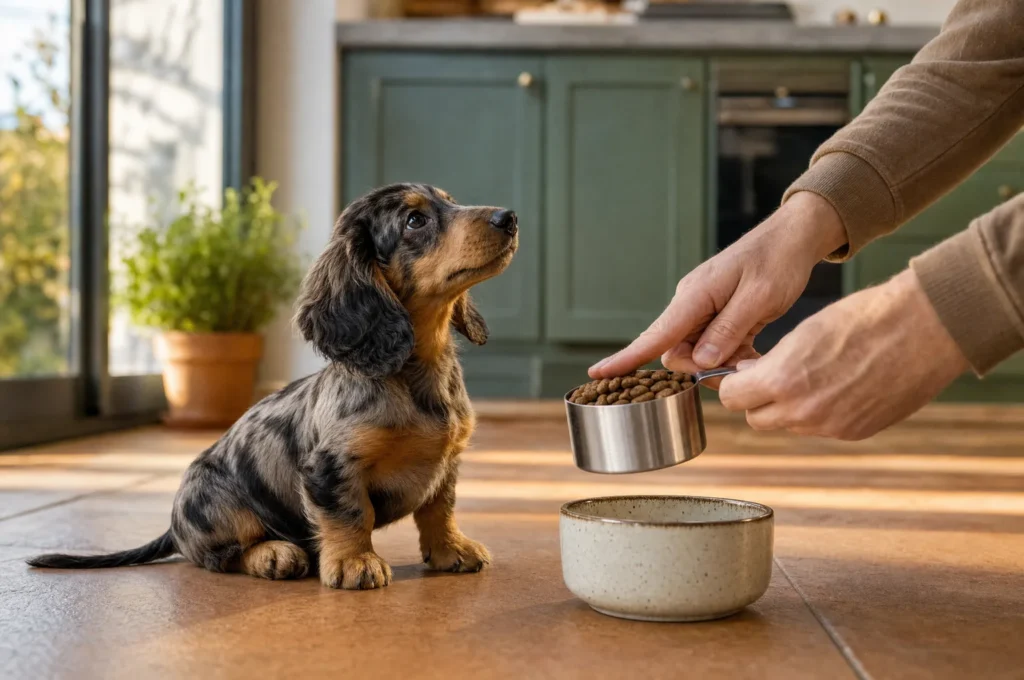
What’s the best time to feed a puppy?
PetMD suggests times that fit your weekdays and still work on a Saturday. Its sample day for three meals runs about 6:30 a.m., 12:30 p.m. and 6:30 p.m. Treat that as one example, and shift it to fit your day. Dinner timing before bed is in our puppy sleep schedule.
She’s asleep at mealtime? PetMD’s word is “preferably” at the same time, which leaves a little room. You can let her finish the nap. Then feed her, take her out, and keep the next meal near its usual time.
How much should I feed my puppy?
Start with the bag, then feed the puppy in front of you. Her body condition sets the amount.
“The most effective method for feeding growing puppies is providing food-restricted meals.”
Dr. Amanda Ardente, DVM, PhD, veterinarian, writing for PetMD
Food-restricted means measured, by the meal or by the day.
- Read the chart on her bag. Find the row for her weight and age.
- Split the day into meals. Divide the daily amount by her meal count. Measure with a measuring cup or a kitchen scale.
- Watch her body. The AKC’s line is “Watch the dog, not the dish.” By 12 weeks, she should be losing her potbelly.
- Check with your vet. The sources split on how far to trust the bag.
Average daily calories, puppies under 4 months
By her ideal weight. Your puppy may need up to 50% more or fewer.
How much should an 8-week-old puppy eat?
It depends on her weight. Turn the chart into cups like this.
- Ask your vet what she should weigh now. The chart works from her ideal weight, and your vet best judges her body condition score.
- Find the calories per cup on the bag. Labels often say kcal, which is the same as calories, per the AKC.
- Divide her daily calories by the calories per cup. Split that across her meals.
Tip: Weigh her once a week. Step on the bathroom scale alone, then again holding her. The difference is her weight. It takes a minute, and a month of numbers shows whether the amount is right.
Is she always hungry, or eating too fast?
Acting starving can come from learned behavior, stress or a health problem, PetMD explains. Hungrier than usual, with weight, thirst or bathroom changes? Book a vet visit before changing her routine.
Gulping is a different problem. The AKC says eating too fast can lead to choking, and may raise the risk of bloat. A slow-feeder bowl, a muffin pan, or kibble used as training rewards all slow her down. If her belly ever looks bloated, see a vet immediately.
When do you switch a puppy from 3 meals to 2?
Somewhere between 4 and 12 months. Bigger puppies can often switch sooner than small ones.
Most puppies can move to two meals between 4 and 6 months, Dr. Coates writes, and larger dogs often earlier. The AKC and PetMD both put twice a day at 6 to 12 months.
- Watch for the hint. An occasional skipped meal can mean she’s ready to drop one, the AKC says, or is getting too much.
- Keep the day’s total the same. Split the same daily amount across two meals instead of three.
- Move the trips with the meals. New meal times mean new after-meal potty trips.
Should you leave food out for your puppy all day?
No. Every source we read prefers measured meals at set times.
Leaving food down all day is called free choice feeding. VCA’s nutrition team says it’s not recommended for puppies. It can lead to juvenile obesity, binge eating, orthopedic problems and diabetes. Measured meals also show you when she leaves food.
Out at work all day? PetMD and Chewy both mention automatic feeders that portion meals on a timer. A midday visit can cover lunch and a potty trip.
What if everyone in the house is feeding her?
Then nobody really knows how much she’s eating. Put one name on each meal, and whoever isn’t named doesn’t pour.
Puppies learn fast how well those pleading eyes work, the AKC notes. A steady diet of table scraps can create a nutritional imbalance. Some ingredients can cause an upset stomach, or worse.
- Keep one measuring cup in the bin. Same cup, same level scoop, every person.
- Write it down when it happens. A time and initials stops the “did you feed her?” text.
- Count treats in her day. The AKC’s 10% rule covers training treats and table scraps, and meals shrink a little to fit. Our potty training treats guide shows the math.
- Stick to set mealtimes. A puppy who eats on schedule is less likely to beg at other times, per Chewy.
For your household: Agree on one calm response and share concerns with your vet or qualified trainer. Consistency helps everyone notice changes sooner.
How soon after eating does a puppy need to potty?
Soon. Plan a trip outside within about 10 minutes of every meal.
VCA says puppies generally need to go within 10 to 15 minutes of eating. Dr. Coates gives 15 to 30 minutes. Be outside by the earlier number, and wait longer if nothing happens. Pairing a trip with every meal also helps her link the urge with the right spot.
A plain day runs on one loop: wake, potty, meal, potty, play, nap, and repeat. Our puppy potty training schedule lays out the daytime trips around meals.
How do you switch puppy food without an upset stomach?
Slowly, over about a week, mixing the new food into the old. Once a food is chosen, stick with it.
Even a simple diet change can cause diarrhea in puppies. The AKC’s food-switch guide spreads the change over 5 to 7 days.
- Day 1: 25% new food, 75% old.
- Day 3: half and half.
- Day 5: 75% new, 25% old.
- Day 7: all new food.
If she shows concerning signs partway through, go more slowly. Still upset after a gradual switch? Call your vet, because some puppies need a different diet. Mild diarrhea from a diet change often clears up with a bland diet. Ask your vet first, especially if it lasts more than a few hours. Keep fresh water down, because even mild diarrhea is dehydrating.
When should a puppy switch to adult food?
When she’s close to grown, which comes months sooner for small breeds.
PetMD says to switch at about 80% of her adult size. That’s about 10 to 12 months for small breeds, 12 to 15 for medium, and 15 to 24 for large.
- AKC: small breeds at 7 to 9 months, larger breeds at 12, 13 or even 14 months.
- Chewy: about 10 months for toy breeds, 12 for small and medium, 18 to 24 for large and giant.
- Spayed or neutered? That lowers her energy needs slightly, so the AKC suggests adult food then. Check with your vet.
When the ages disagree, waiting longer is the safer side. The AKC says to err on the side of caution. PetMD sees no harm in waiting if calories fit her body. Switch with the same 7-day mix.
Where do the experts split on feeding?
Mostly on the bag chart, and on what a skipped meal means.
PetMD says bag charts often aren’t the most accurate, and don’t consider her individual needs. Chewy’s Dr. Coates calls the label chart a starting point, then adjusts to her body. Start with the bag, then confirm at the next vet visit.
A missed meal needs context, including age, size and other symptoms. Call promptly for a young or toy-breed puppy. Vomiting, weakness or unusual sleepiness makes the call more urgent.
When should you call the vet about your puppy’s eating?
Right away for any red-flag sign. Soon if she isn’t thriving on her food.
Most puppy diarrhea isn’t severe, the AKC says. Call your vet immediately if you see any of these:
- Bloody diarrhea, or black, tarry stools
- Fever, pale gums, vomiting, or signs of pain
- Diarrhea lasting more than one day
- You think she swallowed something toxic or a foreign object
Also call if she has diarrhea and hasn’t had all her vaccinations.
Ask your vet about her schedule if she’s extremely active, has trouble maintaining weight, or isn’t thriving, Dr. Coates adds.
What should you do this week?
- Today: put one measuring cup in the food bin, and give each meal one name.
- Tomorrow: weigh her with the bathroom scale trick, and write it down.
- Changing foods? Start the 7-day mix.
- Mealtime manners: our puppy training schedule shows where a sit before the bowl fits.
- Next vet visit: bring her weight and the food bag. Ask how many meals, and how much.
You’ll know it’s working when every meal on the log has one set of initials. Your weekly weigh-ins also give the vet real numbers to work with.
Puppy feeding schedule FAQ
What is the 10-10-10 rule for puppies?
It’s a memory aid from pad maker Earth Rated. Offer a potty break about 10 minutes after waking, 10 after eating, and after about 10 minutes of play. The vet guides we read don’t use the name. VCA’s 10 to 15 minutes after a meal fits it. Set a timer when the bowl goes down.
Should a puppy have water all day?
Yes. Fresh water should be available at all times, according to the AKC. Wash the bowl daily to keep bacteria down.
Can puppies eat adult dog food?
Not as their regular food. PetMD says adult food isn’t balanced for puppies, and could lead to deficiencies if eaten regularly.
Is wet or dry food better for puppies?
Either can work. The AKC says both can provide complete nutrition when made for puppies. Wet food costs more, and puppies often like it better. Pick one labeled complete and balanced.
Should I feed my puppy as soon as I get home?
Feed according to her needs and usual schedule. Offer a potty break when you arrive. A meal at homecoming does not by itself diagnose or cause separation anxiety.
Last updated: October 24, 2026. We checked current search results and reviewed the guidance linked in this article. This is general education, not an individual veterinary assessment.
Sources
- PetMD: How Much To Feed a Puppy, by Amanda Ardente, DVM, PhD, reviewed by Tara Hansen, DVM. Why Is My Dog Always Hungry?, by PetMD Editorial, reviewed by Brittany Kleszynski, DVM.
- VCA Animal Hospitals: Feeding Times and Frequency for Your Dog, by Caitlin Grant, DVM, DVSc, Dip ECVCN, and colleagues
- American Kennel Club (AKC): Puppy Feeding Fundamentals, by AKC Staff. How Many Treats Can a Dog Have Per Day, by Anna Burke. How to Switch Dog Foods, by AKC Staff. Puppy Diarrhea, by Anna Burke. How to Help Your Dog Eat More Slowly, by AKC Staff.
- Chewy: How Often To Feed a Puppy, by Jennifer Coates, DVM