

Short answer: Build a puppy sleep schedule around frequent rest, meals and potty trips. Adjust it to her needs.
Keep nights calm and her sleeping space nearby. Respond when she needs comfort, a toilet break or medical attention.
It’s 6 p.m. She’s biting your sleeves and tearing laps around the couch. By 2 a.m. she’s crying in the crate, and you’re doing math about her bladder. Somewhere in there, you wonder if you made a mistake. Owners call that feeling the puppy blues.
Your partner says tire her out. Your mom says let her sleep whenever. Three videos gave you three bedtimes. A puppy sleep schedule is the daily pattern of naps, play, meals and potty trips. It sets up her night. That’s fixable, starting today.
We sell a printable puppy schedule kit and offer a free potty timer, and we link to both below.
✓ Built on guidance from the AKC, PetMD, Preventive Vet and Humane World.
Bedtime is tonight and you have no plan? Do this.
- Follow her usual feeding plan. Ask your vet about meal timing for young or toy-breed puppies.
- An hour before bed, a short walk and gentle play. Then lights low.
- The last person to bed takes her out, calm and boring.
- Crate in your bedroom tonight. Lie down and act asleep.
What does a good puppy sleep schedule look like?
One loop, run over and over: potty, play or a meal, potty, nap.
The AKC builds its sample puppy day from that loop. She may nap every hour or so, which adds up to a lot of naps per day. The moment she wakes, she goes straight out.
Choose a routine that fits her needs and your household. Keep the detailed daily plan in your existing kit.
Her total hours by age are in our how much should a puppy sleep guide.
How do you build a puppy sleeping routine that sticks?
Run the same loop at roughly the same times, with everyone in the house. These habits come from the AKC’s sleep guide.
- Same wake-up, same meals. The AKC says puppies thrive on routine and structure.
- A nap after every play. Don’t wait for her to choose. End the play, take her out, put her down.
- One nap spot. She’ll learn that spot means sleep. In a loud house, PetMD suggests a quiet place.
- Let her sleep. Leave a sleeping puppy alone. Tell the kids. Tell grandma.
How does the schedule change as she grows?
The loop stays the same. At 2 months, her bursts of energy fill only 4 to 6 hours a day, VCA Animal Hospitals notes. As she matures, play stretches out and her nights get longer.
Rather not work out each change yourself? The First 14 Days Kit has a schedule for 8, 10, 12 and 16 weeks. A quick log check tells you when to move up.
Can rest help an overtired puppy settle?
Evening biting can increase when a puppy is tired. Offer a quiet resting space without forcing a frightened puppy inside.
The AKC warns that too much stimulation and exhaustion can lead to unfortunate behavior. Puppy Leaks calls a nap you choose for her an enforced nap, since some puppies keep going past exhaustion.
- Play hits about an hour, or the biting turns frantic. Stop, even mid-game.
- A quick potty trip, no play.
- Into the crate or pen with a chew. Lights low, and nobody wakes her for a cuddle.
- When she wakes on her own, straight out.
Puppy zoomies at night can have another cause. The AKC links them to puppies crated all day or short on exercise. Our sister guide lists the overtired puppy signs.
What should a puppy bedtime routine look like?
The same five steps, in the same order, every night. This countdown comes from PetMD and Preventive Vet.
- Keep meals appropriate for her age. Do not delay a needed meal to chase a longer night.
- A short walk and gentle play about an hour before bed. Then something calm to lick or chew.
- Lights low, volume down. The AKC says quiet and dark become her cue for sleep.
- The last trip out, as late as possible. The last person to bed takes her, and keeps it boring.
- Offer a familiar sleeping space nearby. Remove bedding she shreds or swallows. Keep fresh water accessible.
“A scared puppy will have trouble falling asleep.”
Rania Gollakner, DVM, MPH, writing for PetMD
What time should a puppy go to bed?
Neither guide sets a clock time. Both count back from your own bedtime. Work nights and sleep days? Run the same countdown into your daytime sleep. Pick a bedtime you can hold every day, weekends included.
Where should a puppy sleep at night?
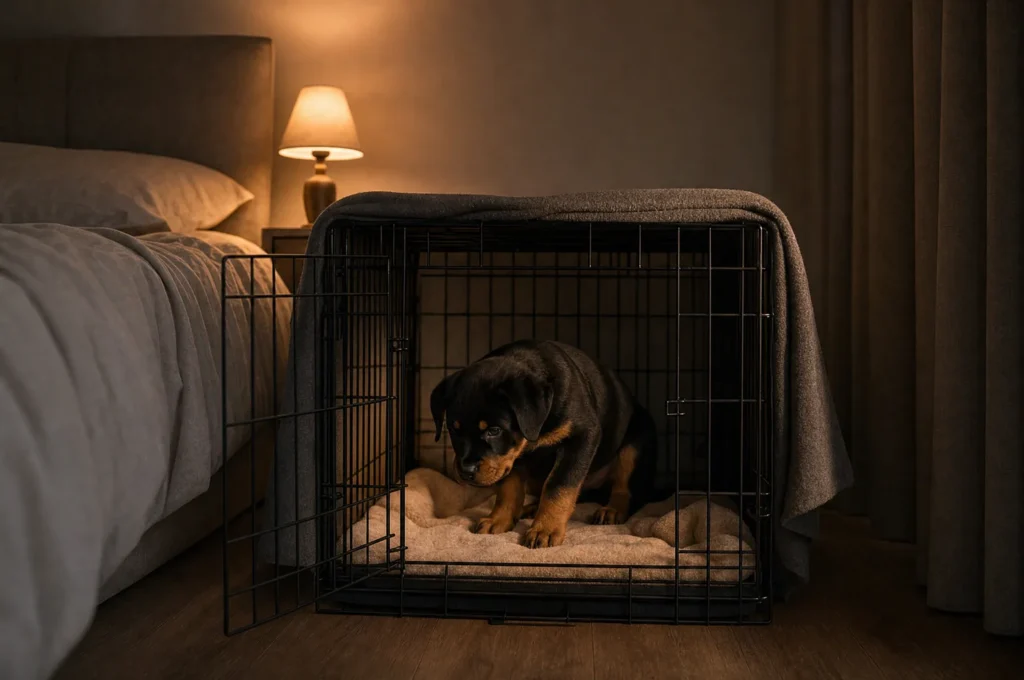
For the first few weeks, in a crate in your bedroom. Then move it slowly, if you want.
PetMD puts the crate in your bedroom for at least the first few weeks. That way she learns she’s not alone. Humane World agrees. Once she sleeps through, gradually move it to the location you prefer.
| Setup | Good for | Watch out for |
|---|---|---|
| Crate in your bedroom | You hear the whimper before the accident. | Early light. Blackout shades or a crate cover help. |
| Crate in another room | Light sleepers, once she sleeps through. | Move it gradually, not on night one. |
| Secure pen beside your bed | Puppies who need more room or are still learning crate comfort. | Remove entanglement hazards. Never leave a sleeping puppy attached to furniture by a leash. |
| In your bed | Later, once she’s potty trained and sleeping soundly. | Not in the first weeks. Preventive Vet says start her in a crate. |
What helps a puppy settle in the crate at night?
A familiar scent may help her settle. Use bedding only if she leaves it intact. Keep the room comfortable and quiet.
Remove covers she pulls through the bars. Never use the crate as punishment. Our crate training guide explains gradual introductions.
When does a puppy sleep through the night, and how do you get there?
Some by 12 weeks, most by about 4 months. Until then, the night has a boring trip or two in it.
PetMD says some puppies can sleep through the night by 12 weeks. Madson, a certified behavior consultant, says most get there at about 4 months. So a 3 month old waking once is normal. A 9 week old who wakes you twice is right on schedule.
An age formula cannot guarantee how long she can hold urine. Young puppies need frequent trips, especially while awake. Arrange help around her observed needs, not a maximum-hour target.
Madson suggests setting your own alarm for the night trip, so she’s never bursting and crying first. The AKC says carry her out calmly, praise quietly, and put her right back. When to drop that trip is in our potty training a puppy at night guide.
Why is my puppy waking up at night again? (puppy sleep regression)
She slept through for two weeks, and now it’s 1 a.m. every night. That’s puppy sleep regression, and the first job is finding what changed. A later dinner, wilder evening play, or something medical can do it.
Crying that starts a few days after a quiet first night is different. Madson says some puppies settle in quickly, and others take a few weeks. Waking repeatedly to pee? Madson says see the vet first to rule out a urinary tract infection.
She also suggests a potty log to spot her pattern.
For your household: Agree on one calm response and share concerns with your vet or qualified trainer. Consistency helps everyone notice changes sooner.
Where do the experts disagree, and what should you do?
They split on water before bed and on how to answer night crying.
Water. The AKC advises restricting food and water for several hours before bedtime. Madson recommends free access to water at all times. Our rule is to leave water down and keep the last meal early. If she still wakes several times a night to pee, call the vet before you touch her water.
Night crying. Check toilet needs, pain and fear. Offer calm reassurance and make confinement easier if she struggles. Do not wait through panic or punish crying.
A recent potty trip does not rule out distress. Stay close and assess her body language. Our puppy whining guide covers common causes and when to call your vet.
When should you call the vet or a trainer about puppy sleep?
When nights go backward suddenly, when she wakes repeatedly to pee, or when the crying sounds like panic.
- Repeated night peeing, or a dry puppy who isn’t anymore.
- A sudden change in night trips or poop. Bring the log.
- Appetite changes, or crying that worries you. Vet calls at any hour.
- Panic in the crate. Humane World warns a panicked dog may get hurt trying to escape. Call a behavior specialist, and see our crate anxiety guide.
- A puppy who can’t settle for days despite comfortable rest opportunities. Vet first, then a trainer.
This week: run the loop and the bedtime steps. Keep the log for seven days, and tell the walker the plan. Keep a flashlight and the leash by the crate.
Puppy sleep schedule FAQ
Why does my puppy wake up so early?
Morning light can wake her, so the AKC suggests blackout shades or a crate cover. PetMD adds that puppies need to potty more often than adult dogs. Sleeping in may wait until she’s older.
Can I leave my 8 week old puppy alone for 3 hours?
Do not assume she can manage three hours. Arrange a helper and frequent potty opportunities. Build comfortable alone time gradually, starting with very short absences.
What about teething at night?
Baby teeth start falling out at about 3 to 4 months, the AKC says. Teething is usually done by 6 months. Sore gums can increase chewing. Preventive Vet keeps safe chew toys in reach at night. Check toys often and pull any she chews chunks off.
Last updated: October 24, 2026. We checked current search results and reviewed the guidance linked in this article. This is general education, not an individual veterinary assessment.