
Short answer: The best potty training treats for puppies are pea-sized, soft and quick to swallow. Give one outside, right after she finishes, every time while she’s learning.
Her own kibble works on an ordinary trip. Save the smelly treats for hard ones. Keep all treats under about 10% of her daily calories.
She finally peed in the yard. You cheered, dug through your coat for a treat, and she’d already trotted back to the door. Was that even a reward anymore?
A potty training treat is a small food reward given the moment your puppy finishes in the right spot. It’s how positive reinforcement works in housebreaking. Its size, its timing and who’s holding it matter more than the brand. Get those wrong and she starts waiting for her treat at the door.
We sell a printable puppy schedule kit and link to it below. We don’t sell treats, and no brand paid for a mention.
Puppy’s home and you have no treats? Do this tonight.
- Put some of her own kibble in a lidded jar by the potty door. Texas A&M’s Dr. Christine Rutter says kibble bits can be just as effective.
- Take a few pieces on every trip. The reward happens outside, by the spot.
- Have bigger treats? Cut them pea-sized before the next trip, as the AKC suggests.
✓ Built on guidance from the AKC, VCA Animal Hospitals, Preventive Vet and Texas A&M’s College of Veterinary Medicine.
Which treats work best for potty training a puppy?
Check the age guidance, ingredients, calories per piece and storage instructions. Choose a texture you can divide safely into tiny rewards.
Small, soft, fast to eat, and something she likes more than the grass.
Stephanie Gibeault, a certified trainer writing for the AKC, says the best puppy training treats are quick to eat. A treat she crunches for ten seconds breaks the link between going and getting paid. Soft treats are faster to eat and smellier, which helps outdoors. Biscuits crumble, and she’ll hunt the pieces instead of finishing the trip.
“Even for large dogs, a pea-sized treat is plenty.”
Stephanie Gibeault, MSc, CPDT, writing for the American Kennel Club
| Treat type | Best for | Watch out for |
|---|---|---|
| Her own kibble | Routine trips in a quiet yard, and tight budgets | May not hold her attention in a busy or new spot |
| Soft, pea-sized training treats | Most trips. Fast to eat, easy to carry in a pocket or jar | Some bags are cut too big. Snip them smaller before you head out |
| Tiny bits of plain cooked chicken or cheese | Hard trips: rain, a new place, other dogs nearby | Perishable, so they can’t live in a pocket all day. Calories add up fast |
| Freeze-dried liver or jerky, broken small | A high-value reward that keeps in a pouch | Break the pieces down before the trip, not while she waits |
| Big biscuits, bacon, sausage | Not potty trips | Slow to eat, high in fat, and a short path to an upset stomach |
Rows built from the AKC, Preventive Vet trainer Cathy Madson’s treat value tiers, and Dr. Rutter’s foods that can cause diarrhea and pancreatitis.
Can you use her kibble as potty training treats?
Yes. Madson and many of her clients use a dog’s regular food as the low-value reward. Low-value treats tend to run lower in calories, too. Count the day’s training kibble out of her bowl, so you’re not feeding her twice. Where it’s quiet, plain kibble may be all she needs.
Tip: Try the two-fist taste test from the same Preventive Vet guide. Put a different treat in each closed hand, let her sniff both, and give her the one she works at. Repeat with new pairs. Now you know her A-list and her everyday list without buying six bags.
When do you give the treat?
Outside, next to the spot, right after she finishes.
Once she’s done, VCA’s behaviorists say to praise her quietly and give a small treat outside, near the spot. The steps in our potty training guide cover the whole trip, from the leash to the reward.
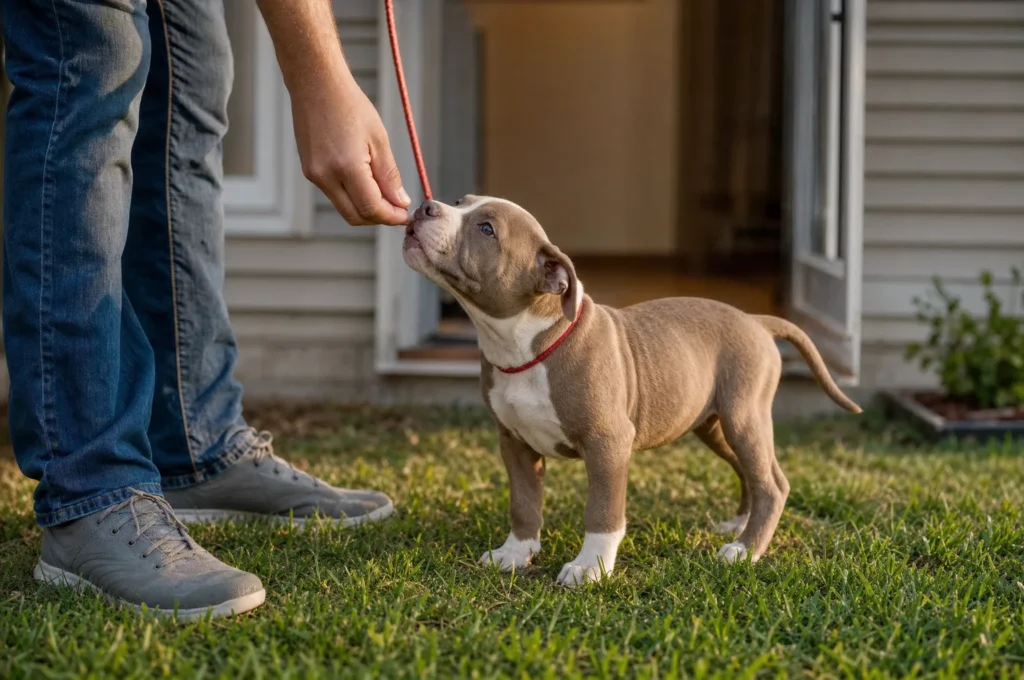
Keep the treats where the trip starts. A lidded jar of soft, pea-sized treats by the potty door means nobody hunts for one mid-trip. A pocket or pouch works too, the AKC says, so the reward is immediate. In an apartment, use the pocket. The treat rides the elevator with you and comes out at the spot.
Nothing after five minutes? VCA’s advice is to bring her in, watch her, and go back out at the first sign of restlessness. No treat for a trip with no result.
Timing mistakes that cost you the reward
- Showing the treat too soon. A puppy who spots food can stop mid-pee to reach for it. Keep it out of sight until she’s finished, Petful’s treat guide advises.
- Asking for a sit first. Then the treat pays for the sit. The same guide says to practice sits separately and reward the pee itself.
- Clear timing. Wait until she finishes, then mark and reward promptly. Keep the treat with you at the potty spot.
- She pees a little, gets the treat, then pees again. Puppies get distracted and don’t always empty their bladder, VCA notes. Wait until she’s fully done before the treat. After the treat, let her sniff around a little before heading in. Patterdale warns against rushing inside right after she goes.
Keep the reward clear: A bell asks for a potty trip. Reward after she finishes at the spot.
Keep play separate until the potty task is complete. Every helper should follow the same sequence.
The treat came only for peeing at the spot, and that’s what fixed it. The same rule works with or without a bell.
When do you need high-value treats for potty training?
New places, bad weather, the dark, or a yard full of distractions.
“High value” means whatever your puppy rates highest. Madson’s top tier is moist or freeze-dried, extra smelly, and something she rarely gets outside training. It’s saved for new behaviors, distracting places and a fast, clean response. Everyday trips get the lower tiers, dry treats or kibble.
- The first week home, or a new yard. Use the A-list treat. She’s learning what the trip is for, and new behaviors get the top tier.
- Rain, snow, dark, a barking neighbor. Step up. In a distracting place, the AKC says, pull out the stinky treats.
- A routine trip in a quiet yard, week three. Kibble. If her interest fades, the same guide suggests a reward of equal or greater value.
One caution before you buy “high value” dog treats for potty training. Preventive Vet avoids bacon and sausage because of the stomach upset and pancreatitis risk. Tiny pieces of chicken top its high-value list instead.
How many treats can a puppy have a day?
Enough for every outdoor potty trip, as long as all treats together stay at about 10% of her daily calories.
The 10% guideline includes training treats, snacks and table scraps. Ask your vet to set a suitable daily allowance for your growing puppy. Keep complete puppy food as the nutritional foundation.
What if the treats upset her stomach?
Stop the new treat if stomach upset follows it, and ask your vet what to feed next. Vomiting, diarrhea, lethargy or reduced appetite in a young puppy deserves prompt advice.
When do you stop giving treats for potty training?
Fade treats to kibble, then to praise, once she’s reliable in that place.
The sources we read don’t name a week to quit. Our guide’s how long it takes section shows the estimates run from days to months. Plan on paying for trips for a while, and lower the reward as she gets it right. Madson’s order runs high value for a new behavior, medium to maintain it, and low value when fading. Low value often means kibble.
- Still having accidents? Keep the reward on every outdoor trip.
- Clean for a couple of weeks in the usual yard? Swap the soft treat for kibble on routine trips. Keep the praise.
- New place, new weather, a setback? Go back up a tier for a few days.
- Months in and reliable? Praise most trips, with a few kibble bits in your pocket for the odd one. Many dogs find toys and attention rewarding too, her guide notes.
A treat at the door, or once she’s back inside, rewards the door instead of the pee. If the door has already become the payday, our guide covers the puppy who pees right after coming inside.
How do you keep food rewards consistent?
Choose small rewards your puppy tolerates. Count treats from every family member within the daily allowance agreed with your vet.
Practice in a quieter place if she cannot focus. A richer treat is not a substitute for feeling safe.
When should you call the vet or a trainer about treats?
Call your vet about stomach trouble. Bring in a trainer if your timing is right and accidents keep coming.
Weight changes, reduced appetite or stomach upset deserve a review with your vet. They do not prove a particular calorie percentage. Seek prompt advice for vomiting or diarrhea in a young puppy.
If rewards are timed right and accidents keep coming on a steady routine, look past the treats. Our potty guide lists when accidents mean a vet check first, and a trainer or behaviorist after that.
What should you do this week?
- Tomorrow: run the two-fist test. Write her A-list treat on the lid so everyone uses the same one for hard trips.
- This week: run every trip the way the timing section shows.
- Sunday: read the food bag, work out 10% of her day, and check the jar fits inside it.
- Need the rest of the list? Our potty training supplies guide covers the crate, cleaner, leash and bags.
Potty training treats FAQ
Does the 10% rule include training treats?
Yes. The AKC says all treats, including training rewards, count toward the 10% of daily calories. Snacks and table scraps count too. If she’s training a lot, use pea-sized bits or her own kibble so the trips fit.
Can an 8-week-old puppy have training treats?
Yes, if the treat suits her age. Read the age directions on the bag first. Petful’s guide notes that “puppy” on the front doesn’t mean every piece fits every mouth. Start with one suitable treat cut pea-sized, or her own kibble. Count it all in her day.
What if my puppy won’t take treats outside?
Outdoor smells and movement can make a puppy ignore a treat she’d grab indoors, Petful’s guide says. Make the trip easier first, with a quieter spot and fewer distractions. Then try a smellier treat, which the AKC suggests for distracting places. If she seems scared outside, don’t push her. Calm praise and a sniff around can be the reward for now.
How do you use treats when moving from pee pads to outside?
The same way. Reward her the moment she finishes, and keep treats beside the potty area. The AKC’s pee pad guide moves the pad closer to the door in small steps. Then it goes just outside, then to her final spot. Our puppy pads guide walks through each step.
When should I take my puppy out so I can reward her?
Offer trips promptly after waking, eating and play, and whenever she signals. Bring the reward outside. Wait until she finishes before giving it.
Can you potty train a puppy without treats?
You can, with quiet praise, a toy or a short play session right after she finishes. VCA pairs quiet praise with a small treat. The AKC notes a tennis ball or a romp can be a reward too. Food is the quickest reward to hand over by the spot.
Do you need a treat pouch for potty training?
No. A jar by the door or a pocket works, as long as the treat is on you. A pouch helps if you also train on walks.
What human foods are safe as potty training treats?
Dr. Rutter of Texas A&M lists boiled or baked poultry, baked whitefish, carrots, green beans and banana as safe in moderation. Cut them pea-sized. She warns off fatty meats, gravies, grapes, raisins, onions, garlic and avocado, which can cause stomach upset or worse.
Editorial review: Updated October 23, 2026 after reviewing search results and relevant source guidance. This is an editorial guide, not a product test or individualized professional advice.
Sources
- American Kennel Club (AKC): The Right Treats Make the Best Rewards, by Stephanie Gibeault, MSc, CPDT. The Ins and Outs of Potty Pad Training, by the same author. How Many Treats Can a Dog Have Per Day, by Anna Burke. How to Teach Your Dog to Go Potty on Cue, by Sassafras Patterdale, CPDT-KA, CTDI.
- VCA Animal Hospitals: Housetraining for Puppies and Dogs, by Ellen Lindell, VMD, DACVB, and Monique Feyrecilde, BA, LVT, VTS (Behavior)
- Preventive Vet: What Kind of Treats Should You Use to Train Your Dog, by Cathy Madson, MA, FDM, CBCC-KA, CPDT-KA
- Texas A&M College of Veterinary Medicine & Biomedical Sciences: Treating Your Pet, with Dr. Christine Rutter
- Petful: Dog Potty Training Treats, Best Puppy Rewards and Timing, by Coreen Saito