

Short answer: Start now, not after her last shot. Show her new things a little at a time, from far enough away that she still takes treats.
Leave while she’s still happy. If she stops eating or hides behind you, you’ve gone too far, so back up.
The vet said “wait for the shots,” and your sister said “get her out there.” Now she’s spent an afternoon behind your knees, and you’re scared you’ve blown it. You haven’t, and tomorrow you can start again, smaller and quieter.
Puppy socialization means letting her meet the people, animals, places, sounds and handling of normal life while it feels good. Socializing a puppy well depends on how she feels during each new thing. The American Veterinary Society of Animal Behavior (AVSAB) calls the first three months of life the most important time. Those weeks keep passing while you wait on the vaccine card, and you can’t get them back.
We sell a printable puppy schedule kit and link to it below. Our check-in tool is free.
✓ Built on guidance from the AVSAB, the AKC, Preventive Vet, Texas A&M’s veterinary college and Dr. Ian Dunbar.
At what age should a puppy be socialized, and when does the window close?
Start the day she comes home. The AVSAB calls this the period when sociability outweighs fear, inside the first three months. Other vet and trainer sources put the edges at 2 to 12 weeks or roughly 3 to 16 weeks. If she came home around 8 weeks, you have four to eight weeks of the easy part.
Puppy socialization timeline
Bar length shows her age in weeks.
What is a puppy fear period?
It’s a stretch when a puppy gets wary of new things, and even of things she liked last week. The AKC puts the first one at 8 to 11 weeks, right when most puppies come home. Texas A&M dates the start of fear to about 8 to 10 weeks. Keep outings short then, and never force anything.
The second fear period, at 6 to 14 months
The AKC says a second fear period comes between approximately 6 and 14 months. Small breeds tend to hit it earlier than large and giant breeds. She may look grown by then, so it can feel like everything you taught her fell apart overnight. It isn’t forever.
- Let her move away from whatever scared her.
- Reward her for looking at it, or for looking to you.
- Let her choose how close to get. Don’t lure her closer.
- Keep it short, and end with treats and praise even if she’s still unsure.
- List what worries her and work it into later sessions.
Some fears fade within days and others take longer. Forcing her toward the scary thing can make the fear worse.
Can you socialize a puppy before vaccines are done?
Yes, carefully. The AVSAB says puppies can start classes as early as 7 to 8 weeks. They need at least one set of vaccines 7 days before the first class, plus a first deworming. In its words, “Behavioral issues, not infectious diseases, are the number one cause of death for dogs under three years of age.” With maternal immunity, early shots and good care, the infection risk is relatively small by comparison.
Full vaccination comes at about 15 weeks, says Texas A&M’s vet school. Until then, home visits with vaccinated older dogs can help prevent parvovirus.
“Vaccination makes them much less likely to shed and spread the diseases.”
Dr. Stacy Eckman, clinical assistant professor, Texas A&M College of Veterinary Medicine & Biomedical Sciences
Safe ways to get her out before the last shot
- Carry her in a sling or a backpack made for puppies, or use a dog stroller.
- Park outside a store or a school and let her watch from the car. Windows up first, then partly down.
- Invite healthy, vaccinated pets to your home instead of visiting parks.
How do you socialize a puppy the right way?
Use small doses from a distance, and end while she’s happy. Preventive Vet’s trainer Cathy Madson calls it “Low and Slow, Short and Sweet.”
What you need
- Tiny soft treats she loves, a fixed leash, and a sling for before the shots are done
- Ten free minutes when she’s rested
- A phone note or paper log: where, what she saw, how she did
1. Start small, at a distance
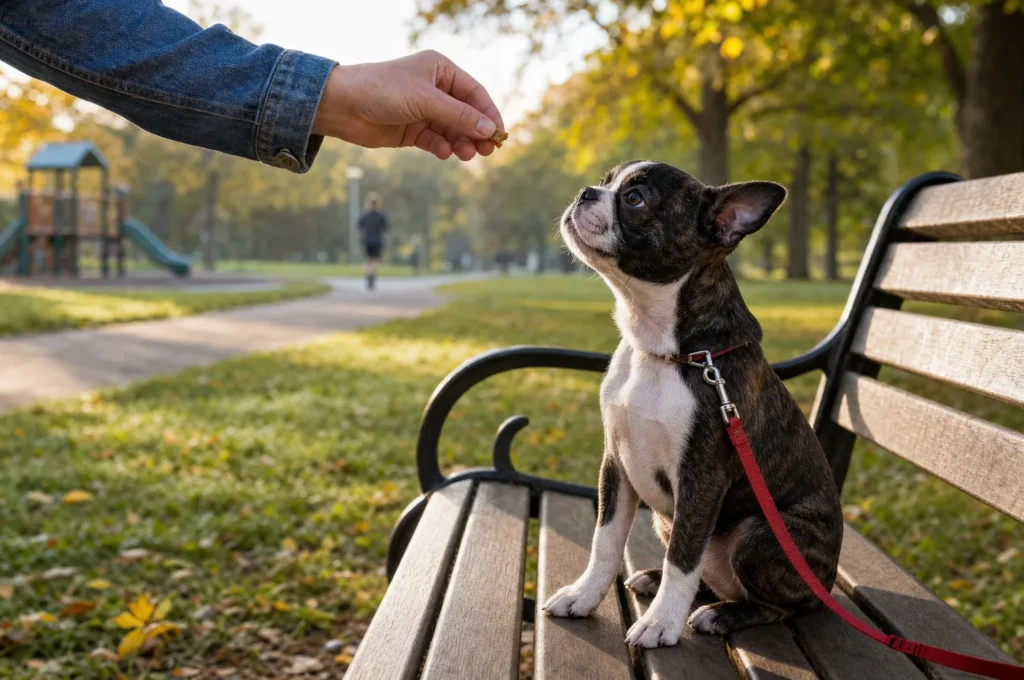
Pick a quiet spot where she can see the thing without being in it. Let her look, sniff and take treats. If she glances at a jogger and then back at you, that’s the win. Leave on that note.
2. Pair every new thing with something good
The AKC says to reward new experiences with treats and praise, and to try to remain calm. Dogs can read our emotions. If you’re tense about the leaf blower, she’ll borrow that.
3. Add one notch at a time
The AKC’s advice is to “try to avoid doing too much, too fast.” Next outing, move a little closer, try a new spot, or add one sound. Strangers work the same way. Start with a few family members, then one stranger, then two.
4. Get the whole house involved, and log it
Have different people take part. Kids can write down everything new she met that day. Three weeks of those lines show you what she’s ready for.
5. Practice handling at home
Touch her collar, muzzle, ears, paws and tail for a second, then treat. Dunbar calls those the “hot spots” a puppy should learn to enjoy having handled.
Tip: Schedule outings for right after a nap and a potty trip, so a missed nap doesn’t read as fear.
What are the signs your puppy is over threshold?
Watch the treat first. Madson lists the obvious signs as tail tucked, ears back, and wide eyes.
- She stops taking treats. Back up until she eats again. If she won’t eat anywhere, go home.
- She hides behind you or pulls away. Add distance or turn the intensity down, so she has space to think.
- She gets tense or starts to bark. If it’s too much to handle, leave the area and try again later.
A story from Michael Northcutt, our founder: Everyone said, “Get her out there! Socialize her!” So on a sunny Saturday, I took our puppy to the busiest park in town.
We lasted six minutes.
Kids on scooters, a soccer game, three dogs off leash and a man with a leaf blower, all at once.
Her tail went low. She tried to crawl behind my legs. When I held out a treat, she didn’t even look at it.
So we tried again, smaller. A quiet weekday morning, a bench far away from the playground. She sniffed the grass and took treats. Ten minutes, and we left while she was still happy.
Is my puppy shy or fearful?
A shy puppy is cautious, then warms up. She sniffs, takes treats and edges closer on her own. Some puppies are more cautious in a group and need extra time and space to settle, Madson writes.
A fearful puppy doesn’t warm up. She shows the signs above, refuses treats even far back, and hides all outing. The AVSAB describes overstimulation as excessive fear, withdrawal or avoidance. That puppy belongs on the vet or trainer list below.
If she won’t touch her favorite treats with guests over, give her a quiet spot. Ask guests to ignore her. A puppy can fear balloons one day and be fine with them the next, the AKC notes.
What should a puppy be socialized to?
Think in categories. A few from each group, done calmly, is enough.
| Category | Examples | From |
|---|---|---|
| People | Young and old; a wheelchair or cane; a beard, sunglasses, a hood or a hat; an umbrella | AKC, Preventive Vet |
| Sounds | Doorbells and the vacuum at home; a thunder recording at the lowest volume; a police siren | Preventive Vet, AKC |
| Surfaces | Carpet, tile, wood, grass and concrete; steps and tunnels | Preventive Vet, AVSAB |
| Handling | Brushing, bathing and nail trims; being held; a collar or harness | Preventive Vet, AKC |
| Places | Car rides; different streets near home; a friend’s house; the pet store once her shots have started | AVSAB, AKC |
How many people should a puppy meet?
The “100 people” rule comes from Dr. Ian Dunbar. He says a puppy should meet at least a hundred people before he is three months old. That works out to roughly three unfamiliar people a day. The AKC takes a slower line and brings strangers in gradually.
How do I socialize my puppy with other dogs?
Start with vaccinated older dogs at your home, then a supervised class. Outside class, skip other dogs while she’s young, unless you know they’re healthy and vaccinated. The AVSAB says puppies should avoid dog parks.
Socializing a puppy with kids
Good socialization can keep a dog from fearing children. Start with one calm child, sitting on the floor, feeding treats. If a child can’t hold the puppy correctly, Texas A&M says, don’t let them.
Car rides when she’s carsick or scared
Motion sickness shows up most often in puppies, the AKC says. The inner ear parts for balance aren’t fully developed yet. Many dogs outgrow it. A puppy who got sick on early trips, or only rides to the vet, may dread the car itself.
- Sit with her in the parked car a few minutes a day, engine off, with praise and gentle petting.
- Next, drive to the end of the driveway, stop and get out.
- Build up to short trips to a spot she likes. Before her shots are done, that’s a parking spot where she watches from the car.
- Seat her in the middle of the back, where she’s more likely to look forward. Use a harness or a solid-sided crate.
- Crack the windows a few inches, and save one toy for car rides only.
Whining, drooling, lip licking or vomiting mean you step back a stage and try again tomorrow. If nothing works, ask your vet about medication for nausea or anxiety.
Do you need a puppy socialization class?
Not strictly, but a good class covers puppies, strangers and new floors, all supervised. Classes before three months can be an excellent means of socializing puppies, the AVSAB says. That holds where illness risk can be minimized. Dunbar calls classes too little, too late for people socialization, so keep inviting strangers home too.
How to find a good puppy socialization class near you
Ask your vet first, since clinics likely know local trainers, then friends and online reviews. AKC S.T.A.R. Puppy classes run for at least 6 weeks, and the AKC lists its approved evaluators. Ask to watch a class first, then check five things from Madson’s guide to picking a class.
- Who runs it: anyone can call themselves a dog trainer, so look for a certification such as the CPDT-KA.
- Vaccine checks: they ask for proof, and every puppy there is up to date.
- Class size: one trainer to six puppies tends to be ideal for most trainers. A quiet corner for shy puppies is a good sign.
- A clean floor: ask how often it’s sanitized and with what. Watch how potty accidents get handled.
- Positive methods: rewards, praise, play and treats. Walk out if you see squirt bottles, shaker cans, yelling or physical corrections.
Is 4 months too late to socialize a puppy?
No, but it’s harder, so go slower and get help sooner. Rescue puppy, or a breeder kept her until 16 weeks? Madson writes, “You may have adopted a puppy older than 4 months that has missed socialization.” You should still do the exercises. You’ll likely need to go more slowly and be more patient, and a certified dog trainer’s guidance helps.
The AVSAB says improper socialization can increase the risk of fear, avoidance or aggression later in life. Behavioral problems are also the number one cause of relinquishment to shelters. Give a shut-down rescue a few days to settle in first. Our crate training guide helps her find a safe spot to decompress.
The experts don’t fully agree. Which rule do you follow?
They agree on the window and the pace. They split on numbers and dog parks.
| Question | One view | Another view | What we’d do |
|---|---|---|---|
| How many people? | Dunbar: at least 100 before three months | AKC: introduce strangers gradually, family first | Count calm people she ate treats near. |
| When is the dog park okay? | AKC: 7 to 10 days after the full series | Madson: not under six months | Skip it in the window. A vaccinated friend’s dog in a yard does the job. |
What happens if a puppy is not socialized, and what makes it worse?
The risk of fear, avoidance or aggression goes up. Two mistakes push it higher.
- Flooding. Everything at once, on one Saturday, is the “too much, too fast” the AKC warns about.
- Pushing through fear. Texas A&M says negative experiences in this period may lead to a fearful adulthood. Leave and try later.
When should you call the vet or a trainer?
- She’s scared of most new things, even when you go slow. The AVSAB tells owners of puppies showing fear to seek veterinary guidance.
- Her fear is severe. The AKC says severe fearfulness needs a veterinarian or animal behaviorist.
What should you do this week?
- Tonight: ask your vet which shots she’s had and when the next is due.
- Tomorrow: ten minutes on a bench or in the parked car, after a nap. Leave while she’s eating.
- Midweek: one calm visitor who sits on the floor and feeds her.
- By Friday: call two trainers and run through the five class checks above.
- All week: log every outing in three words. Where, what, how she did.
If the grown-ups keep giving her different rules, our free Puppy Week Check‑In gives your household one practical next step. No signup needed.
Outings and potty trips share one clock. See our puppy potty training schedule and how to potty train a puppy.
Puppy socialization FAQ
How do I socialize a puppy in an apartment before her shots are done?
Bring the world to her. Dunbar says a puppy too young for the streets should meet people invited to your home. For outings, use a sling or stroller, or watch from a parked car outside a store.
Can I put my puppy on the floor at the vet’s office before vaccinations?
Dunbar says no. He calls the ground outside the clinic door and the waiting room floor two of the most likely contaminated areas. Carry her from the car and keep her on your lap, or leave her crated until it’s her turn.
My puppy barks at strangers on walks. Did I miss the window?
Not necessarily. If she gets tense or barks, Preventive Vet says to add distance or reduce the intensity. Feed treats while the stranger passes, and leave if it’s too much.
How we put this together: In October 2026 we read the five sources below, page one of Google and owner forum threads. Nobody at LoveMyPuppy is a veterinarian or a certified trainer.
Sources
- AVSAB: Position Statement on Puppy Socialization
- AKC: Puppy Socialization, Puppy Fear Periods, Car Sickness in Dogs and AKC S.T.A.R. Puppy
- Preventive Vet (Cathy Madson, CBCC-KA, CPDT-KA): When to Start Socializing Your New Puppy and Choosing the Right Puppy Class
- Texas A&M College of Veterinary Medicine: Socializing Your Puppy
- Dog Star Daily (Dr. Ian Dunbar): Socialization With People