

Short answer: To potty train a Lab puppy, take her out on a leash to one outdoor spot. Go when she wakes, after meals and play, and on a clock in between. Reward her the moment she finishes.
For a big puppy: use an adult-size crate with a divider, and the yard over pads. Expect 4 to 6 months. Goldens and German Shepherds also follow the same steps.
Not long ago she fit on your lap. Now her puddle reaches the edge of the rug, and she tows you to the door.
No affiliate links. We do, however, sell two things linked here: the First 14 Days Kit and the Washer Cleaner Tablets.
How do you potty train a Lab puppy, step by step?
Our full how to potty train a puppy guide covers the whole method.
- Take her out first thing, then often. Betty Barkley takes Lab puppies out first thing once they wake up, then every half hour. Go after play, meals and drinks too.
- Walk her to one spot, on a leash. Use the same spot every time, even in your own yard.

Walk your Lab to the same outdoor spot on a leash, then wait quietly. - Say one cue as she goes. Use a short phrase such as “go potty,” said calmly as she starts.
- Reward her right there. As soon as she finishes, praise her and hand over a small, high-value treat.
- Watch her, or tether her. Indoors, keep her on a 6-foot leash tied to you. When she circles or sniffs hard, go now.
- Crate her when you can’t watch. When she’s been in the crate for hours, go straight to her spot.
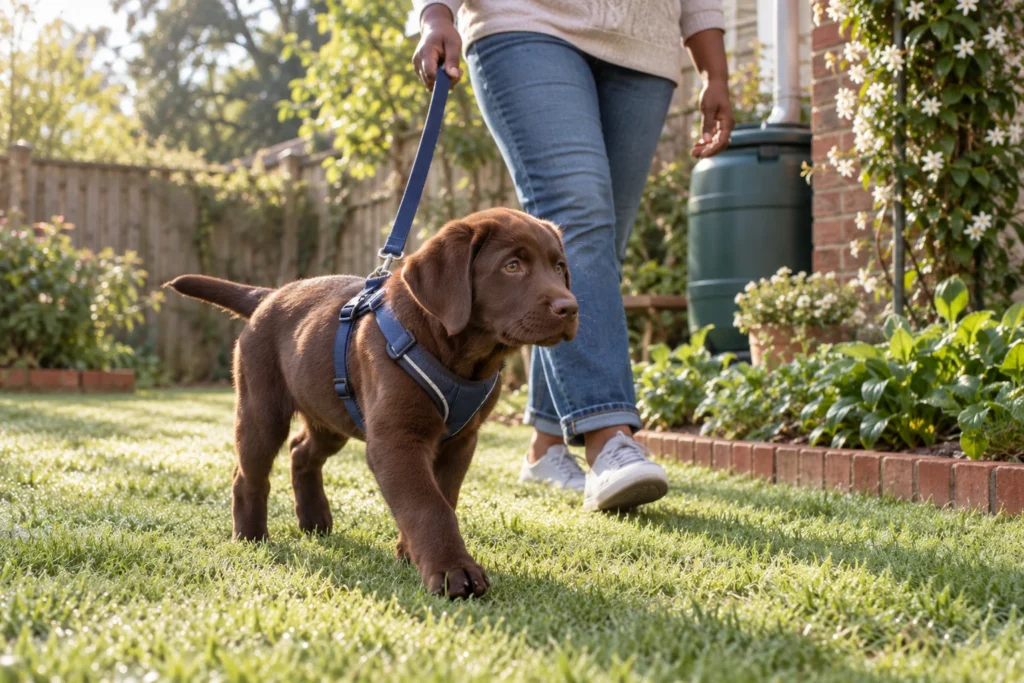
Tip: Clip the leash on before you open the crate door. Then a strong puppy can’t bolt first.
“Labs love to please and are quick learners.”
Betty Barkley, Labrador Retriever breeder for more than 35 years, to the AKC
How often should you take her out when you potty train a Lab puppy?
| Source | How often while awake |
|---|---|
| Lab breeder (AKC interview) | Every half hour, after a first trip on waking |
| AKC potty training guide | Every one to two hours, depending on age |
| Humane World for Animals | At least every two hours |
All three set the clock by her age. So start at the short end, and stretch the gap once she stays dry.
2 months old
3 months old
4 months old
5 months old
Source: about 1 hour per month of age is normal (AKC, Humane World). Outer limit is months plus one hour (AKC, Humane World).
The job is a trip at least every two hours she’s awake, for 4 to 6 months. Through 5 months, months plus one is 6 hours or less, so an 8-hour night may need a trip. In the end, those months of trips give you a big dog you can trust indoors.
Who keeps the clock when you potty train a Lab puppy?
A story from Michael Northcutt, our founder: A friend’s mom offered to watch their new puppy for an afternoon. She’d raised four kids and a parade of family dogs. “I’ve got this,” she said.
An hour later, my friend’s phone buzzed mid-meeting. “How often does she need to go out?” Twenty minutes after that, again.
It wasn’t Grandma’s fault. The plan lived in my friend’s head, but her head was at work.
That night they made a one-page sitter card. Its front held today’s rhythm, while the back held house rules, like “Write every potty trip on the log by the door.”
After that, Grandma didn’t call once. The log held a neat column of times, and a note: “Good girl. Napped at 2.”
Your big puppy’s clock can’t live in one head either. A missed trip now means a bigger puddle, so write it down for every walker.
Why does she pee right after you come back inside?
Often she never finished. Puppies are easily distracted and may stop midway. So stay boring at her spot, and praise only once she has completely finished, Humane World advises. Then walk her around or play a while before going in, so peeing doesn’t end her time outside. A feeding schedule with meals at set times makes her potty times predictable too.
What changes when you potty train a Lab puppy?
Three things change with size: the crate, the puddles and the pad chewing.
What size crate does a Lab or German Shepherd puppy need?
Big enough to stand up, turn around and lie down comfortably, and no bigger. Any bigger than that, and she can eliminate in one end and sleep in the other, warns trainer Stephanie Gibeault, CPDT. So buy a crate for her typical adult size, with a divider, and move it back as she grows. Teaching her to like it is in our crate training guide.
Bigger puddles: should a large puppy use pee pads?
Go outside when you can. Dogs make about 20 to 100 mL of urine per kilogram of body weight a day. So a puppy who doubles her weight makes roughly double the urine, and a pad soaks through sooner. Pads can also slow the move outdoors.
What if your Lab puppy chews the pee pads?
Swallowed pad pieces can be an ingestion hazard that causes a blockage, Barbara Rivers of Puppy in Training cautions. So supervise, swap in a chew toy, and use a holder for her pee pad or washable pads.
Crate, leash and clock only work if every walker follows them. In a busy house, that’s the hard part.
Lab, Golden or German Shepherd: what’s different?
The steps stay the same, though each breed adds its own snag.
How do you potty train a Golden Retriever puppy?
She learns like a black, yellow or chocolate Lab, so watch for restlessness, circling, heavy sniffing or a drift to the door.
How do you house train a German Shepherd puppy?
The AKC calls it one of the easiest breeds to housetrain, with “constant supervision and consistency.”
Why is my big puppy peeing in her crate at night?
Often she has run out of hold time. An owner told the AKC her 4-month-old German Shepherd came out of her crate “dripping wet” every morning. At 4 months, months plus one is 5 hours at most. So an 8-hour night runs past that. Toy breeds reach that limit even sooner. Here’s how to potty train a Yorkie puppy.
- Move the crate into your bedroom, so you hear her stir.
- Use the divider, so there’s no dry end.
- Lift the water bowl about two and a half hours before bed.
- Keep the trip calm: out, potty, back to bed.
Night trips by age are in our puppy potty training schedule.
What do you do after a big accident?
Stay calm. Then calmly pick her up and carry her to her spot, with the soiled paper towel. Scolding or rubbing her nose in it only makes her fearful and slows progress. Dogs often return to spots that still smell, so the AKC recommends an enzymatic cleaner.
Tip: Keep paper towels and the enzyme cleaner by the crate, not under the sink. A big puddle needs them fast.
Our enzyme cleaner for dog urine guide covers the cleanup. Between accidents, her sleeping corner can still hold a smell.
How long does it take to potty train a Lab puppy?
House training a Lab puppy, also called housebreaking or toilet training, typically takes 4 to 6 months. Some settle within days, while others need several months. Our guide on how long potty training takes has the timeline. If she was dry for weeks and starts slipping, see our puppy potty training regression guide.
When should you call the vet?
- She pees often, strains or pees in odd places. Frequent or painful urination and urinating in inappropriate places can signal a urinary tract infection.
- She still struggles after consistent training. See the vet first, then a trainer, advises the AKC’s Mary Burch, PhD.
- Her stools stay loose, bulky or unusually foul. Ask your vet about her diet.
- She swallowed pad pieces. Call your vet, since pad pieces can cause a blockage.
Our free Potty Break Timer takes her age and last trip. It then shows her next trip and her longest hold.
Large breed puppy potty training FAQ
How many accidents are normal when potty training a puppy?
There’s no set number. Accidents are a normal part of potty training, especially early on, and they drop as she learns the routine. If she’s really struggling, see your vet or a positive-reinforcement trainer.
Why does my puppy poop when no one’s around?
She may have learned that going in front of you is risky. Shouting can teach her it’s only safe to go when you’re not around, the RSPCA warns. Drop the scolding, supervise her, and reward every outdoor poop.
How do I teach my puppy to tell me she needs to go out?
Link one action to going out, like ringing a bell. Reward the signal, then the trip. Our dog potty bells guide covers bell training.
Do these steps work for a husky or pit bull puppy?
Yes. The steps come from general puppy guidance, not one breed. Size the crate to her adult size.
How we made this guide: We read the AKC, Humane World and the RSPCA in October 2026. The Merck Veterinary Manual and Puppy in Training added health and pad facts. We tested no crates or pads. Nobody at LoveMyPuppy is a veterinarian.
Sources
- American Kennel Club: How to Potty Train a Puppy, by Mara Bovsun, plus its crate guide by Stephanie Gibeault, MSc, CPDT, and its night crate and breed pages
- Humane World for Animals: How to Potty Train Your Dog or Puppy, plus its crate training guide
- RSPCA: Toilet training your dog
- Merck Veterinary Manual: Urine Volume and Specific Gravity table, plus Infectious Diseases of the Urinary System in Dogs, by Scott A. Brown, VMD, PhD, DACVIM
- Puppy in Training: How Do I Get My Puppy to Stop Chewing His Pee Pads? by Barbara Rivers