

Short answer: German Shepherd puppy training starts the day she comes home. From 8 to 16 weeks, the AKC’s breed timeline puts socialization, crate training and housetraining first. From 3 to 9 months come sit, down, stay, recall and impulse control.
Keep lessons to 5 to 10 minutes, one new behavior at a time. Reward what you like, give her drive a daily job, and go easy on her growing joints.
Needle teeth in your sleeve. A tug on your pant leg every time you cross the kitchen. She’s ten weeks old, smart as a whip, and she won’t be small for long.
Puppy training teaches a young dog manners, confidence and basic cues. High-drive breeds like the Belgian Malinois need all three early. Skip it, and a Shepherd may grow into a medium to large dog who pulls hard on the leash.
How to train a German Shepherd puppy
“It is never too early to start training a German Shepherd puppy.”
Wailani Sung, MS, PhD, DVM, DACVB, writing for Chewy
Sung’s four training habits:
- Find her paycheck. Treats, praise, toys, play or a cuddle.
- Teach one thing at a time. Repeat sessions 3 to 5 times until it sticks.
- Then reward the moment she gets it right. Positive reinforcement builds a confident dog.
- Watch what you reward by accident. Pet her when she jumps on you, and she learns jumping gets attention.
Are German Shepherds easy to train?
Generally yes, compared with some other breeds, says Sung. Breeder Nadia Adams told the AKC a well-bred one is “thriving on praise and wanting to please.”
German Shepherd puppy training schedule by age
| Age | Main goals | The GSD twist |
|---|---|---|
| 8 to 16 weeks | Socialization, crate training, housetraining (AKC) | A natural guardian needs to learn which strangers are friendly |
| 3 to 9 months | Sit, down, stay, loose-leash walking, recall, impulse control (AKC) | Daily loose-leash walks by 3 to 5 months, depending on your neighborhood (Chewy) |
| 9 to 24 months | More impulse control, plus nose work, scent work, tracking or agility (AKC, Chewy) | Some start barking at passersby and visitors (Chewy) |
Sources: AKC German Shepherd training timeline; Chewy.
Sources: AKC breed timeline, fear period, nipping and exercise guides.
Loose-leash walking: the first steps
Start before you ever take a walk, says trainer Michele Miller, CPDT-KA. For large puppies, she also likes a front-clip harness.
- Teach a marker first. In a quiet room, say “yes” or click, then treat.
- With the leash on, mark and reward every look she gives you.
- Then pair a cue like “let’s go” with moving, and reward every few steps.
- Also, at the end of the leash, say her name. Mark the look back, reward her return, then walk on.
- Head outdoors once she gets it inside or in the yard, with plenty of high-value treats.
Recall: teach her to come when called
The AKC’s recall guide starts indoors, where little competes with you.
- Show her a toy or treat, and praise her as she heads your way. Add “come” once she’s moving toward you.
- Call her mid-play, reward her, then send her back to play. Otherwise “come” starts to mean “time to go home.”
- Praise every recall, even a slow one. If she bolts, don’t chase. Run the other way instead.
When do German Shepherd ears stand up?
Usually around 4 to 6 months, and sometimes later, says a Petco vet answer. In fact, floppy ears at 2 months are normal. Teething can tip them up and down for a couple of months before they stand for good.
Typically, ears still down at 6 to 8 months likely won’t stand. “Some GSDs have erect ears, and others don’t,” writes vet Christie Long, DVM. Ask your vet before taping, since it may make her prone to ear infections.
German Shepherd puppy biting: the land shark months
Arms look like you lost a fight with a rosebush? That’s because herding breeds, German Shepherds included, may nip more. They were bred to nip at the heels of calves and sheep, says Dr. Jerry Klein, the AKC’s chief veterinary officer.
Usually it’s play, though bigger dogs’ play bites hurt more. Klein and trainer Kate Naito share these tips:
- Plan play, then rest. Schedule playtime, and give her quiet time after big excitement.
- Use long toys, and swap chew toys weekly.
- Play tug with rules. She sits to start. If her teeth move to your hand, the game stops.
- Time out at the first touch of teeth on skin or clothes.
- Never hold her muzzle shut. It teaches fear.
Why does she bite one person more than the rest?
Even calm petting can get a puppy excited, the AKC notes, and then the teeth come out. Naito adds that young kids often come across “like a giant squeaky toy.”
So whoever she targets follows the same house rules. So keep a quiet body and a long toy ready. Then give her a time out the second teeth touch skin.
When do German Shepherd puppies stop biting?
Dogs teethe until roughly seven months, Naito notes, and some keep puppy play energy into year two. Start early, and results come sooner, Klein adds.
The kit below, our comb and the 3 to 6 Month Puppy Plan are ours to sell.
Socialization and fear periods in German Shepherd puppies
For a breed that guards by nature, socialization is extra important, the AKC timeline says. “Good socialization translates to confidence,” says breeder Nadia Adams.
Trainer Jacqui Foster, CPDT-KA, suggests fun three-minute games with noises, odd surfaces and family members. Sung also adds puppy classes once she’s had one DHPP shot and deworming and seems well.
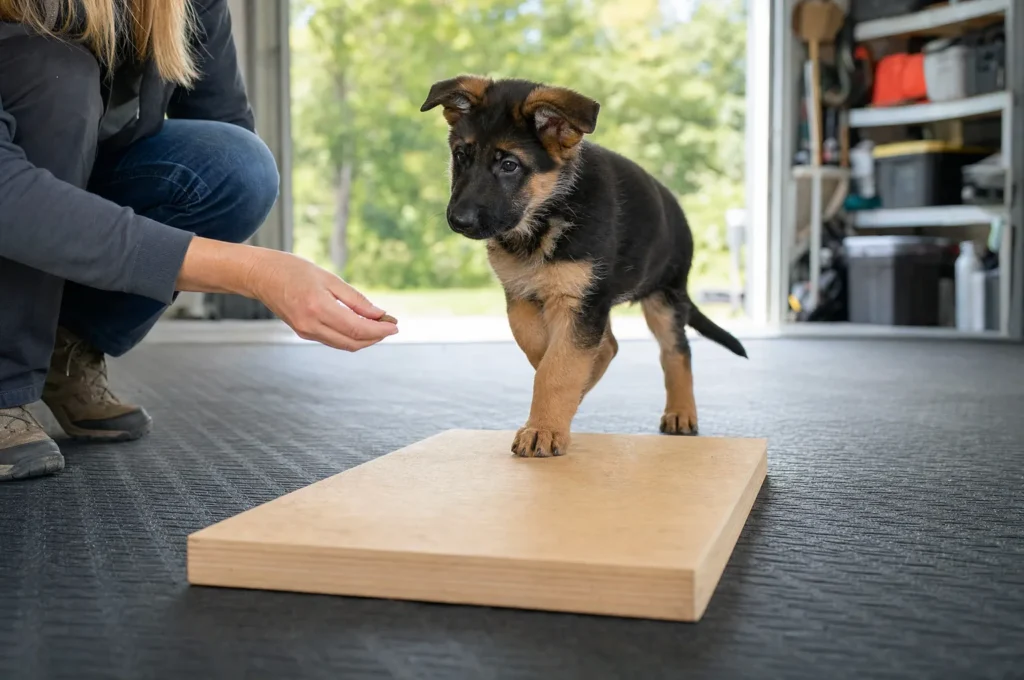
She doesn’t have to greet everyone she sees. Let her meet people without pressure to interact.
Why is my German Shepherd puppy suddenly scared?
She may be in a fear period. Puppies go through two, and no amount of socialization can prevent them. The first comes at 8 to 11 weeks, the second at 6 to 14 months, often later in large breeds.
Your teen Shepherd looks grown, then spooks at a plastic bag. It’s a normal stage.
- Let her move away from what scared her.
- Reward her for looking at it, or at you.
- Let her choose how close to get.
- Keep it short, and end on a win.
Will she guard the house? Strangers, barking and protection work
Some adult Shepherds stay cool or indifferent toward people they’ve just met, Sung notes. Still, friendly meetings with new people help her accept strangers.
Between 9 and 24 months, some start barking at passersby, delivery drivers and visitors at the door. Sung suggests sending her to her bed and rewarding her there when the door opens.
The AKC lists protection work among activities for 9 to 24 months.
A story from Michael Northcutt, our founder: Every day at 11:20, the mail carrier came up our walk. Every day at 11:20, our puppy lost her mind.
She’d launch onto the couch and then bark at the window. The carrier would walk away, and she’d look at me like she’d won. In her mind, she had.
Then she started barking at joggers, then at kids on bikes, and then, I think, at a leaf.
So I took away the stage. Frosted film went on the bottom half of the front window. Then the couch moved a foot from the glass. Her bed and a chew went in the back room around 11:00.
When she started to rumble, I said “thank you, I’ve got it,” and tossed a treat on her bed. Over a few weeks, the sound of the gate meant “treat on my bed” more than “bark at the window.”
It’s been months. Some days she still gives one big woof, and then she remembers the bed.
For Michael, it was mostly habit. If window barking turns into real fear or lunging, call a qualified trainer.
High drive: give her a daily job
This breed loves to have a job, per its AKC timeline. Leave her bored, and she may bark, dig, chew hard or chase. Because of her prey drive, that can even mean cars.
Tip: In German Shepherd puppy training, impulse control is the first job. The same goes for corgi puppy training, since both are herding breeds. Ask for a sit before her food, a favorite toy or the door to the yard.
Trainer Laurie C. Williams likes brain games beyond the walk. For example, think tug, hide-and-seek, a flirt pole or a “sniffari” for kibble tossed in the yard.
The shedding habit: start grooming while she’s small
German Shepherds “blow their coats” in seasonal sheds, usually twice a year.
So treat grooming as training. Make grooming part of German Shepherd puppy training. Introduce combs, brushes and nail clippers early and slowly, and make it fun. Our undercoat rake guide covers how often to rake in shedding season.
How much exercise does a German Shepherd puppy need?
Less than her energy suggests. Too much sustained, vigorous exercise while she grows may lead to bone and joint problems later, the AKC warns. That goes double for constant running on sidewalks or blacktop.
| Source | Walks | Jogging |
|---|---|---|
| AKC puppy exercise guide | About 5 minutes per month of age, once or twice a day | No leash jogging until 12 to 18 months for large breeds |
| AKC growth guide, with Dr. Jerry Klein | Short walks on softer surfaces like grass are generally safer | Klein: no road work or jogging before 14 to 18 months |
Sources: AKC puppy exercise and growth guides.
Tip: If she sits down or struggles to keep up, head home.
Can puppy exercise lead to hip dysplasia?
Obesity in puppies can lead to a predisposition to hip dysplasia later, Klein warns. To protect her growing joints:
- Follow the feeding guidelines, and aim for a lean puppy over a chubby one.
- Skip repeated jumping, like a ball tossed straight up.
- Let her free run in a fenced yard, where she can stop when she’s tired.
How to potty train a German Shepherd puppy
Many owners find it one of the easiest breeds to housetrain, the AKC says. It still takes constant supervision and consistency.
GSD trainer Alexa Hagood, LVMT, suggests short crate breaks and five to ten minute crate meals. Our crate training guide covers the steps.
Still wetting her crate at 4 months? An AKC answer to a German Shepherd owner says there’s no magic number of months when accidents stop. Past 16 weeks? Our 3 to 6 Month Puppy Plan has daily schedules for 4, 5 and 6 months.
Watch the clock while she’s small. A puppy can hold it about one hour per month of age as a normal stretch. Her age in months plus one, in hours, is the outer limit. For crate size and night wetting, see our large breed potty training guide.
Lost track of her last trip? Our free Potty Break Timer takes her age and that time, then shows her next trip.
When to call a trainer or your vet
A serious bite usually comes head-on, stiff and silent, Naito says. If she fixes on a person and goes very still, a bite may follow.
Biting like that needs professional help, Klein says. So does fear or lunging that keeps growing. Health worries go to your vet.
German Shepherd puppy training FAQ
What is the first thing to teach a German Shepherd puppy?
Socialization, crate and potty training, plus two cues: come and sit, Sung advises. Puppies can learn to sit at 5 to 8 weeks.
Is a German Shepherd a good dog for a first-time owner?
It depends on your time. Breeder Nadia Adams told the AKC “the sky is the limit” with plenty of quality time, especially in year one.
Our method: In October we read the AKC, Chewy and Petco vet pages below. We also studied this search’s Google results and German Shepherd owner threads. None of us is a veterinarian, so take her health questions to yours.
Sources
- American Kennel Club: Puppy Training Timeline for Your German Shepherd Dog, by Yasmine S. Ali, MD, plus Leash Training: How to Train a Dog or Puppy to Walk on a Leash and Reliable Recall: Teaching Your Dog to Always Come When Called
- American Kennel Club: Why Does My Puppy Nip at Me and Chew on My Clothes?, with Dr. Jerry Klein and trainer Kate Naito, plus What Are Puppy Fear Periods?
- American Kennel Club: How Much Mental and Physical Exercise Do Puppies Need?, plus When Does My Puppy Finish Growing?, How to Potty Train a Puppy and Why Does My Dog Pee in the Crate?
- Chewy: How To Train a German Shepherd Puppy, by Wailani Sung, MS, PhD, DVM, DACVB
- Petco Pet Education Center: My German Shepherd’s Ears Are Still Flopped. Will They Ever Stand Up?, answered by Christie Long, DVM