

Short answer: If you’re wondering how long to potty train a puppy, plan on about 4 to 6 months of steady training, and up to a year for some puppies. That’s the range from Humane World for Animals and WebMD.
Daytime vs overnight: Most puppies can sleep about 7 hours at night before they need to pee. In the daytime, out of the crate, plan on a trip every 2 hours or so (WebMD).
By age: with an early start, a 6-month-old is usually dependable most of the time (AKC’s chief vet). Accidents are still common up to a year old.
She’s 11 weeks old. You take her out after every nap and every meal. Then she squats on the rug ten minutes after you come back in. Now your partner asks the question you’ve been asking yourself. Shouldn’t she be getting this by now?
Probably not yet, and you’re not behind. Puppies may not become consistent until 12 to 16 weeks old. In fact, control is at its weakest around 8 weeks, the age most puppies come home.
Open up the house before she’s ready, though, and accidents can come back. For the hour-by-hour plan, see our puppy potty training schedule.
No affiliate links here. The one product we sell on this page is our First 14 Days Kit.
How long does it take to potty train a puppy, according to each source?
PetMD: a week to a month
Humane World: typically 4 to 6 months
WebMD: 4 to 6 months, some up to a year
Sources: PetMD, Humane World, WebMD. Orange on WebMD’s bar marks its “some up to a year” stretch.
In short, two of the three put a fully trained puppy at 4 to 6 months or more.
Part of the spread in how long to potty train a puppy is what “potty trained” means. It can mean she has the idea, or that you can trust her all day. WebMD’s range, for example, is for full house training.
“…it depends on the puppy and the schedule you keep.”
Dr. Jerry Klein, Chief Veterinarian, American Kennel Club
Can you potty train a puppy in 7 days?
She can learn the routine fast, but bladder control takes longer. Some puppies build reliable habits within days, while others need several months (AKC). Best Friends Animal Society puts house training at days to weeks, with a predictable routine.
PetMD’s range starts at one week, while the others put full reliability at months, not days. Full reliability usually takes months. So a 7-day plan can start good habits. If she still has accidents on day 8, nothing went wrong.
A story from Michael Northcutt, our founder: On our puppy’s first birthday, I found her very first potty log at the bottom of a drawer. Coffee rings. A torn corner. Handwriting from three different people, and a note in the margin that just said “WHY?!”
I read it at the kitchen table like a diary. Day one: eleven trips outside, three accidents. Day nine: “Slept 5 hours straight!!!” And on day twelve: a little puppy face, doodled by someone clearly up since five.
I could feel it all again. The cold floor in my socks. Standing at the back door at 2 a.m., whispering, “Please, please, just go.”
Then I looked across the kitchen. She was asleep in the sun, snoring a little. The schedule on the fridge, meanwhile, had come down months ago. It didn’t happen in a week, or because of one trick. It happened one trip at a time, most of them written on that crumpled sheet.
So I put the log in a frame. It hangs in the hallway, coffee stains and all.
Write every trip down, the way his house did. On a slow week, you can look back and see how far you’ve both come.
What does the puppy potty training timeline look like at each age?
Treat the ages in this puppy potty training timeline as rough guides. In any case, start the day she comes home, whatever her age, the AKC advises.
| Her age | What the sources say | Source |
|---|---|---|
| 8 to 12 weeks | Potty training can usually begin, which is when most puppies arrive. | PetMD |
| 12 to 16 weeks | She may start to be consistent, as bladder and bowel control improve. | WebMD |
| 3 months | May hold it about 3 hours. Months plus one puts the limit near 4. | Humane World, AKC |
| 6 months | Usually dependable most of the time, if training began early. | AKC |
| Up to about 1 year | Accidents are still common. | WebMD |
How long she can hold it has two numbers. About 1 hour per month of age is the normal stretch, up to about 9 months to a year. In contrast, her age in months plus one hour is the outer limit. Plan trips well before she reaches it.
Not sure when her next trip is due? Our free Potty Break Timer uses her age and last trip to show her next trip time, awake or napping.
When should a puppy be fully potty trained?
No single age fits every puppy, which is why sources split on how long to potty train a puppy. If training began early, Dr. Klein’s answer is a 6-month-old who is dependable most of the time. However, smaller dogs and those with a history of being caged may take longer (WebMD).
How do you know potty training is working, week by week?
So check her log each week for these signs.
- Fewer accidents. The count should drop as she learns a steady routine (Humane World).
- Longer gaps. As she grows, bladder control improves, and she can hold it longer between breaks (AKC).
- She heads for the door. Scratching or whining at the door is one of her signals. Take her straight out when you see it.
- A clean week. After a week or so with no accidents, she can start earning more freedom in the house (Best Friends). Keep supervising.
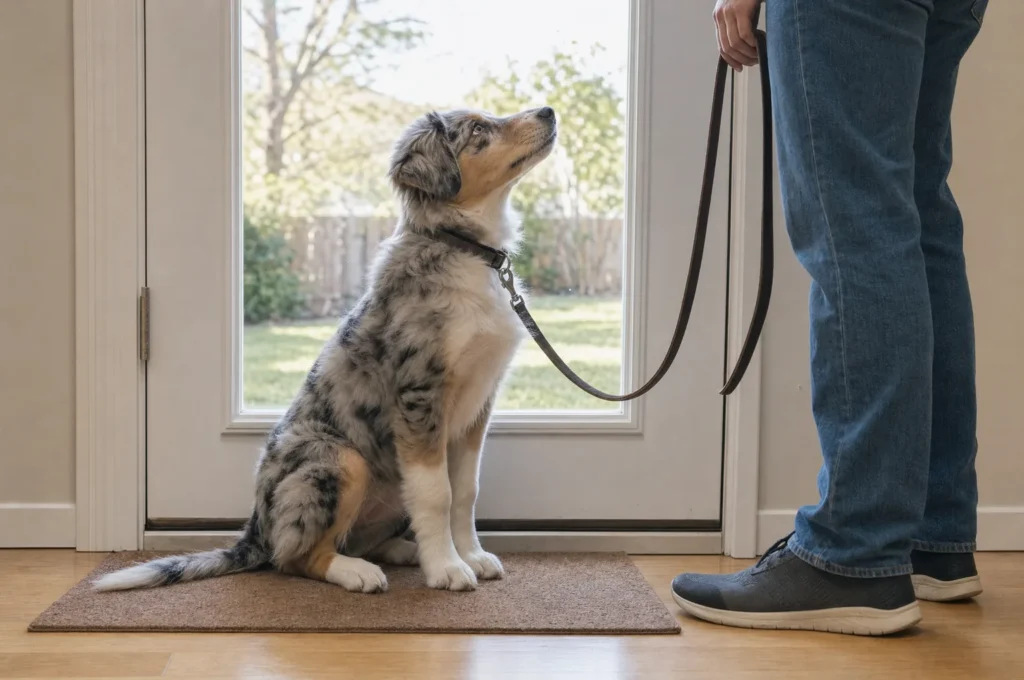
Tip: Add one new room at a time, and only while you’re in it with her. If accidents start in that room, go back a step for a while.
Some weeks the log looks flat and you’re running on broken sleep. Not sure you can keep this up? You’re tired, and that’s allowed. So hand one shift to someone else this week.
What slows potty training down?
These brakes are why there’s no one answer to how long to potty train a puppy.
- Her size. Smaller breeds have smaller bladders and higher metabolisms, so they need more trips (WebMD). Our small breed and large breed guides go deeper.
- Freedom too soon. Many owners expand access to the house too quickly, and accidents return (AKC).
- Old smells. Dogs go back to spots that still smell of past accidents. So clean them with an enzyme cleaner for dog urine.
- Scolding. Punishment only makes her fearful and slows progress.
- Pads indoors. They can also slow the move to going outside. Our puppy pad guide covers the switch.
A young puppy may need a dozen or more trips a day. Two weeks at that pace is 168 trips or more, so decide now who takes which ones. Humane World calls consistency key, so run each trip the same way, whoever takes her.
How do you house train a puppy when you work full time?
At 3 months, months plus one gives her about 4 hours in the crate. A full workday is far past that, so ask a trusted friend, neighbor or dog walker to cover the daytime trips. Away more than four or five hours a day? Humane World asks you to consider whether now is the right time for a puppy.
Tip: Ask the walker to use your door, your spot and a leash. Same door, same area, on a leash, is the AKC’s rule.
Is my puppy behind, and when should I call the vet?
Some delays are medical. If she’s well behind the usual answer to how long to potty train a puppy, book a visit when any of these fit.
- No progress after a couple of months. Consistent training that long with little change calls for a full veterinary workup.
- Progress stalls. A urinary tract infection or other health issue can delay house training.
- Health is ruled out. Then an experienced trainer or behaviorist may be the next step (AKC).
Was she nearly there, then started slipping? See our guide to puppy potty training regression. For the full method from day one, see how to potty train a puppy.
Puppy house training timeline FAQ
How many accidents are normal when potty training a puppy?
There’s no set number, and frequent accidents early on are normal (Humane World). If she’s really struggling, reach out to a vet or a positive-reinforcement trainer.
How long does it take to house train an older dog?
No source we read gives a set time for how long potty training a dog takes. Older dogs can hold it longer, which helps (WebMD). The steps to toilet train an adult dog are mostly the same as for a puppy. A new dog of any age still needs supervision in the house (Best Friends).
How we made this guide: In October 2026 we read guides from the AKC, Humane World, WebMD, PetMD and Best Friends Animal Society. We set their numbers side by side, since they disagree. Nobody at LoveMyPuppy is a veterinarian.
Sources
- American Kennel Club: Puppy Potty Training Timeline and Tips, by Harriet Meyers, quoting Dr. Jerry Klein, plus How to Potty Train a Puppy, by Mara Bovsun
- Humane World for Animals: How to Potty Train Your Dog or Puppy
- WebMD: House Train Your Puppy, by Julie Edgar, reviewed by Amy Flowers, DVM
- PetMD: Puppy Training Guide, by Shelby Loos, DVM, reviewed by Molly Price, DVM
- Best Friends Animal Society: How to Potty Train a Puppy or Dog