

Short answer: To potty train a Yorkie puppy, walk her on a leash to one spot at least every two hours. Then reward her there the moment she finishes. Between trips, keep her in sight or in a small space.
Why the extra trips: toy breeds are physically unable to hold it as long as large-breed puppies.
You find it hours later, a damp spot behind the couch the size of a coaster. She went out an hour ago. Then at the door tonight, in the rain, she just shivered and looked back at you.
Small messes are easy to forget, until the rug starts to smell. So more trips outside mean fewer of those spots to find.
No affiliate links here. The one thing we sell on this page is the First 14 Days Kit, linked below.
Why are small breeds harder to potty train?
- Tiny bladder, tiny messes. She goes more often, and many owners don’t make house training a priority.
- Cold and wet. A Yorkie is also more sensitive to inclement weather, both hot and cold.
- Mixed rules. In a Vienna study of obedience (1,276 surveys), small-dog owners were more inconsistent.
How do you potty train a Yorkie puppy?
- Go out often. Take her out at least every two hours. Also go after sleep, play, meals and drinks.
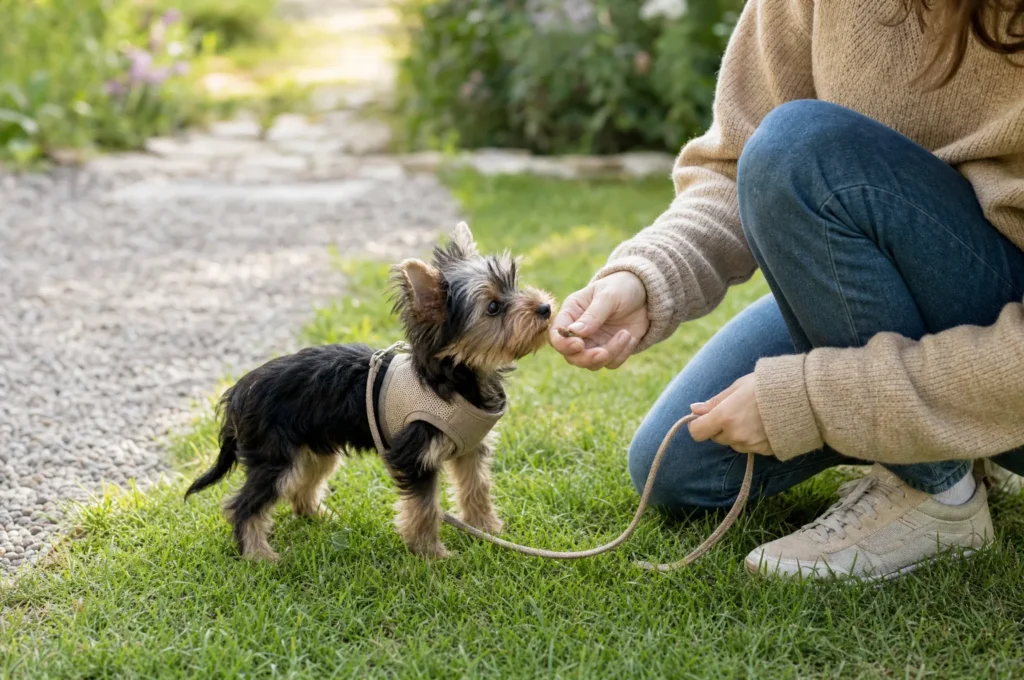
- Harness, not collar. Tracheal collapse is usually seen in certain toy breeds, says AKC chief vet Dr. Jerry Klein. So a harness spares her throat.
- Same spot, then a treat. Leash-walk her to one spot. Treat her immediately once she finishes.
- Stay out with her. Hawks and coyotes are a bigger risk for small dogs, warns breed club board member Judy Marksbury.
- Skip public grass for now. Until her vaccinations are done, use your own yard. Otherwise, she could catch illness from other dogs’ feces. Vet Chyrle Bonk, DVM, keeps young puppies out of dog parks too.
Most puppies can sleep about seven hours without a potty break. That leaves about 17 hours of day, so at one trip every two hours, that’s eight or nine trips a day on her housebreaking schedule. Naps, play and meals also add more. Our how to potty train a puppy guide has the full method.
How long can a Yorkie puppy hold it?
About one hour per month of age is normal, while months plus one hour is the AKC’s outer limit, never a target.
2 months old
3 months old
4 months old
Source: about 1 hour per month of age, up to about 9 to 12 months (AKC, Humane World). Outer limit is months plus one hour (AKC).
In short, a 2 to 4 month old puppy can usually hold it 2 to 4 hours.
Smaller dogs may need more potty breaks, so plan on the shorter bar. See our puppy potty training schedule.
How do you potty train a Yorkie puppy at night?
However, a very young toy puppy may not last seven hours yet.
- Pick up her water about two and a half hours before bedtime.
- Keep the crate near your bed, so you hear a whimper or a whine.
- Expect some overnight trips. Keep them quiet, with no play.
A story from Michael Northcutt, our founder: Our pup’s first weekend home landed on a family birthday. Everybody wanted to hold the puppy. Nobody was around at 9 p.m. when it all fell apart.
The doorbell rang every twenty minutes. Aunts, cousins, and a neighbor who “just wanted to peek” came through. Each new person dropped to the floor and said, “Come here, baby!” She loved it, for about an hour. Then she got glassy and a little frantic.
By the time the guests left at nine, we had a wired, overtired puppy and an accident on the rug. Everyone had loved her, but nobody was watching the clock. No naps. No potty trips on time. Too many hands.
The next time we had people over, I taped a card to the front door. “Puppy in training! Please let her come to you. Ask before treats. She naps at 2 and 4.” We also picked one person as her handler for the day. Their whole job was the schedule.
The guests didn’t mind at all. In fact, a few took pictures of the card. And she napped in a quiet back room with a chew while the party went on.
A puppy this small gets passed around, so give one person the clock on busy days.
Tip: Ask guests to sit on the floor and let her come to them.
Are Yorkies hard to potty train?
Accidents throughout the house are a common complaint among toy breed owners. Often, yes. Her bladder runs out of time sooner, so she needs more trips.
Tip: Hang the harness, clipped to the leash, by the door.
Should you potty train a Yorkie puppy in a crate or a pen?
Breed site Yorkie Info Center prefers a pad-lined playpen. Breeder Yampa Valley Yorkies, on the other hand, uses a small crate. Either works if it’s small. More in crate training a puppy.
With a bladder this small, everyone in the house needs to know when she last went.
How do you potty train other small breeds?
| Breed | Snag | What to plan for | Named by |
|---|---|---|---|
| Yorkshire Terrier | Weather, predators | Stay out with her | AKC, with Judy Marksbury |
| Dachshund | Low belly in cold, wet grass | Go out in weather breaks | Blogger Jessica, You Did What With Your Weiner |
| Chihuahua | Frostbite risk | A cleared spot by the door | Oakland Veterinary Referral Services |
| Shih Tzu | Does what she wants | A fixed daily ritual | Breeder Nancy Broz (AKC) |
| Maltese | Goes very often | No play on potty trips | American Maltese Association |
| Toy poodle | Small bladder | A steady schedule | Vet Dr Jack Ayerbe |
How do you potty train a Dachshund puppy?
Many Dachshunds hate a wet belly, so they may refuse to go out when it’s cold or wet. When the rain lets up, go early (You Did What With Your Weiner). Circling and sniffing the floor are often early warnings (Dachshund Health UK).
Are Dachshunds hard to potty train? They can be harder, but she still learns with trips on time.
How do you potty train a Chihuahua puppy?
For a Chihuahua, cold is the big snag. Small puppies, especially toy breeds, are particularly susceptible to frostbite and hypothermia (Oakland Veterinary Referral Services, an emergency hospital). So clear a spot by the back door.
How do you potty train a Shih Tzu puppy?
“Shih Tzu do what they want but they respond well to ritual,” says longtime Shih Tzu breeder Nancy Broz. Same times, same spot, same cue.
Maltese, toy poodles and other toy breeds
The American Maltese Association keeps potty outings all business: no play, no chatter. Toy poodles, meanwhile, can take longer to housebreak, writes vet Dr. Jack Ayerbe, BVSc. Their small bladders need frequent breaks, so keep a steady schedule.
What if she won’t go outside in rain or cold?
Use any break in the weather, pack down mud at her spot, and bundle her up. Puppy pads may be useful for very small dogs in areas with severe winter weather. See our best puppy pee pads.
No yard? Can you potty train a Yorkie puppy on pads?
Pads can be an effective tool for apartment dwellers. For the pad-to-outdoor transition, move the pad toward the door in small steps. Then move it just outside, then to her final spot. Still, outdoor housebreaking may take longer this way (Humane World). More in potty training a puppy with puppy pads.
Why does my small puppy still have accidents?
Time it and still guess wrong? Naps, play, meals and drinks each reset the clock, so count from the last one.
- Clean it fully. Leftover scent invites her back, so clean soiled areas thoroughly with an enzyme cleaner for dog urine.
- Never punish an accident. Instead, go out sooner next time.
- Same rules from everyone. Consistent owners had more obedient dogs in the Vienna study.
Accidents after weeks of success are a regression, and a little remedial potty training may help. See puppy potty training regression.
Why does she pee right after coming inside?
Outside is full of smells, so she forgets why she’s there. Give her up to 15 minutes at her usual spot. If nothing happens, crate her for about 10 minutes, then try again. Praise only once she’s completely finished. Save play for after.
Is it excitement peeing or marking?
Many puppies pee when greetings, play or affection feel overwhelming. So keep greetings low-key, and never punish it. Marking means peeing small amounts, usually on vertical spots. It tends to start around 6 to 9 months, mostly in intact males.
Finally, accidents with no obvious trigger deserve a vet visit, to rule out infections or bladder stones (Dachshund Health UK).
As you potty train a Yorkie puppy, timing gets easier when the math is done for you.
Small breed potty training FAQ
How long does it take to potty train a Yorkie?
Most puppies take 4 to 6 months (Humane World). Toy breeds often need longer, so plan on the long end.
Can a Yorkie use pee pads and go outside?
Yes, with consistency. Yorkie Info Center describes a hybrid: indoors at night or in bad weather, outside otherwise.
Can you litter box train a Chihuahua puppy?
Yes. Some trainers teach indoor potty spots that work like a litter box (AKC).
How we made this guide: In October 2026 we read AKC guides on training, breeds, pads, marking and health. We also read Humane World, an emergency vet hospital and the Vienna size study. Breed sites, a breed club and a vet are named where used. Nobody at LoveMyPuppy is a veterinarian.
Sources
- American Kennel Club: How to Potty Train a Puppy, by Mara Bovsun, plus its toy dog, Yorkie and tracheal collapse guides
- Humane World for Animals: How to Potty Train Your Dog or Puppy
- Oakland Veterinary Referral Services: How to Potty Train Your Puppy During the Winter
- Psychology Today: Behavior Differences Between Smaller and Larger Dogs, by Stanley Coren, PhD