

Short answer: Choose an indoor dog potty by usable size, cleaning effort and the surface your dog accepts.
A pad holder suits pad users. Grass may suit dogs moving outdoors later. Measure the standing area before buying.
It’s pouring sideways. Or you’re on the 14th floor, and the elevator is slow again. Or it’s 7:40 a.m., and you won’t be home until six.
Your puppy can’t wait for any of that. Some dogs hold it in bad weather, which can be uncomfortable or even unsafe. Others go in the house instead. On a rented floor, every miss is one more spot to scrub before move-out.
An indoor dog potty gives her somewhere to go when outside is out of reach. Stores sell them as pee stations too. Aim for one spot she understands and one backup plan for bad days. The right one depends on which of those three days you’re having.
We don’t sell indoor potties, pads, trays or litter boxes, and this page has no affiliate links. We do sell a printable puppy schedule kit, linked below.
✓ Built on guidance from the American Kennel Club, Whole Dog Journal’s Pat Miller, PetMD and Humane World for Animals.
Which indoor dog potty fits your home?
Before buying, check the usable standing area, step-in height and how you will empty or wash it.
Include replacement grass, pads or liners in the ongoing cost. Confirm that refills are available where you live.
Indoor dog bathrooms come in real grass, artificial grass, pee pads, other absorbent materials and plastic units. Pat Miller, a certified trainer, sorts them that way in Whole Dog Journal’s review. Her team prefers boxes with some type of natural surface. Start with your problem, then match the option.
| Option | Best for | Watch out for | Read next |
|---|---|---|---|
| Pads on the floor | A young puppy, or a short-term backup | With no edge or tray, many pups miss the pad | Disposable puppy pad buying guide |
| Pad holder or tray | A puppy who drags, shreds or misses pads | You still buy and swap the pads | Puppy pad holders |
| Washable pads | Pen floors and less trash | A spare set, plus laundry | Washable pee pads |
| Real grass patch | A puppy who will go outside later | More upkeep than turf; not for grass allergies | Grass patch for dogs |
| Turf with a tray | A reusable grass feel under her paws | Turf pads may wear out quickly | Real grass or turf |
| Dog litter box | Small dogs and apartments | Leg-lifters need tall sides; prevent chewing or swallowing the liner | Below |
| Self-cleaning potty | Small dogs, 25 pounds or less | Costly, and the moving pad may spook her | Below |
| Bark potty | A natural, outdoor-like surface | Some dogs chew it; smell can creep in early | Below |
| No indoor potty | Quick outdoor access, where weather is the only trouble | She needs a covered spot and a cue | Below |
Most watch-outs come from Whole Dog Journal’s product review and the AKC’s indoor potty guide.
On a bare floor, many dogs miss the pad, since nothing marks the edge. A tray, a box or a change of surface helps her aim. Indoor grass suits many dogs who won’t go on paper pads or litter. Our product picks for pads, holders and grass sit in the guides linked above.
Dog litter box: how to set one up
A dog litter box is a low-sided box with a liner she can pee and poop on. You can buy one made for dogs, some topped with turf. The AKC’s setup steps:
- Keep the sides shallow, so she steps in and out with ease. For a small puppy, cut a little doorway in one side.
- Pick a liner. Choose a dog-appropriate surface your puppy accepts. Avoid loose material she tries to eat.
- Prevent chewing. Supervise introductions. Remove any liner she tears or swallows; no absorbent liner is intended as food.
- Make it easy to clean. The liner should be disposable or washable.
- Switch surfaces if she balks. Puppies form surface preferences, so try another liner.
Whole Dog Journal likes a tall-sided box, with pads on the walls, for dogs who lift a leg. The one it reviewed suits small dogs up to 20 inches.
Tip: For a leg-lifter, stand a sturdy, washable post in the middle of the box. Pat Miller suggests a few drops of his or another dog’s urine on it.
Self-cleaning and smart dog potties
A self-cleaning potty advances a fresh section of pad over the platform after she goes. Whole Dog Journal describes one roll as 21 full pad advances. A smart version advances the pad from a phone app.
The model it reviewed is pricey and only for dogs 25 pounds or less. The motion may also scare some dogs, so watch her reaction before you commit.
Bark potties and other disposable trays
A bark potty is shredded tree bark in a cardboard frame, with netting on top and a plastic tray inside. It’s a surface she’d find outside. Some dogs chew the box and the bark. It’s sold to last a month, yet urine smell may show after three weeks.
What if bad weather is the only problem?
Then try a sheltered spot outside before you buy an indoor potty. If the door is close, start there. An indoor potty makes sense when the trip itself takes too long.
Some dogs hate rain on their backs. Others hate wet ground under their paws. Small dogs are often unhappiest, since they’re closer to the ground. Short-coated breeds and dogs who chill easily may struggle too. The AKC’s trainer author, Sassafras Patterdale, CPDT-KA, gives these bad-weather fixes:
- Find shelter. Scaffolding over a curb or a big tree works on walks. A flower bed under a covered patio works at home.
- Make a temporary spot. Sod in a planter or a kiddie pool filled with dirt can do the job.
- Try gear. A fitted raincoat helps with rain on her back. Fitted boots help with wet ground.
- Watch her after a no-go. Keep her leashed to you or in a small area, then try again soon.
Tip: Teach a potty cue on a dry, calm day first. Then use it in the rain, with a high-value treat ready.
Bad-weather backup: Choose a safe, accessible potty spot before a storm. Introduce the surface calmly while conditions are manageable.
A backup does not replace outdoor exercise, company or needed care during a long workday.
Michael’s fix stayed outside, a few steps from the door.
“Try again soon” works best when everyone knows when she last went.
Is a balcony dog potty safe?
It can be, with care. A balcony or patio potty keeps the mess outside your living room. Falls are the main risk, though, and dogs can squeeze through railings.
“Folks may not think that two stories is that high, but yes it is.”
Dr. Sonja Olson, senior clinician in emergency medicine, BluePearl Veterinary Partners, speaking to PetMD
Even a one-story fall can sometimes injure a dog, she adds. Before the potty goes out, run this balcony safety check:
- Put her on a leash or harness for every balcony trip.
- Move chairs and other furniture away from the edge, so nothing works as a step.
- Check for gaps where a head or paw could get caught in the railing.
- Keep her away from a hot grill and toxic plants.
- Stay with her for the whole trip.
A grass patch out there brings its own list: runoff, lease rules and rain. Our balcony grass patch section covers those.
Long workdays and high floors: how long can she wait?
In an apartment with no yard, the elevator trip may take longer than a puppy can hold it. A long workday stretches that gap further.
Do not plan a full workday from a bladder formula. Arrange care, suitable toilet access and companionship around your puppy’s actual needs.
How long a puppy can usually hold it, next to an 8 hour workday (hours)
Normal stretch: the AKC’s one hour per month of age. Limit: months plus one hour, from Humane World for Animals and the AKC. The 8 hour bar is a plain workday for scale.
A single lunch visit may not cover a young puppy’s needs. Plan enough help for toilet breaks, meals, activity and company.
Puppies under 6 months shouldn’t stay crated more than three or four hours in a stretch, per Humane World. A pen with an indoor potty at one end gives her somewhere to go. Keep her bed at the other end. Our crate training guide covers the crate side.
Choose the setup around the hours you are away and the care someone can actually provide.
How do you teach a puppy to use an indoor potty?
Indoor puppy potty training follows the same method as outdoor training. The AKC names one difference. You take her to her indoor spot instead of outside. Here’s the order, from the AKC and Whole Dog Journal:
- Pick a spot you’ll keep. Choose a quiet, low-traffic corner with good airflow and a tile or linoleum floor.
- Let her explore it first. Help her get comfortable stepping in and out before you use it for potty.
- Show her what it’s for. Place a little of her urine or stool on the surface.
- Take her there on a clock. Go after meals, naps and play. Our puppy potty training schedule lays out the gaps by age.
- Use the same cue word you’ll use outside, like “Go potty.”
- Reward right after she goes, with praise and a treat.
- Limit her freedom until she’s reliable, just as you would for outdoor training.
Where the experts split: treats on the potty. The AKC lures a puppy into the litter box with treats while she learns to step in. Pat Miller says not to put treats on it, because dogs tend not to eliminate where they get food. She gives the reward away from the potty.
Our rule: if you lure her in, hand her the treat as she steps in. Never leave food on the surface. Once she uses it as a toilet, reward her a step off it.
Tip: Need to move the potty later? Go slowly, maybe only inches a day, to head off accidents.
Already using pads? Our guide to potty training a puppy with puppy pads walks through the pad version.
Can a puppy use both an indoor potty and outside?
Yes. An indoor and an outdoor spot can be handy in bad weather. Teach one place first, then the other, so she isn’t learning both at once.
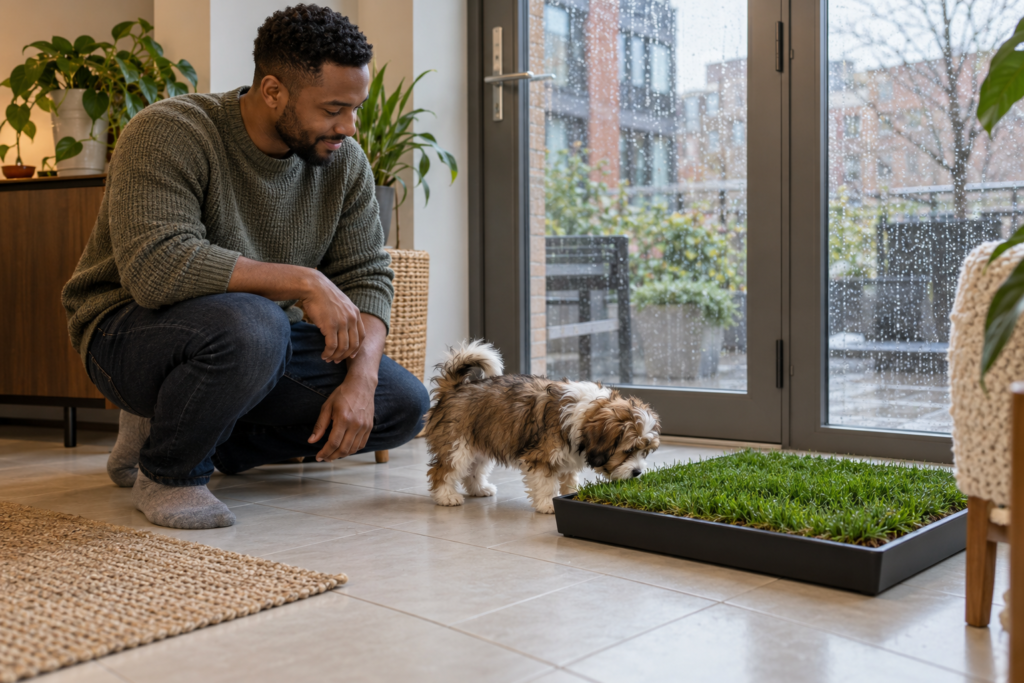
When you move her outside, carry a piece of the liner to the new spot. Pat Miller offers a reverse trick for a dog who won’t use the indoor potty. Set it on her usual outdoor spot. Let her use it there a few times, then bring it back in.
Our guide to training a puppy to pee outside covers the move step by step. The full method lives in how to potty train a puppy.
When should you skip an indoor potty?
Whole Dog Journal’s good reasons for one include medical issues and fear of outdoor sounds. Bad weather, a high floor and long absences make the list too. The AKC adds owners for whom frequent walks are too hard, such as elderly or mobility-challenged owners.
If none of those fit, an indoor spot may only add a second habit to undo later. Skip it, or keep it short-term, when:
- You can get her outside quickly from most rooms.
- Weather is the only problem, and a sheltered spot works.
- She chews or eats every liner you try.
- Someone can cover the midday trip on workdays.
Keep her out in the world either way. Walks and outdoor play still give her socialization, exercise and mental stimulation.
And if she keeps missing despite a steady routine, see your vet. Persistent house soiling may signal a medical problem. Mary Burch, PhD, of the AKC advises a vet check for dogs who stay hard to house train. Clean every miss with an enzyme cleaner for dog urine, so the smell doesn’t pull her back.
Not sure which part of your week keeps slipping? Our free Puppy Week Check-In asks six quick questions once she’s home, or three before. You get one practical next step, and no email is needed.
Indoor dog potty FAQ
Can you use a cat litter box for a dog?
Only if its usable area and entry suit the dog. Choose a suitable liner and supervise introductions. Avoid loose litter or liners she eats.
Can a large dog use an indoor potty?
Some can. Whole Dog Journal lists a real grass tray in sizes up to 24 x 48 inches. The walled box and the self-cleaning model it reviewed suit small dogs only.
Do indoor dog potties smell?
They can. Whole Dog Journal places the potty in a spot with good ventilation to keep odor down. Empty and clean it often, and treat misses with an odor neutralizer.
Can an older dog learn to use an indoor potty?
Yes, though it may take longer. Pat Miller writes that dogs who were careful about house training may take more effort. Our guide to potty training older puppies and adult dogs can help.
Editorial review: Updated October 23, 2026 after reviewing search results and relevant source guidance. This is an editorial guide, not a product test or individualized professional advice.
Sources
- American Kennel Club: Indoor Potty Training for Puppies, by AKC Staff, plus Potty in Bad Weather, by Sassafras Patterdale, CPDT-KA, CTDI, its potty training guide and its crate accidents guide
- Whole Dog Journal: Indoor Dog Potty, by Pat Miller, CBCC-KA, CPDT-KA
- PetMD: Balcony Safety and Pets, by Paula Fitzsimmons, with Dr. Sonja Olson and Dr. Lori Bierbrier
- Humane World for Animals: How to Crate Train Your Dog or Puppy