

Short answer: Take her to one outdoor spot after waking, meals and play. Reward her there immediately after she finishes.
Before using shared ground, ask your vet which places are appropriate for her vaccination stage and local disease risk.
You stood on the grass in your socks for ten minutes. She sniffed a leaf, chased a moth and looked at you. Then she trotted inside and squatted by the couch.
How to train a puppy to pee outside comes down to one idea: one outdoor spot is her bathroom. The next trip is a fresh start. The seven steps below make every trip run the same way.
We sell the puppy planning kit linked below. This guide contains no affiliate links.
✓ Built on guidance from the AKC, Humane World, PetMD, Best Friends and the UC Davis vet school.
How do you train a puppy to pee outside, step by step?
Run every trip the same way, from the crate door to the grass. The loop below comes from AKC, Humane World, Best Friends and UC Davis guidance.
What you need: a leash, small rewards for outdoor potty training, one chosen spot outside, paper towels and an enzyme cleaner.
“Wait until your puppy is completely finished before offering praise or rewards.”
Humane World for Animals, house-training guidance
- Pick one spot and one route. Lingering scent from earlier visits tells her what the area is for. Building a gravel or mulch corner? Our outdoor dog potty area guide covers it.
- Clip the leash on, even in a fenced yard. It keeps her focused on the job (AKC). Treat the yard like any other room in the house (Humane World).
- Walk straight there. No detours past the toys.
- Stand still and stay quiet. Let her sniff in a small circle. Skip play on the trip, so it keeps its purpose (Best Friends).
- Say your cue as she starts. Pick one phrase, like “go potty,” and have everyone use it. Say it calmly as she begins to urinate or defecate.
- Reward her right there, when she’s done. Wait until she’s completely finished, since a puppy can stop midway if interrupted. Then praise and treat on the spot.
- Then the fun. A sniff walk or a short game comes after she goes.
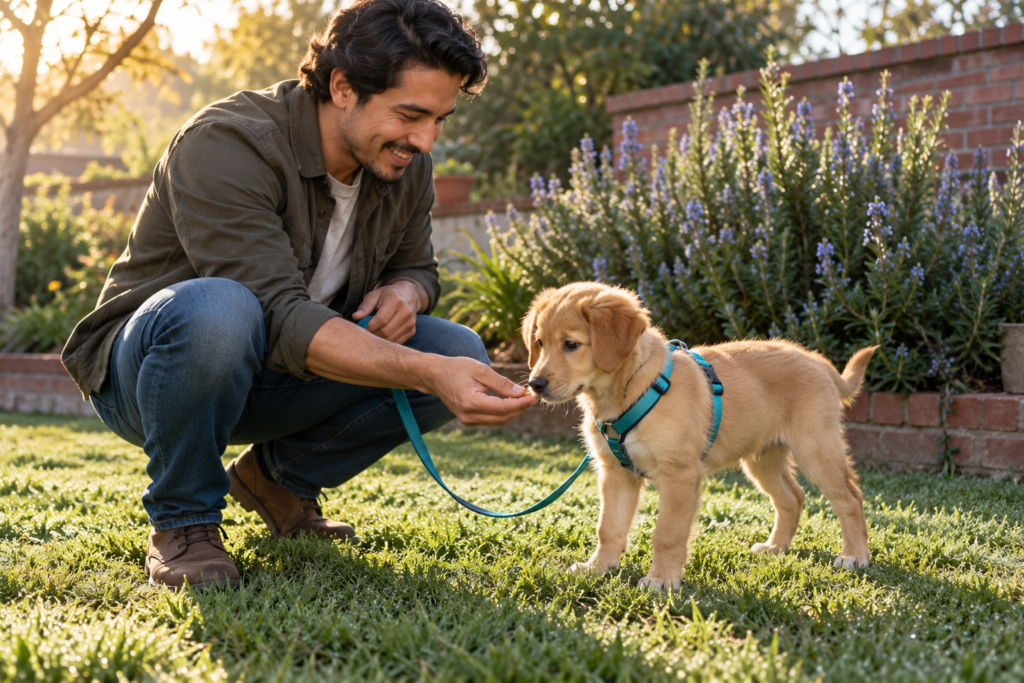
No pee yet? None of our sources sets a wait time, so use common sense and give her a few quiet minutes. Then bring her in and keep her with you, or in her crate. Try again shortly. Our how to potty train a puppy guide covers the whole first month around these trips.
Keep the trip consistent: Bring the leash and reward outside. Ask every helper to use the same spot and cue.
If she does not go, return to close supervision and try again shortly. Do not punish an indoor accident.
Raised a dog before? Run the steps above like it’s your first puppy, and write the trips where everyone can see them.
When can puppies go outside to pee?
Ask your vet for a local plan before using shared dog areas. Vaccine status and local disease exposure both matter.
A private yard may offer lower exposure, but it is not automatically free of infection risks. Avoid unknown dogs and heavily used dog areas until your vet clears them.
Use safer supervised experiences while vaccines continue. Our puppy vaccination guide explains why the schedule needs individual advice.
How often should you take her outside?
A UC Davis vet school handout gives these daily counts by age.
Source: Housetraining Your Puppy, UC Davis Clinical Animal Behavior Service. Bar length shows the top of each range.
These are general planning ranges, not a daily cap. Add trips when she wakes, eats, plays or signals a need.
Start with frequent opportunities and adjust from her actual pattern. Age-based formulas cannot predict an individual puppy’s bladder. Our puppy potty training schedule helps organize the day.
Eight to 10 trips a day is a lot to track, especially when several people share them.
How do you get a puppy to poop outside?
Use the same loop and time it around meals. Many puppies need to go shortly after eating, waking from a nap or active play (AKC).
- Feed at set times. Regular meals make potty times more predictable (Humane World).
- Go out after every meal. The UC Davis handout calls elimination after eating and drinking a natural reflex in dogs.
- Return to the same spot. Consistency helps her recognize the routine. Pick up feces promptly.
- Clean indoor accidents. Use an appropriate enzyme cleaner rather than moving waste around the home.
Tip: After each meal, keep her in sight. Sniffing the floor, circling or a hunched back means take her out now (AKC).
How do you move a puppy from pads to outside?
Move her slowly, while she’s already using the outdoor spot. Pads can slow the transition to going outdoors (AKC). A pad‑trained puppy may also keep a lifelong surface preference (Best Friends).
Can you use pads and outdoor training together? For a while, yes, with a plan to drop them. Pads help owners who can’t get home often, but every indoor trip practices an indoor spot. Our pads to outside steps walk through the move toward the door.
How do you teach a puppy to tell you she needs to go out?
Pick a signal and link it to going out. Humane World suggests an action like ringing a bell or barking at the door. Reward the signal, then reward the potty outside. Keep supervising her closely indoors until she’s reliably trained. Thinking about a bell? Our dog potty bells guide compares types and setup.
What if it’s raining or cold?
Some puppies love rain and snow, and others stall at the door. To raise a year‑round outdoor dog, the AKC suggests short outdoor play sessions in wet, cold or windy weather. Stretch them a little as she gets comfortable. On a stormy day, keep the potty trip short and save play for later.
Tip: Leave a towel by the door on rainy days. A quick paw wipe after she goes means you don’t dread the next wet trip.
What slows down outdoor potty training?
Each row starts with what you see on the trip, then the likely reason and a fix.
| What you see | Likely reason | Try this |
|---|---|---|
| She plays and sniffs, but doesn’t go | The trip feels like playtime | Leash on, straight to the spot, stand still. Play only after she goes. |
| She goes, but doesn’t seem to connect it | The treat came late, back inside | Treat outside, the moment she finishes. |
| You let her out alone and watch from the window | You miss the moment to praise her | Go out with her. UC Davis advises against leaving her outside unsupervised. |
| Accidents in rooms nobody was in | Too much house, too soon | Tether her to you on a 6‑foot leash (Humane World). Add space after about a week with no accidents (Best Friends). |
| She keeps using the same indoor spot | Leftover scent draws her back | Clean with an enzyme cleaner for dog urine. |
Accidents inside every day? Our guide on how to stop a puppy peeing in the house goes deeper. Leave scolding out. Punishment will only make them fearful and slow progress (Humane World).
Not sure which part of the routine keeps slipping? Our free Puppy Week Check‑In asks six quick questions once she’s home, or three before she arrives. You get one practical next step, and no email is needed.
How long does it take to train a puppy to go outside?
Expect months for a puppy, with real progress in weeks. The ranges differ, partly because the sources cover different dogs.
- Humane World: house training a puppy typically takes 4 to 6 months. Size, age and past habits change that.
- AKC: most puppies make significant progress within a few weeks. Complete training often takes several months.
- Best Friends: house training a dog can take days to weeks. Its guide covers adult dogs as well as puppies.
So an older dog may click faster than an 8 week old with a tiny bladder. Starting past 4 months? See our guide to house training an older puppy. Humane World and the AKC both call accidents a normal part of learning.
Frequent opportunities and prompt rewards give her more chances to practice successfully.
When should you call the vet?
- She was doing well, then accidents start again. Check with your vet, since there might be a medical cause (Best Friends).
- She’s really struggling despite a steady routine. Humane World suggests a vet or a positive reinforcement trainer.
Puppy outdoor potty training FAQ
How many shots does a puppy need before going outside?
There is no single number that makes every location safe. Ask your vet about her vaccine series and local exposure risk. A shared dog park and a private yard pose different risks.
Can I walk my puppy before her shots are done?
Ask your vet which routes and activities are appropriate locally. Avoid high-traffic dog areas until cleared. Carrying her can allow some experiences without contact with shared ground.
What should I do if I catch her peeing inside?
Calmly pick her up and take her outside right away, the AKC says. If she finishes out there, reward her. Don’t yell, which Best Friends says can make her stop going in front of you.
Editorial review: Updated October 23, 2026 after reviewing search results and relevant source guidance. This is an editorial guide, not a product test or individualized professional advice.
Sources
- American Kennel Club: How to Potty Train a Puppy, by Mara Bovsun, plus its Expert Tips for Potty Training Your Puppy, by Stephanie Gibeault, MSc, CPDT
- Humane World for Animals: How to Potty Train a Puppy
- PetMD: When Can a Puppy Go Outside Safely?, by Brittany Grenus, DVM, reviewed by Molly Price, DVM
- Best Friends Animal Society: How to Potty Train a Puppy or Dog
- UC Davis Clinical Animal Behavior Service: Housetraining Your Puppy (handout by veterinary students)