

Short answer: Catch her mid-pee, calmly pick her up and carry her outside. Praise her if she finishes there. Then clean the spot so no scent is left to call her back.
To stop the next one: take her out before she has to go, after every nap, meal and play. Watch her or confine her the rest of the time. If accidents keep coming despite all that, see your vet first.
Urgent: Repeated straining with little or no urine needs immediate veterinary attention. A urinary blockage can be an emergency.
You just cleaned the rug. She went out ten minutes ago. Now there’s a fresh puddle by the couch, and she’s looking at you like nothing happened.
By the fourth puddle it can feel personal. The common causes are fixable, though. Think too few trips, too much freedom, or a lingering smell. Leave the smell, and dogs frequently return to it (AKC).
House soiling means a dog peeing or pooping indoors, where she shouldn’t. Below is how to stop a puppy from peeing in the house once accidents have started. It starts with matching the pattern you’re seeing to its cause.
We sell the First 14 Days Kit and washer-cleaner tablets, linked below. There are no affiliate links on this page.
✓ Built on guidance from the AKC, Humane World for Animals and VCA Animal Hospitals.
Why does my puppy keep peeing in the house?
Here are five common reasons, and more than one can run at once. The table matches what you’re seeing to the likely cause and the first move.
| What you see | Likely cause | First move |
|---|---|---|
| Puddles a while after the last trip | She waited longer than her bladder can | Shorter gaps between trips (AKC, Humane World) |
| Accidents started when she got more rooms | Freedom grew faster than her habits | Shrink her space again, then widen slowly (AKC) |
| Same corner, again and again | Old scent still marks it as a bathroom | Enzyme clean, following the label (AKC) |
| Dribbles at greetings or during play | Excitement or submissive urination | Calm, low-key greetings (VCA) |
| Straining, crying, blood, strong smell | Possible urinary tract infection | Call your vet (VCA) |
Age gives context, but it cannot tell you exactly how long your puppy can wait.
Age-based holding estimates are rough guides, not safe waiting limits. Awake puppies may need much more frequent trips.
Respond to her signals and changes in her usual pattern. Never make her wait to meet a chart.
Take her out frequently, especially after waking, play, eating or drinking. Shorten the gaps when accidents happen.
Why does my puppy pee on my bed?
Your bed is where she wakes up, wrestles and gets excited. Each of those moments sends a puppy looking for a spot. The bed is also extra freedom, and the AKC links accidents to expanding access too quickly. The same goes for the sofa or the rug.
A big bed can also work like an oversized crate. A too-big crate gives a puppy room to potty, then move away from it (AKC). A queen mattress offers plenty of room.
- Close the bedroom door for now. The bed is a privilege she earns back later.
- Empty her first. If she joins you, take her out right before, and stay with her.
- Lift her off after naps. Carry her straight outside when she wakes.
- Get the scent out of the bedding. A mattress or comforter that still smells will call her back. Our enzyme cleaner guide covers mattresses and dog beds.
Why does my puppy pee when she’s excited?
That’s excitement urination. It tends to happen at greetings, especially when family comes home, or during vigorous petting. VCA’s board-certified behavior vets see it most commonly in puppies and young females. Many dogs grow out of it with age.
Submissive urination looks different. She lowers her body, flattens her ears, cowers or rolls onto her back. Fear and anxiety drive it. A loud voice, reaching for her or standing over her makes it worse.
The fix starts at the front door, every time someone walks in. Skip eye contact, touch and talk until she calms down. Then:
- Let her come to you, rather than going to her.
- Kneel down instead of standing over her.
- Speak softly, and pet her chest instead of her head.
- Toss a treat or her ball as you walk in, so greetings mean play.
- Ask guests to greet her the same way.
- If she dribbles, skip the scolding. Reprimands make her more anxious and fearful.
A story from Michael Northcutt, our founder: Our pup had gone almost two weeks without an accident. I was bragging about it. Then, at four months old, she peed on the rug right in front of me.
The next day, another one. Then she started waking up at night again. I honestly thought we’d broken something.
So we went back to basics. I put our old fridge schedule back up. More trips outside after waking, eating and playing. Closer watching, and her pen when I couldn’t watch. I cleaned the accident spots really well, so the smell wouldn’t pull her back.
I also started the potty log again. Most of the new accidents landed in the late afternoon. That’s when the kids next door got home and she got wound up. So we added a trip right before then. I called our vet too, to rule out anything medical. Everything checked out.
Things settled back down. Not perfect, but back on track. Training isn’t a straight line.
His fix was the old routine, a vet check and one well-timed trip. If your puppy was doing well and then slipped, start there. Below is what to do the moment you catch one in the act.
What do you do when you catch your puppy peeing inside?
Move fast, and keep your voice low. The AKC’s instruction is to calmly pick them up and take them outside immediately.
- Interrupt quietly. Scoop her up mid-pee. No shout, no chase.
- Carry her straight to her outdoor spot. For a bigger puppy, clip the leash on and walk her out.
- Wait. Stand still and let her finish.
- Reward a finish outside. If she finishes there, praise and reward her.
- Clean the indoor spot after. Bring the soiled paper towels to her outdoor spot, so the scent links that patch with the job (Humane World).
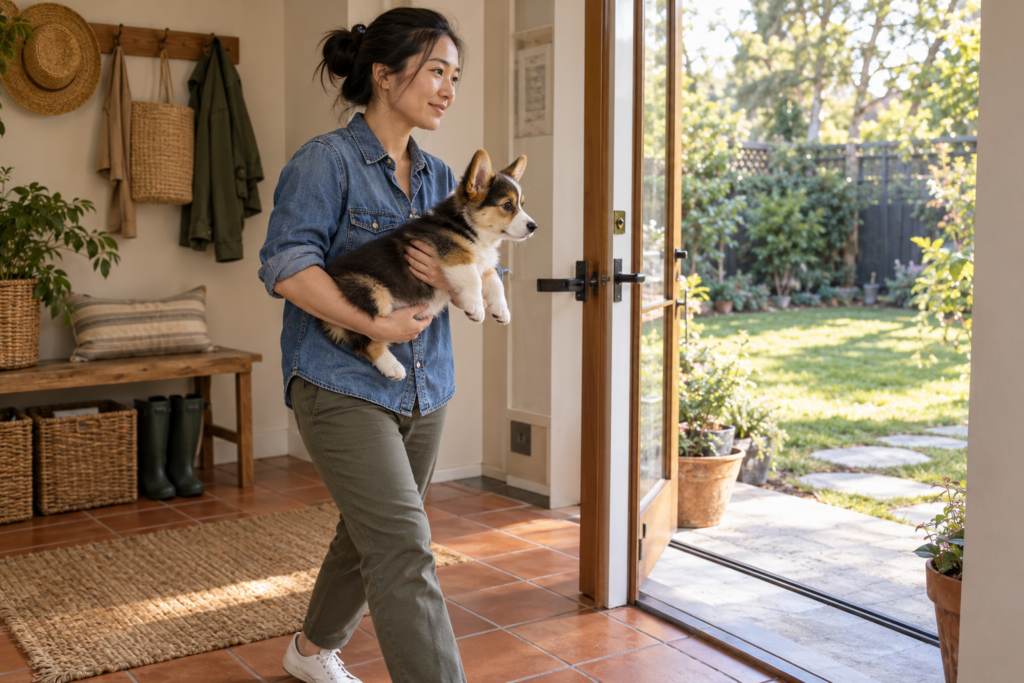
Found the puddle later? Skip steps 1 to 4 and just clean it. Dr. Mary Burch of the AKC advises against making a fuss.
Tip: Outside, hold your praise until she’s completely done. Puppies may stop midway if interrupted (Humane World).
Should you punish a puppy for peeing or pooping in the house?
No. Scolding or rubbing her nose in it will only make them fearful and slow progress, Humane World says. The AKC agrees that punishment works less well than rewards and prevention.
For a submissive puppy, reprimands make her more fearful, VCA’s behavior vets warn. Fear can cause the very puddle you’re upset about.
Already yelled once? You haven’t ruined anything. Start the calm routine today, and keep it the same for everyone at home. If cleanup also means stopping a puppy eating poop, that guide covers the scoop-and-reward routine.
How do you stop a puppy from peeing in the house in the first place?
You take away her chances to get it wrong, and give her many chances to get it right. These steps come from Humane World’s housebreaking guide unless noted.
- Go out on a clock, plus after events. At least every two hours, and after waking, playing, eating or drinking.
- Watch her indoors. Tether her to you with a 6-foot leash when you’re not playing or training.
- Know her signals. Circling, sniffing the floor, scratching at the door or sudden squatting means go now.
- Confine her when you can’t watch. A crate or a gated bathroom corner works.
- Feed on a schedule. Puppies usually need to go soon after eating, so set meal times make potty times predictable.
- Keep water available. Do not restrict drinking to prevent accidents. Ask your vet about unusual thirst.
- Add rooms one at a time. Gradual freedom tends to work better than full access too early (AKC).
Tip: Keep the leash on in the yard as well. Humane World treats the yard like any other room while she learns.
Our Potty Break Timer offers a reminder based on your entries.
It cannot determine her safe holding limit or replace watching her signals.
For the full method from day one, see our how to potty train a puppy guide. Ready to move her from pads to the yard? Read how to train a puppy to pee outside.
What if she’s pooping in the house too?
Use the same loop, with meals as your alarm clock. Puppies usually need to go soon after eating, so take her out after every meal. Watch her stool too. If it’s routinely loose, bulky or unusually foul-smelling, talk to your veterinarian. Diarrhea makes housetraining considerably more challenging.
How do you clean a pee spot so she doesn’t go back?
The goal is a spot her nose can’t find. The AKC recommends enzymatic pet stain cleaners, used exactly as the product instructions say. Leftover scent can invite repeat accidents (Humane World).
- Blot first. Soak up what you can with paper towels.
- Save one towel. Put it on her outdoor spot (Humane World).
- Treat the whole spot. Follow your cleaner’s label, including how long it sits.
Our enzyme cleaner for dog urine guide covers products, carpet, couches and hardwood floors step by step.
Treat urine on the affected surface. An air freshener or odor device cannot replace cleaning the spot.
When are puppy accidents a medical problem?
When the pattern changes, or training isn’t working. VCA’s veterinarians list these signs of a urinary tract infection in dogs:
- Trying to pee often, every time she goes outside
- Straining, crying or whining while she pees
- Blood in the urine, or dripping urine
- Licking her genitals a lot
- Urine with a very strong odor
“A break in house training is a red flag.”
Courtney Barnes, DVM, Malcolm Weir, DVM, and Robin Downing, DVM, writing for VCA Animal Hospitals
Young puppies are among the dogs most often seen with UTIs, and females are more prone than males, per VCA. A vet usually starts with a urine test. Call sooner if she was reliably trained and suddenly isn’t.
Even with no medical signs, a vet visit still makes sense. The AKC’s Mary Burch, PhD, advises it for dogs still hard to housetrain despite consistent training. If the vet rules out health problems, an experienced trainer or behaviorist may be the next step. Our house training an older puppy guide covers slips past the baby stage.
When do puppies stop peeing in the house?
Full housetraining typically takes 4 to 6 months, per Humane World. It varies with her size, age and past habits. The AKC is more cautious, and its advice column finds no magic number of months when accidents stop.
Use 4 to 6 months as a rough guide, not a deadline. Humane World expects accidents to decrease gradually, so fewer each week means you’re on track. If they climb, or appear in a puppy who was dry, go back to the vet signs above.
Each calm, well-timed trip is one less puddle to find. For a day-by-day plan, our puppy potty training schedule lists trip times by age.
Puppy peeing in the house FAQ
Can you house train an 8 week old puppy?
Yes. The AKC says potty training should begin the day she comes home, often around 8 weeks. Expect lots of trips, since bladder control is weakest at that age.
Do sprays or plug-ins stop a puppy peeing inside?
For house soiling, our sources point to enzyme cleaning, close supervision and more trips outside, not sprays or plug-ins. One exception: VCA’s behavior vets say a synthetic dog pheromone may help some fearful, submissive puppies.
Why is my puppy peeing in her crate?
She may need more frequent trips or a better-fitting crate. She must have room to stand, turn and lie comfortably.
Persistent accidents, pain or sudden changes need a vet check. Do not withhold water to keep bedding dry.
How we made this guide: In October 2026 we read two AKC housetraining pages and Humane World’s potty training guide. We also read VCA’s articles on urinary tract infections and on submissive and excitement urination. The guides and owner threads that rank for this problem decided which sections we wrote. Nobody at LoveMyPuppy is a veterinarian. Call your vet about any health worry.
Sources
- American Kennel Club: How to Potty Train a Puppy, by Mara Bovsun, with Mary Burch, PhD, plus My Dog Pees in Her Crate
- Humane World for Animals: How to Potty Train Your Dog or Puppy
- VCA Animal Hospitals: Urinary Tract Infections (UTIs) in Dogs, by Courtney Barnes, DVM, and colleagues, plus Submissive, Excitement, and Conflict Urination, by Debra Horwitz, DVM, DACVB, and Gary Landsberg, DVM, DACVB