
Short answer: A puppy eating poop is common, and many puppies outgrow it. You stop it by getting there first.
Leash her for every potty trip. Reward her the second she turns to you, then scoop while she chews her treat. The guide to how often a puppy poops helps you track the timing of those trips.
She has it in her mouth right now?
- Don’t chase or yell. Yelling can teach her that poop gets your attention.
- Call her to you in a happy voice, and reward her if she comes and leaves it.
- Stool can expose her to harmful organisms. Prevent access and ask your vet about repeated stool eating.
- Vomiting, diarrhea or weight loss afterward? Call your vet.
You’re on the back step in socks, holding the door. She squats, finishes, sniffs, and then you see her head drop. You yell her name. She grabs it and runs.
Now you’re wondering about every puppy kiss. And you’ve read ten pages that all say something different.
The medical name is coprophagia, eating stool, her own or another animal’s. In puppies, the AKC calls it part of exploring the world. Left alone, though, the habit can stick.
She hasn’t learned yet that turning to you pays better than the pile.
We sell a printable puppy household kit and link to it below. Our potty timer and Puppy Week Check‑In are free.
✓ Built on guidance from PetMD, the AKC, Banfield Pet Hospital, VCA Animal Hospitals and a UC Davis veterinary study.
Why is my puppy eating poop?
Watch what came just before the grab. Mother dogs eat their puppies’ poop for about the first three weeks, per the AKC. Puppies copy her.
| What you notice | Likely reason | What to try |
|---|---|---|
| She noses and mouths everything in the yard | Curiosity, exploring with her mouth | Leash, then reward the turn to you |
| Long stretches alone or with little play | Boredom or stress | More play, chew and puzzle toys |
| She goes for it fast after you yell | Attention, even angry attention | Calm voice, call her away |
| She eats indoor accidents before you find them | Hiding evidence after scolding | Stop scolding, praise outdoor potty |
| Always hungry, thin, or loose stool | Too little food, poor digestion or parasites | Call your vet about food and a fecal test |
| She ignores old piles but grabs fresh ones | Fresh poop draws stool eaters | Scoop every pile right away |
The rows draw on PetMD and Banfield’s vet-reviewed guide, though Banfield thinks curiosity is likelier than hiding. In a UC Davis owner survey, 85% of stool eaters mostly ate stools no more than 2 days old.
Why is my puppy eating poop all of a sudden?
Sudden onset is on Banfield’s red-flag list, along with weight loss and appetite changes. Call your vet first.
- Hunger. Puppies can outgrow their portions faster than you adjust them.
- Illness. Diseases that make dogs ravenous, such as exocrine pancreatic insufficiency (EPI), may drive her to look for food.
- Medicine. Steroids and other drugs that raise appetite can play a part.
- Stress. Routine changes, confinement or harsh correction can sometimes trigger it.
Is it normal for an 8 week old puppy to eat poop?
Yes. Puppies naturally eat their own poop. At this age, your job is to pick up every pile before she reaches it. Start the leash routine on day one.
For your household: Agree on one calm response and share concerns with your vet or qualified trainer. Consistency helps everyone notice changes sooner.
How do I stop my puppy eating poop?
Make sure she never gets the chance, and make your hand worth more than the pile.
Keep a leash by the potty door and small treats in your pocket. Banfield calls prevention the easiest and most effective strategy.
1. Leash every potty trip
Yes, even in your fenced yard. A leash lets you walk her away from her own poop and other animals’ poop.
2. Stay calm while she goes
Stand still and keep your voice easy. A big reaction from you can be exactly what she’s after.
3. Reward the turn to you
The second she finishes, say “yes!” and put a treat at her nose. You’re teaching her that coming to you after she poops pays.
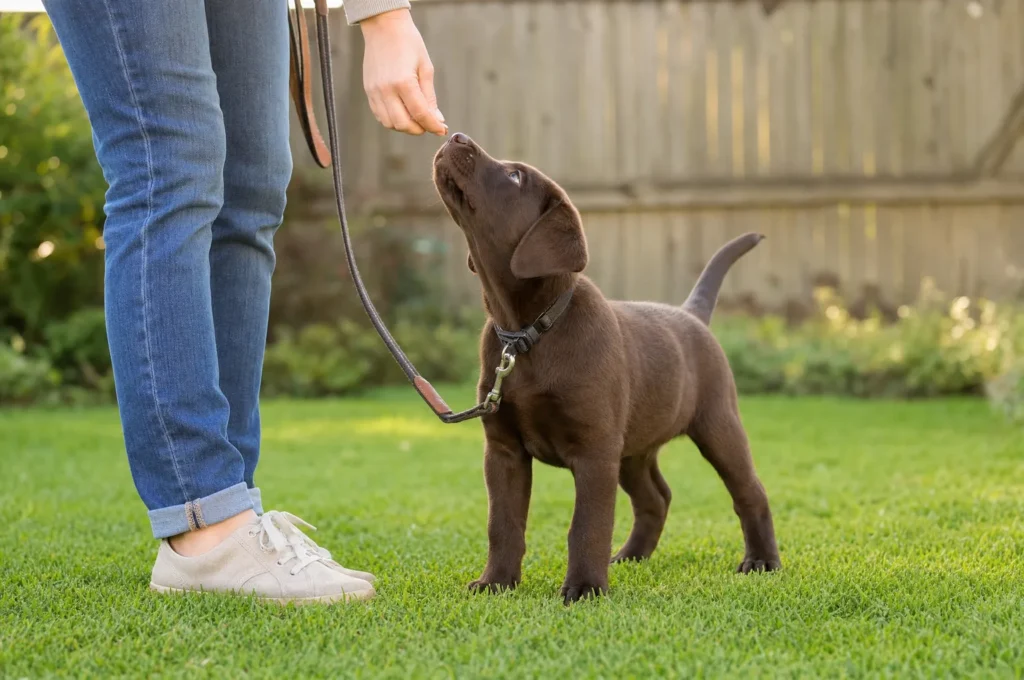
4. Scoop while she chews
Pick the pile up while she chews her treat. If she lunges at it while you bend down, use PetMD’s version. Bring her inside first, then remove the stool.
5. Teach “leave it” step by step
Rewarded “leave it” did best in the UC Davis survey, though only 4% of owners said the eating stopped. These steps come from AKC trainer Stephanie Gibeault, MSc, CPDT.
- Cover a floor treat with your hand. When she stops trying for it, say “yes” and give a better treat from your other hand.
- Lift your hand, ready to cover again. Reward her for looking away or leaning back.
- Clip on her leash and stand up. Cover the treat with your foot instead of your hand.
- Once she ignores dropped food on her own, say “leave it” before each drop.
- Walk her on leash past a row of floor treats, then practice on sidewalks and in the yard.
Don’t use the cue near poop until she’s reliable with treats. A cue she won’t follow lets her practice ignoring you.
6. Cover food, play and her space
Feed young puppies a puppy diet three or four times a day on a consistent schedule. Frequent play and chew or puzzle toys help with boredom.
Tip: Keep her food and water bowls well away from her potty spot, as the AKC advises.
Leash trips only work if you’re out there when she goes. Our free Potty Break Timer gives her next trip time and a countdown from her age and last trip. For the full routine, see our guide on how to potty train a puppy.
Get everyone to scoop the same way
Chasing or shouting can make cleanup harder and may frighten her. Calmly prevent access, then reward moving away.
“Punishment tactics should never be used with puppies to help with house-training or stool-eating.”
Dr. Jamie Lovejoy, DVM, veterinarian, writing for PetMD
So agree on three things for every yard trip. Leash on, treat at the turn, scoop while she chews. Indoor accident? Clean it up quietly, without a word to her.
More than one dog at home? Hart’s team linked stool eating to multi-dog households. Scoop after every dog, not only the puppy.
Can you stop a puppy eating poop overnight?
No. In Hart’s survey of frequent stool eaters, the habit was “not readily changed.” Tonight you can change access, though. A leash and a quick scoop mean fewer chances to practice it.
The routine costs you one treat and a few seconds per trip. Progress looks like her head turning to your hand before her nose drops. Plan on weeks, not days.
Do deterrents and home remedies stop poop eating?
Ask your vet before trying a stool-eating deterrent or supplement. Suitability depends on ingredients, age and health. Evidence of reliable benefit is limited.
The UC Davis owners had dogs seen eating stool more than 10 times. Only 7.3% of those dogs were under 1, and about 64% were 4 or older. So read the chart as mostly adult-dog data.
Owners who said the stool eating stopped
Percent reporting success among owners who tried each method. Bars are drawn on a 0 to 10% scale.
Chasing her away, peppering stools and electronic or noise collars scored 1 to 2%. The study didn’t track whether owners followed product instructions.
With taste-aversion products, every dog in the house has to eat the deterrent, the AKC points out. Some people have had success with digestive enzyme supplements. Ask your vet first.
Pineapple, pumpkin or meat tenderizer?
None of the vet sources we read backs pineapple, pumpkin or meat tenderizer for poop eating. None was among the 11 products in the UC Davis survey. Run any food additive past your vet first.
Why does my puppy eat other animals’ poop?
Some dogs find horse manure and goose droppings especially appealing, the AKC notes. Another animal’s stool also carries more risk than her own.
What do I do if my puppy ate goose poop?
Don’t chase her. In Michael’s story, lunging only made his puppy swallow faster.
- Tell your vet. A fecal test can check for intestinal parasites. Call sooner for vomiting, diarrhea or weight loss.
- Shorten the leash near water. Walk a wide path around spots where geese gather.
How do I stop her eating poop on walks or in a shared yard?
You can’t scoop the neighbor dog’s mess, but you can steer her past it. Keep her on a short leash, reward the look-back, and pick up her own poop right away. Our puppy potty training schedule helps you plan trips by age.
Is it dangerous if my puppy eats poop?
No stool is guaranteed safe. Other animals’ feces can contain parasites, bacteria or toxins. Call your vet about vomiting, diarrhea, lethargy or repeated stool eating. Wash your hands after cleanup and avoid face licking.
When do puppies grow out of eating poop?
Some puppies stop as they mature. Others continue, so do not rely on a birthday to solve it.
Banfield says many puppies stop as they mature, though some need guidance and supervision. Without that help, PetMD warns, it can become a lifelong habit.
Hart’s UC Davis team saw it differently. In their first survey, 75.1% of frequent stool eaters were over 4, and 1.7% were under 1. They concluded the habit doesn’t seem to reflect juvenile behavior. But puppies were scarce in that sample. Either way, start the routine now.
What is the treatment for coprophagia in dogs?
Treatment for coprophagia in dogs starts with your vet ruling out medical causes. Then it moves to diet, management and training at home.
- Rule out medical causes. Parasites, malabsorption, diabetes, EPI and steroid medicines can all play a part. A fecal test checks for parasites.
- Check her food. Ask whether the amount and number of meals fit her age and size.
- Manage and train. Leash potty trips, scoop right away, and teach “leave it” and “come” at home. If the cause is behavioral, your vet can likely refer you to a behavior expert.
- Deterrents last. For persistent cases, your vet may suggest deterrent supplements or diet changes.
When should you call the vet or a trainer?
Banfield’s call-your-vet list covers sudden onset, eating large amounts often, weight loss, vomiting or diarrhea, and no response to training. Vet found nothing and you’re still stuck? A positive-reinforcement trainer can help with “leave it” and recall.
Puppy eating poop FAQ
Do puppies eat poop because of a vitamin deficiency?
It’s an old theory, and vitamin B deficiency has long been a prime suspect. The UC Davis survey found no evidence linking stool eating to diet. Ask your vet before adding supplements.
Will eating poop make my puppy harder to house train?
Probably not. The AKC and Hart’s UC Davis team both report stool eaters are no harder to house train.
Why does my puppy eat poop in her crate?
Too much time confined in a small space can lead to poop eating. Shorten crate stretches, take her out on time, and clean any mess promptly. Our crate training guide covers crate time step by step.
Is my puppy eating poop because she gulps her food?
It may be linked. Eating style was the factor most tied to stool eating in the UC Davis survey. Of frequent stool eaters, 51.1% were called greedy eaters, against 28.2% of dogs never seen eating stool.
Last updated: October 24, 2026. We checked current search results and reviewed the guidance linked in this article. This is general education, not an individual veterinary assessment.
Sources
- PetMD (Jamie Lovejoy, DVM): Why Do Puppies Eat Poop?
- American Kennel Club (AKC): Why Does My Dog Eat Poop?; How to Teach Your Dog the “Leave It” Command
- Banfield Pet Hospital: Why do puppies eat poop? A vet’s guide to coprophagia
- VCA Animal Hospitals: Why is my puppy eating poop?
- Hart BL, Hart LA, Thigpen AP, Tran A, Bain MJ (UC Davis): The paradox of canine conspecific coprophagy, Veterinary Medicine and Science, 2018