

Short answer: Start over as if she were a brand-new puppy, whatever her age. Get a vet check first. Then take her out more often than she needs to go, and reward her outside the second she finishes. Indoors, keep your eyes on her or keep her in a small space.
Why it works: many older dogs learned to potty where they lived, explains animal behaviorist Patricia McConnell, PhD. With a history of indoor accidents, it may take a little longer (Whole Dog Journal).
The shelter card said “mostly house trained.” Or she’s your own puppy, six months old, and the rug says otherwise. You’re cleaning the same corner before work, wondering if she’ll ever get it.
McConnell has watched couples fight over a dog’s accidents. She has seen dogs go back to the shelter over house training.
House training an older puppy means teaching a dog past about 4 months to hold it and go outside. She either missed the lesson or learned the wrong one, and the table below helps you tell which. The fix is kinder than you might fear.
We sell printable puppy plans linked below. This page has no affiliate links.
✓ Built on guidance from Patricia McConnell, Whole Dog Journal, the AKC, Humane World and Wisconsin Humane.
Why isn’t my older puppy or adult dog house trained?
Usually because nobody taught her, or her old life taught her something else. Trainer Pat Miller, CBCC-KA, CPDT-KA, names dogs who grew up outdoors, in a kennel, or with nobody watching. McConnell’s rescued Cavalier came from a puppy mill. To her, home meant bathroom, and concrete meant toilet.
| Her background | What she may have learned | Where to start |
|---|---|---|
| Lived outdoors or in a kennel | Go wherever, whenever | The full puppy routine below (Whole Dog Journal) |
| Puppy mill or long confinement | Her living space is her bathroom | Very frequent trips; ease into any crate (McConnell, AKC) |
| Used pads or newspaper | Indoors is one right answer | Move the spot outside step by step (see pads) |
| Your own puppy, now 4 to 7 months | Half the rule, with gaps | Back to supervision; widen freedom slowly (AKC) |
| Small marks on walls or furniture | Marking, often tied to stress | Vet check, then a force-free behavior pro (Whole Dog Journal) |
How to potty train an adult dog or older puppy, step by step
Miller says to train an adult dog like a puppy with no potty knowledge at all. So how to housebreak an older dog looks like puppy training, at a different pace.
What you need: a 6-foot leash, small treats she loves, a crate or gated room and enzyme cleaner.
These steps come from Patricia McConnell, Whole Dog Journal and Wisconsin Humane, with other sources named where they come in.
- Book a vet check first. A urinary tract infection, spay incontinence or stomach trouble can make holding it physically impossible.
- Pick one spot, and season it. Put a urine-soaked rag or feces there. Choose a spot you’ll gladly walk to at night, in the rain.
- Go out more often than she needs to. In the first days, McConnell goes out as often as every 15 minutes. Also go when you wake up, and 10 to 20 minutes after meals or a long drink. Go again 10 to 20 minutes into indoor play.
- Reward her outside, the moment she finishes. Stay with her on every trip. A treat back inside can teach her that coming inside earns the reward. Food is usually the easiest reward.
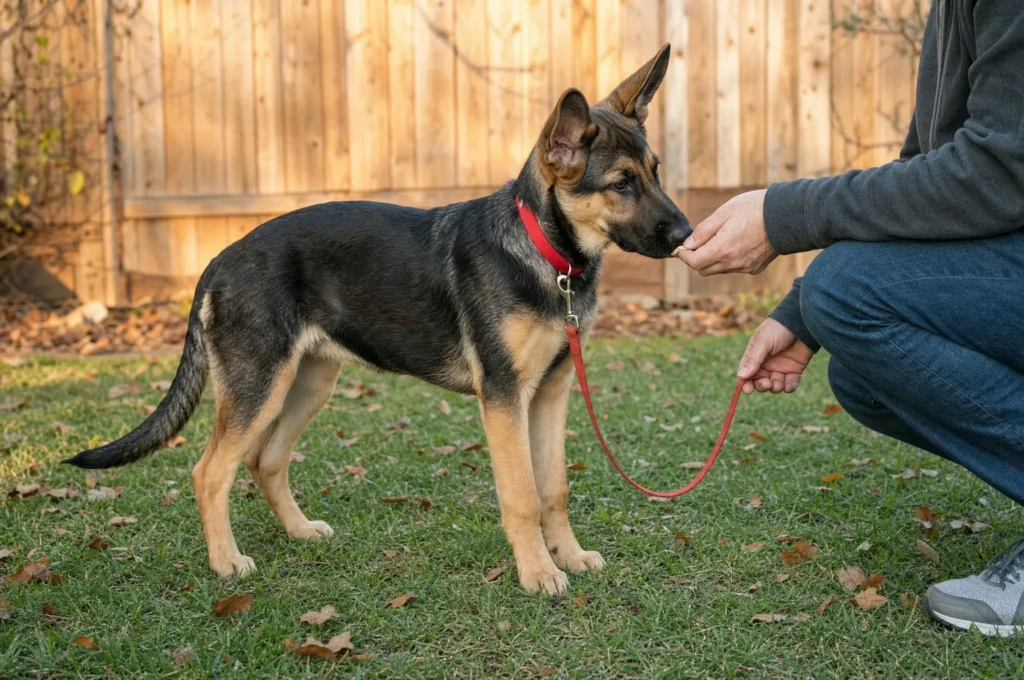
- Keep eyes on her, or keep her small. Tether her to you on a 6-foot leash (Humane World). When you can’t watch, use a crate or a gated room small enough to rest in.
- Interrupt, never punish. Caught mid-squat? Make a noise that doesn’t scare her, then go straight outside. Punishment can teach her to go only when you’re not looking.
- Clean every spot with an enzyme cleaner. Dogs find their bathroom by smell. Our enzyme cleaner for dog urine guide shows how.
- Widen her world slowly. Many owners open up the house too quickly, and accidents can follow (AKC).
“Go outside more than most books suggest.”
Patricia McConnell, PhD, applied animal behaviorist
Those first days are tiring. McConnell took her Cavalier out about every ten minutes at first, and it didn’t take long. A few tiring days beat weeks more of scrubbing the same rug.
So ask about potty habits, ideally before she comes home. Where did she go, on what surface, and how often? To some dogs, gravel, grass and dirt aren’t the same thing (McConnell).
How to potty train a rescue dog in the first days
Soiling the crate itself? Dr. Mary Burch of the AKC says it often shows up in rescued dogs who spent long stretches confined. She suggests frequent trips outside, a regular feeding schedule and help when you’re away for long. Puppy mill dogs who weren’t allowed outside as puppies may need more potty breaks. Our crate training a puppy guide shows how to introduce a crate slowly.
Tip: If she shuts down when you cheer, go quiet. Exuberant praise might stress your dog (McConnell). A calm “good” and a piece of chicken may land better.
Frequent trips and a regular schedule only hold if everyone at home runs them the same way.
How often should a 4, 5, 6 or 7 month old puppy go outside?
Age alone cannot tell you how long your puppy can comfortably wait. Training history, drinking, activity and health matter.
| Situation | Next step |
|---|---|
| Just woke, ate or played | Offer a toilet trip promptly. |
| Sniffing, circling or heading toward the door | Go outside now, even if a reminder is not due. |
| Accidents between planned trips | Shorten the interval and record the pattern. |
| New urgency, pain or a sudden change | Contact your vet rather than extending the interval. |
PAWS recommends a consistent routine, close supervision and immediate outdoor rewards. Start with frequent opportunities and adjust to your puppy.
Our free Potty Break Timer offers reminders, not a measurement of bladder capacity. See the puppy potty training schedule for the daily routine.
How long does it take to house train an older dog?
Anywhere from days to months. Some puppies build reliable habits within days. Others may need several months, especially after inconsistent routines (AKC). Humane World puts a typical puppy at 4 to 6 months, varying with size, age and past habits.
A 6-month-old from a kennel is starting late, and that’s fine. Slips can be short. When McConnell’s Cavalier went back to peeing on concrete, treats fixed it in two weeks.
Bringing home an 8-week-old instead? Our how to potty train a puppy guide covers the full method from day one.
Tip: Write down every trip and every accident for a week, with the time. A pattern you can’t feel day to day often shows up on paper.
Can an older dog learn to go outside after pads?
Yes, with a plan. “You’re reinforcing two different options for the puppy,” Dr. Burch says of pads. Indoor training can also make outdoor training take longer (Humane World).
Move the pads closer and closer to the door, then outdoors (Wisconsin Humane). Our puppy pad training guide and our guide to training a puppy to pee outside cover the move.
If she’s between 4 and 6 months, a few other changes land at the same time.
What slows house training an older dog?
- Trips spaced too far apart. McConnell calls once an hour far too long between trips for a new dog.
- Punishing old accidents. If you find it later, it’s too late to correct. Rubbing her nose in it only makes her afraid of you (Wisconsin Humane).
- Praise mid-stream. Wait until she finishes, or the praise can distract her (Wisconsin Humane).
- Only one surface. A dog who knows one surface can struggle elsewhere, so practice on a few (Wisconsin Humane).
Every 15 minutes or every 2 hours? Where advice splits
Humane World’s guide sets trips at least every two hours. McConnell goes far more often with a new rescue. Both can be right. For a dog who has peed indoors for years, start with McConnell’s short gaps for the first days. For your own older puppy who half knows the rule, use the triggers and keep the two-hour ceiling.
When should you call the vet or a trainer?
- Before you start. Miller calls a vet’s clean bill of health critically important for success.
- No progress despite steady training. Get a veterinary evaluation, then an experienced trainer or behaviorist (AKC).
- Signs of stress. Anxiety can cause accidents and very loose stools. Look for a qualified force-free behavior professional (Whole Dog Journal).
- She was trained and suddenly isn’t. That’s a different problem. Our guide to stopping a puppy peeing in the house covers it.
If the vet rules out a medical cause, start with one change, not five.
House training an older puppy FAQ
Is it too late to potty train an older dog?
No. Starting right away helps a dog of any age learn where to go (AKC). Use the same steps you’d use with a young puppy.
Should a male who lifts his leg indoors wear a diaper while he learns?
It can help. McConnell’s rescue Skip lifted his leg faster than she could interrupt him. She found a diaper worked wonders. Keep the outdoor trips and rewards going alongside it.
Does my rescue dog have to use a crate?
No. Many rescued dogs have never been in one. McConnell uses an easy-to-clean exercise pen or small room while she eases them into a crate slowly.
About this guide: Sources are linked beside the advice and listed below. This is educational guidance, not an individual assessment or a hands-on product test.
Sources
- Patricia McConnell, PhD: Way to Go! Housetraining Rescued Dogs
- Whole Dog Journal: How to Housetrain an Adult Dog, by Pat Miller, CBCC-KA, CPDT-KA
- American Kennel Club: How to Potty Train a Puppy, with Mary Burch, PhD, plus My Dog Pees in Her Crate
- Humane World for Animals: How to Potty Train Your Dog or Puppy, plus its crate training guide
- Wisconsin Humane Society: Housetraining for Puppies