

Short answer: Labrador puppy training works best built around three Lab traits. She has a retriever’s mouth, a big appetite and big energy.
Give her mouth a job, keep food out of reach and pay her with her meals. Keep exercise short. Start lessons at home now, and a class at about four months.
Your sock is in her mouth again. Then on walks she tows you toward every wrapper. Tonight her teeth found your son’s sleeve.
Wait it out, and those habits move into a much bigger body. A Lab without enough exercise is likely to turn hyperactive or destructive, the AKC warns.
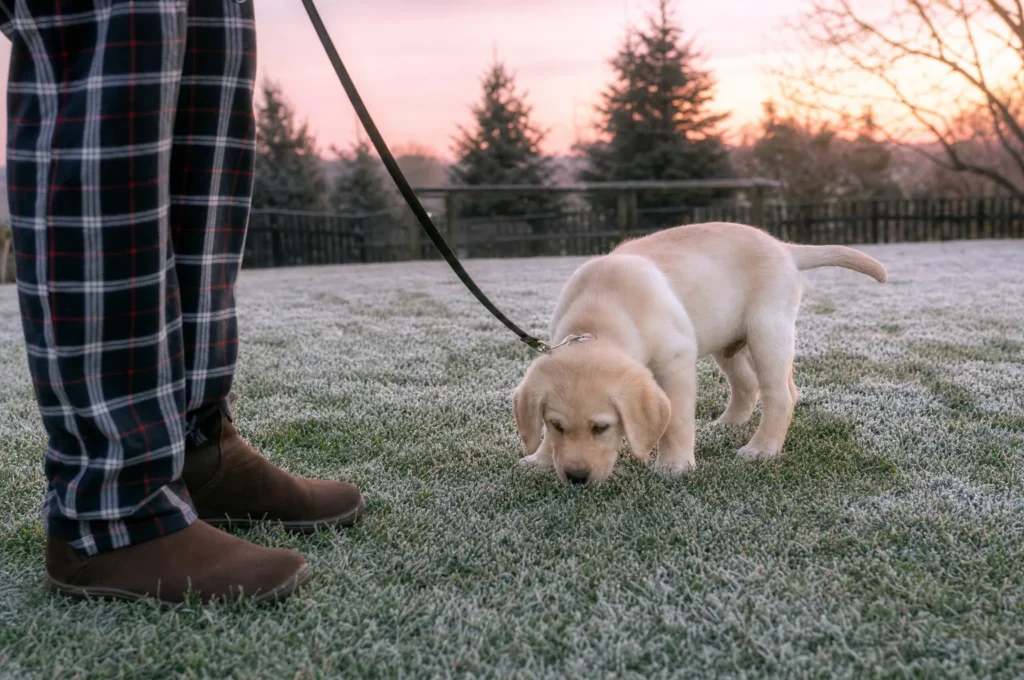
What makes Labrador puppy training different?
Labrador puppy training starts with her mouth. The AKC credits Labs with a keen retrieving instinct. So a Lab carrying off your shoes is doing what she was bred for. Good Labrador retriever training gives that instinct a job. Golden retriever puppy training works with the same retrieving drive.
| Lab trait | Train for it this way |
|---|---|
| Bred to retrieve | A toy of her own to carry and trade |
| Highly food motivated | Clear counters, and pay her with part of each meal |
| Very energetic | Daily play, brain games and real naps |
| Big, fast-growing body | Loose leash skills early, short walks, no jogging yet |
Sources: AKC; University of Cambridge. Full list at the end.
When should you start Labrador puppy training?
Two Lab breeders the AKC interviewed split on this. Betty Barkley says Labs can start basic obedience as soon as they’re home. However, Cathy Straub Benedict lets a puppy be a puppy for six months.
If you’re wondering how to train a Labrador puppy this young, use both. Start gentle basics now: her name, sit, potty trips and a leash. Then save classes for about four months, after her shots.
Socialization can’t wait. The AKC names 7 weeks to 4 months for gently meeting many people, places and situations.
Source: AKC Lab puppy timeline, from two Lab breeders.
How do you potty train a Labrador puppy?
First, take her out after she wakes, eats, drinks or plays. The AKC gives two numbers. About 1 hour per month of age is a normal stretch. Her age in months plus one is the outer limit. So a 10 week old Lab can hold it about 2.5 hours, and 3.5 at most.
Our guide to potty training a Lab puppy has the six steps.
We sell the First 14 Days Kit and the 3 to 6 Month Puppy Plan.
Why does my Lab eat everything?
In fact, part of it may be in her genes, which matters for Labrador puppy training. About a quarter of Labradors carry a POMC gene mutation, Cambridge researchers report. As a result, those dogs get hungrier and burn around 25% less energy at rest.
“It’s very difficult to keep these dogs slim, but it can be done.”
Dr. Eleanor Raffan, Cambridge physiology researcher who led the study
Too many treats can cause obesity, the AKC cautions. So pay her from her measured meals.
Dog counter surfing: stop the first win
Counter surfing is self-rewarding. If she never finds food up there, she’ll stop looking there, writes trainer Stephanie Gibeault, MSc, CPDT.
- Store food away and cook back from the edge.
- Give her a place while you cook: behind a gate with a food toy.
- Skip the scolding. After all, punishment can raise anxiety or make dogs sneaky.
A story from Michael Northcutt, our founder: I turned to rinse my hands. When I turned back, our puppy’s front paws were on the counter. Meanwhile, her nose was two inches from a raw chicken breast.
I yelled. She dropped down. A chef’s knife was on that board too.
Every adult in our house handled it differently. One pushed her down. One said “off” while laughing. A third snuck her cheese while cooking.
So the kitchen got a baby gate. When the stove was on, she was on her mat beyond it, with a chew. A sticky note on the hood said: “Gate up? Chew down?”
Also, outside cooking hours, the counters stayed clear. One Sunday someone forgot the gate, and she got a slice of cheese. Still, that was one slip in a week, not ten a day.
When the whole family keeps the same rules, training is more likely to stick, Gibeault writes.
Dog ate a sock? Call your vet now
Some swallowed things pass. Others block the gut, and surgery is the only treatment once an obstruction occurs, VCA’s vets write.
So if she swallowed a sock, a toy piece or stuffing, call your vet now. Signs VCA lists include vomiting, belly pain, poor appetite and straining to poop. Our chewing guide covers the next steps.
Why is my Lab puppy so mouthy?
Mouthing is part of Labrador puppy training too. It’s just as big a part of pitbull puppy training. The first goal is teaching her that people have very sensitive skin, the ASPCA says.
- Yelp and go limp when she bites hard. No more than three times in 15 minutes.
- Then a time-out. If yelping doesn’t work, painful play ends and gentle play continues.
- Redirect her to a tug toy from your pocket.
- Never slap or hit. It can make puppies bite harder, or fear you.
When kids play, keep an adult in the room. Give each child a tug toy to offer instead of a sleeve.
Her baby teeth fall out around four to five months, Barkley says. For puppies past 16 weeks, our 3 to 6 Month Puppy Plan has a teething guide and mouth check.
How do you stop a Lab puppy pulling on the leash?
Like the rest of Labrador puppy training, leash walking is a trained skill, and it can start before her first walk.
Loose leash walking: Labrador puppy training step by step
- Gear: for large puppies, trainer Michele Miller, CPDT-KA, suggests a front-clip harness.
- Teach the lookback. When she hits the end of the leash, say her name. Reward her when she comes back.
If she bites the leash, say “drop,” reward the release, then keep it loose with less slack.
How much exercise does a Lab puppy need while she grows?
A puppy’s body is still building. Barkley suggests about five minutes of activity per month of age. So at four months, that’s about 20 minutes. The chart above shows the AKC’s stairs, walk and jogging limits.
Fill the rest with short training, food puzzles and fetch, then naps. Our puppy schedule also shows where naps fit by age.
Tip: A big dog’s growth plates may not close until 18 months or older, Barkley notes. Also, ask your vet about spay or neuter timing.
When should you call a vet or a trainer?
- Call your vet if she collapses or seems weak after hard exercise. The AKC notes exercise induced collapse in some young adult Labs.
- Call a qualified pro, a behaviorist first, the ASPCA says, if she bites from fear or frustration.
Labrador puppy training FAQ
Are Labrador puppies easy to train?
Barkley told the AKC that Labs love to please and learn quickly. Keep lessons short and the rules the same for everyone.
When do Labrador puppies stop biting?
No source we read gives one age. The ASPCA’s goal is no mouthing on people at all. It warns that frustration biting isn’t simply outgrown, so get help early.
When do Labs calm down?
Don’t plan on a calm-down birthday. PetMD says Labs remain highly energetic throughout most of their lives. A grown Lab generally needs at least an hour of exercise a day.
Where this guide comes from: This October we read the sources below and Lab owners’ threads. Nobody at LoveMyPuppy is a veterinarian. If her eating, belly or energy seems off, call your vet.
Sources
- AKC: Labrador Retriever Puppy Milestone Timeline, by Mary Kearl, plus the Labrador Retriever breed page and How to Teach a Puppy to Walk on a Leash, How to Get Your Dog to Stop Counter-Surfing, How to Potty Train a Puppy and My Dog Pees in Her Crate
- University of Cambridge: Labradors Hard-Wired for Obesity
- ASPCA: Mouthing, Nipping and Biting in Puppies
- VCA Animal Hospitals: Ingestion of Foreign Bodies in Dogs, by Ryan Llera, DVM, and colleagues
- PetMD: Labrador Retriever Dog Breed Health and Care, by Michelle Diener, DVM