
Short answer: Puppy chewing is normal. Puppies explore with their mouths, and dogs 3 to 6 months of age also chew from teething. The worst of it usually eases by about six months, when teething winds down.
Until then, put tempting things out of reach. Also, watch her, or confine her with her own chews. When she grabs the wrong thing, trade it for a chew and praise her.
A wet sneaker by the door. Fresh grooves in the chair leg. A phone charger bitten clean through, ten minutes after you looked away.
Leave it alone, and she keeps practicing on your things. Swallowed clothing, sticks and rocks can block the gut, and with a blockage time is critical.
Why do puppies chew everything?
A puppy learns her world with her mouth. So destructive chewing is that normal urge landing on your things.
VCA’s veterinary behaviorists list several motives, and each one needs a different first step. Some dogs even learn that chewing gets attention, a scolding included.
| What you see | Likely reason | First step |
|---|---|---|
| Chewing all kinds of household things | Play and investigation, maybe teething | Clear the floor, watch her, trade for a chew |
| Drooling or little spots of blood on her toys | Teething | Teething chews; call your vet if anything looks unusual |
| Chewing the crate door or a doorway | Trying to escape confinement, or anxiety | Help her feel safe there first |
| Chewing when alone, plus whining, barking, pacing or accidents | Possible separation anxiety | Talk to your vet or a trainer |
| Chewing or licking her own paws hard | Possible itch, allergy, pain or injury | A vet check; see the paw section |
Sources: listed at the end.
We sell the 3 to 6 Month Puppy Plan and the First 14 Days Kit, both linked below. The Puppy Week Check-In and Food Checker we link are free.
How do you stop puppy chewing, step by step?
1. Puppy-proof at her height
Put valuables away until the chewing is under control. Shoes, clothing and books go out of her reach. Remotes, phones, glasses and pillows tempt puppies too. Keep tampons and pads in a closed container, since they can expand inside her gut.
2. Watch her, or confine her with her own chews
In fact, she needs supervision at all times to learn which things are hers. When you can’t watch, use a crate or a small dog-proof room behind a baby gate. Our crate training guide covers making that space feel safe.
3. Trade the wrong thing for the right one
When you catch her with a shoe, say “Uh-oh,” take it, and hand her a chew toy. Then praise her the moment she takes it. Cheerful redirecting to her own toys works better than punishment, the AKC’s chewing guide says. Also, skip old shoes as toys. She can’t be expected to learn that some shoes are fine and others aren’t.
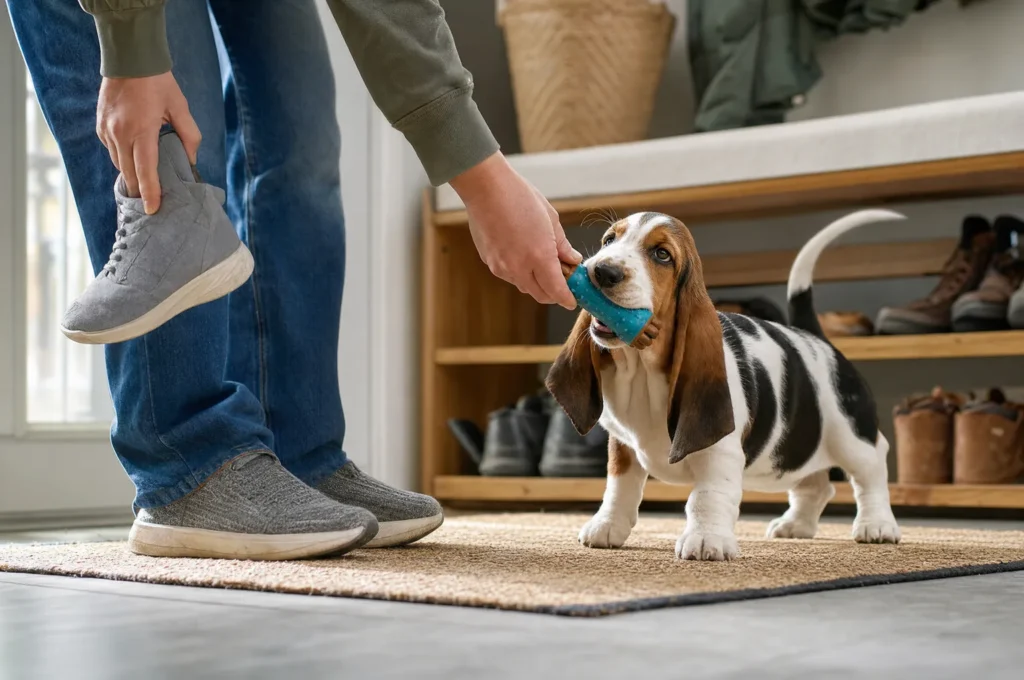
Try toys with different tastes and textures to learn what she likes. Dog puzzles and rubber toys stuffed with food, then frozen, keep her busy longer. For what to give her while she’s teething, see our teething puppy chew toys guide.
Tip: Rotate her toys every couple of days.
4. Never punish after the fact
“You can only correct your dog’s behavior if it is caught in the act.”
Debra Horwitz, DVM, DACVB, and Gary Landsberg, DVM, DACVB, veterinary behaviorists writing for VCA
Of course, coming home to a chewed couch hurts. Feeling fed up with her doesn’t make you a bad owner. Scolding her then only raises her anxiety, though, because she can’t link it to what she did earlier.
Should you say no, or just trade?
VCA allows a verbal reprimand, a shake can or an alarm, in the moment. The ASPCA uses a calm “Uh-oh” and a trade. Both say never punish later. Start with the calm trade, since some puppies get more worked up if you yell (AKC).
What about puppy chewing on wood, baseboards and cords?
VCA’s behaviorists note that wood products attract most dogs. Chair legs, baseboards and door trim can’t move, so make them taste bad. A chewing deterrent such as bitter apple guards them when you can’t watch.
Let her taste a little on a tissue first. Then spray it on everything you don’t want chewed, and reapply it every day for two to four weeks. A spray alone isn’t enough, so keep trading.
Cords, however, need more than a spray. Unplug them, move them out of reach, or run them through cord concealers. Otherwise, a chewed cord can cause mouth burns or an electrical shock.
Shredded pee pads are another common target. Our puppy pad training guide covers pad holders. If she swallows pad pieces, take the pads away and call your vet.
A story from Michael Northcutt, our founder: The TV remote went missing on a Sunday. I found it on Wednesday, under the couch, with three buttons chewed clean off.
I’d blamed everyone in the house at first. Turns out the thief had four paws and was very proud of herself.
So I got down on my hands and knees and looked at the living room from puppy height. Phone chargers hung down like vines. Shoes sat by the door. A remote sat on the edge of the coffee table, right at nose level.
We made a basket for remotes, chargers, glasses and anything small, and it went up high. Shoes went in the closet, too. I taped a checklist inside a cabinet door: “Floor sweep before puppy time.”
She still finds things. Puppies always do. But it’s a lot less often now, and the remote has buttons again.
Before her next free run of the room, get down to her eye level and clear the floor first.
When do puppies stop chewing everything?
The intense puppy chewing phase usually ends by six months of age. That timing lines up with teething, too.
Baby teeth start falling out at about 3 to 4 months. Her 28 baby teeth make room for 42 adult ones. By about 4 months, most puppies have started growing adult teeth. The back teeth follow between 4 and 7 months. Meanwhile, her gums can be sore, and you may see drooling or little spots of blood on toys.
For sore gums, some people offer ice cubes or a frozen wet washcloth. The ASPCA says that might help numb teething pain.
Sources: AKC; VCA teething and chewing pages. Teething chewing runs about 3 to 6 months, back teeth up to 7.
From 3 months to 6 is about 13 weeks to plan around. Adult dogs still like to chew, so keep her own chews coming.
Is puppy chewing at 6 to 12 months still normal?
Some pups keep chewing for several months after their adult teeth grow in. With enough daily play, exercise and the right outlets, puppy chewing may decrease in time.
However, in older dogs, chewing everything could have a completely different cause, the AKC cautions.
Those 13 weeks go easier when everyone in the house follows the same plan.
Why is my puppy chewing on the leash?
Leash biting is a phase many puppies go through and usually grow out of, writes trainer Sassafras Patterdale, CPDT-KA. Boredom, frustration in a busy place, or not knowing what a leash means can set it off.
- Give her mouth a job. Let her carry a ball or toy on the walk.
- Keep the leash loose and behind her. Don’t dangle it in front of her like a toy.
- Let her sniff. Sniffing is rewarding and calming for dogs.
- Reward walking nicely instead of punishing the tugging.
Is puppy chewing from boredom, anxiety or a missed nap?
Too little exercise and mental work can push a dog toward destructive fun. VCA’s answer to boredom chewing is a predictable daily routine with play, training, exercise and potty breaks. In between, she naps in her bed or crate, or gets a chew toy. For mental work at mealtime, our snuffle mat for dogs guide covers the tested pick and how to use one safely.
On busy days, serve some meals inside food toys so she works for them. Before you leave her, give her a good play session first. Our puppy schedule shows where naps fit by age.
Chewing mostly while you’re gone, plus whining, barking, pacing or accidents, can point to separation anxiety. Also, a camera while you’re out can help show it. Bring what you see to your vet or a trainer. If it happens in the crate, read our guide to dog anxiety in the crate.
Tip: Keep a short chewing diary for a few days. Note when and where she chewed, and what happened just before. VCA calls it one of the best ways to find the motive.
For one practical next step for your house, try our free Puppy Week Check-In. It asks six questions once she’s home, and no email is needed.
VCA’s routine puts naps between the busy times. For a puppy under 16 weeks, the kit below puts those naps on paper.
Should puppy chewing on paws mean a vet check?
Occasional paw licking is normal. Aggressive licking or chewing could mean pain or injury, notes PetMD’s vet-reviewed guide. So work with your vet to find the cause, which may be one of these.
- Stings, cuts, broken or ingrown nails, or dry, cracked paw pads
- Allergies to food, seasonal triggers or household products
- Fleas and ticks
- Habit, boredom, stress or anxiety
Dr. Valentina Henao, medical director of an emergency vet clinic, gives the urgent signs. See a vet as soon as possible for bleeding, swelling, limping, pus, or crying out when the paw is touched. Our puppy chewing paws guide covers the common causes and when to call the vet. Left untreated, licking can lead to a painful paw infection.
What if she swallowed something she chewed?
Dogs are notorious for swallowing paper, tissues, clothing, sticks, bones, food wrappers and rocks. Signs can include vomiting, diarrhea, belly pain, poor appetite, straining to poop or low energy (VCA).
If you think she swallowed a piece, call your vet or a 24/7 poison line now. Don’t make her vomit unless a vet tells you to. Socks, toy pieces, string and stuffing can also block the gut. If she’s tearing into her bed, see our guide to chew-proof dog beds. Type a sock into our free Food Checker and it shows one line: “That’s not a food, so call now.”
Tip: Check her toys often. She shouldn’t be able to chew off chunks or pull out fiber or stuffing.
Puppy chewing FAQ
Is it normal for a puppy to chew sticks and rocks?
Many puppies chew sticks, but sticks can be hazardous, the AKC says. Rocks and sticks are also on VCA’s list of things dogs swallow. Trade them for her own chew.
Is chewing the same as nipping my hands?
They’re related, since teething can increase both chewing and mouthing. Teach her that human skin is not a chew toy. Redirect her bites to approved toys and reward gentle play (AKC).
Do chewing deterrent sprays work?
They can help when you can’t supervise, and most dogs learn to avoid the taste after a few tries. Many dogs need to be taught to dislike it first. A deterrent alone isn’t enough, so keep offering her own chews (ASPCA).
Why is my puppy chewing on her crate?
Chewing at the door of a crate can be an attempt to escape, or an outlet for anxiety, VCA notes. She needs to feel comfortable and secure in there first. For a chewed crate pad, our chew proof crate pad guide covers sturdier options.
Can I leave my puppy alone with a chew?
Supervise edible chews. Dogs can choke when they bite off and swallow large hunks, the ASPCA warns. Keep her apart from other dogs while she chews, and skip cooked bones.
How we made this guide: In October 2026 we read the VCA, AKC, ASPCA and PetMD pages listed below. Nobody at LoveMyPuppy is a veterinarian. Ask your vet about anything that worries you.
Sources
- VCA Animal Hospitals: Dogs and Destructive Chewing, by Debra Horwitz, DVM, DACVB, and Gary Landsberg, DVM, DACVB, plus Gastrointestinal Foreign Bodies in Dogs and Puppy Teething Toys
- American Kennel Club: Puppy Teething and Nipping: A Survival Guide, plus How to Stop Your Dog From Chewing Everything You Own, by Hilarie Erb, Puppy-Proofing Your Home and Yard, by Harriet Meyers and Solutions for Dogs That Tug on Leashes, by Sassafras Patterdale, CPDT-KA, CTDI
- ASPCA: Destructive Chewing
- PetMD: Why Do Dogs Lick and Chew Their Paws?, by Janelle Leeson, reviewed by Barri J. Morrison, DVM