

Short answer: Puppy chewing paws now and then, like brief licking after a walk, is usually grooming. Licking or chewing that is frequent, intense, or won’t stop when you call her means something is wrong. It could be an injury, an itch from allergies or fleas, an infection, pain, or stress.
Look at the paw first. See your vet as soon as possible for bleeding, swelling, limping, pus, or crying out when you touch it.
That wet licking sound again. She’s working at one front paw, and the fur between her toes has turned a rusty brown. You wonder if she’s just cleaning, or if something hurts.
Left alone, the moisture from constant licking can bring on a secondary bacterial or yeast infection. That then means more itching, redness, swelling and licking. Vets call inflamed paws pododermatitis.
No affiliate links. We sell the First 14 Days Kit, linked below, and link our free Puppy Week Check-In.
Is puppy chewing paws normal?
Tonight you only need to know which signs can wait for a regular visit, and which can’t.
Some licking is normal. So why do dogs lick their paws when nothing is wrong? They do it to explore, to self-soothe, or to clean off muck after a walk. In fact, most often it’s nothing to worry about.
“Occasional paw licking is normal for dogs as a part of their self-grooming process.”
Dr. Jerry Klein, DVM, chief veterinarian of the American Kennel Club
The line gets crossed when it’s frequent and intense. For instance, a simple test is to call her name or offer a favorite toy. So a puppy who won’t stop for either is licking excessively.
Teething can increase chewing, and puppies explore their world with their mouths. None of the vet pages we read lists teething as a cause of red, swollen or sore paws, though. So a red, swollen or sore paw still needs your vet.
| What you see | What it may mean | What to do |
|---|---|---|
| A quick lick after a walk, then she stops | Normal grooming | Wipe her paws when you come in |
| Sudden licking at one paw | An injury, or something stuck between the pads | Look at that paw now |
| Itchy tops of the paws, reddish brown fur stains | Possible allergy | Book a vet visit |
| Red, swollen paws, hair loss or pus | Possible infection | See your vet as soon as possible |
| Limping, bleeding, or crying out when touched | Pain or injury | See your vet as soon as possible |
| Licking when bored or alone, and the vet found nothing | Boredom, stress or habit | More play and puzzle toys; ask about a behaviorist |
Sources: AKC, VCA and PetMD pages listed at the end.
What if she pulls her paw away from you?
A story from Michael Northcutt, our founder: Nell pulled her paw away every time we reached for it. My first move was a quick-fix product, and it went back.
This time we changed the order. First we checked for pain. Only then did we practice handling her paws.
I kept a short paw log, and our notes went to the vet. The log helped us see what was changing. It did not diagnose Nell.
Within a week, everyone who looked after her was following the same plan: pain check first, gentle handling second.
Copy Nell’s order with your own puppy. Rule out pain first, then practice handling.
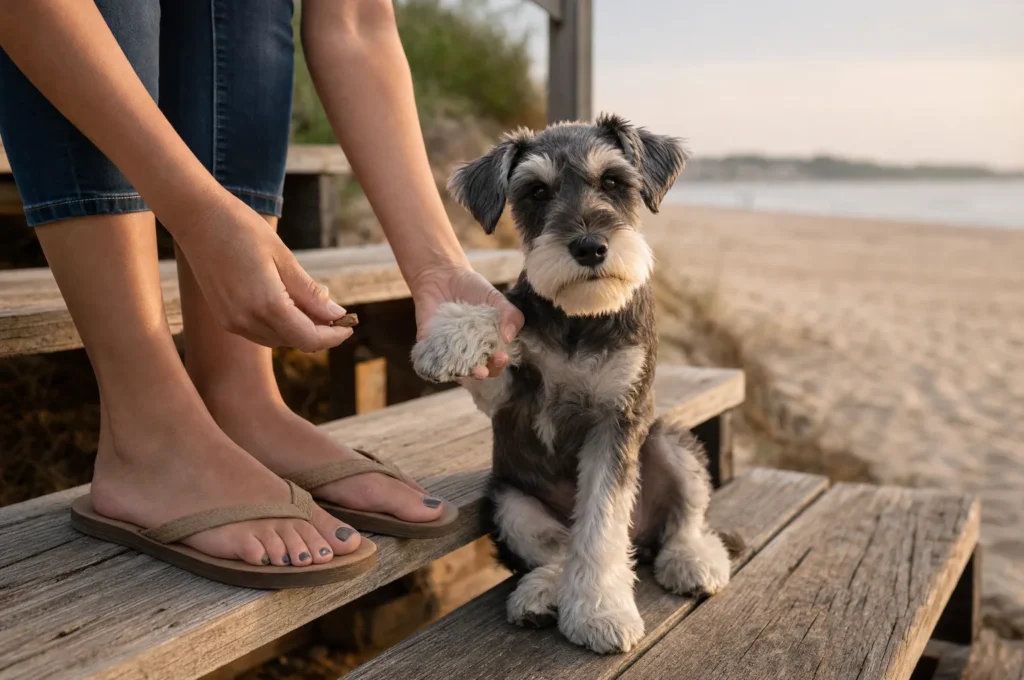
How do you check a puppy’s paw?
Pick a calm moment, like after a walk, and good light. Then look at each part in turn, the way the AKC’s chief veterinarian describes:
- The nails. Look for a torn nail.
- Between the toes and pads. Check for a cut, a growth, a stone, a thorn or an ice ball.
- The pads. Look for a blister, or irritation from hot or salted sidewalks.
- The tops of the feet. Look for redness, swelling or stained fur.
Ticks can drive puppy chewing paws too. They most often burrow between the toes, under the legs and behind the ears. Also, a flea comb run through her coat can show fleas or the black specks of flea dirt.
If she yelps, pulls hard or won’t let you near one paw, stop. Tell your vet about that reaction before any handling practice.
Tip: Keep a bowl of water and a towel by the door. PDSA vets suggest rinsing paws in cool, plain water after every walk if she’s nibbling excessively.
Check first, or call the vet first?
The two vet sources split here. The PDSA’s vets say the first thing to do is contact your vet. Dr. Klein’s first step is examining the paws, especially when licking starts suddenly at one paw.
Both fit, depending on the situation. Sudden licking at one paw calls for a look now, since it may be a thorn or a cut. Licking that keeps going goes to your vet, as both sources advise. So does anything you find and can’t remove easily.
Why is my puppy chewing her paws? The common causes
Here are the causes our vet sources give for puppy chewing paws, starting with the quickest to check.
Could it be an injury or something stuck?
A sudden start at one paw points here first, so use the check above. Some injuries need simple first aid, while others need a vet. If you think she was stung, look for a stinger, since stingers can cause allergic reactions (PetMD).
Could allergies be behind puppy chewing paws?
Dr. Valentina Henao is a medical director at Veterinary Emergency Group, quoted by PetMD. Her list of allergy triggers includes food, grass and pollen, and household products like laundry detergent. In airborne allergies, the feet are among the most frequently affected areas. The face, ears, front legs and belly are the others. Licking or chewing the paws is one of the signs.
Her age helps narrow it. Airborne allergies generally start between 6 months and 3 years of age, per the Merck Veterinary Manual. A very young puppy is under that range, but flea allergy can begin at any age.
Sources: Merck Veterinary Manual, Allergies in Dogs; VCA, Flea Allergy Dermatitis. Food allergy’s age of onset varies. A puppy under 6 months is younger than the usual start of airborne allergies.
In contrast, food allergy itching changes little from season to season. Only your vet can tell which allergy is behind puppy chewing paws, and the tests take time.
Fleas and other parasites behind puppy chewing paws
Fleas and mange can make paws very itchy. In a flea-allergic dog, a single flea bite can cause itching for several days. You may not see a live flea, because fleas often stay only minutes to hours while they feed. Fleas don’t often live on the feet. A dog who can’t reach the itch may lick her paws instead, the PDSA notes.
Could it be an infection?
Bacteria, yeast and fungus can all inflame the paws. With an infection, the feet are often red and swollen. There may be bumps, sores, pus or hair loss, and the dog may lick constantly (VCA).
Pain somewhere else
Even when the pain sits elsewhere in the body, some dogs keep licking a front paw. Stiff, sore joints can do it too. This needs a vet’s diagnosis.
Boredom, stress or habit
Once your vet has ruled out the problems above, boredom or anxiety may be left. Licking can start with an itch and continue as a habit after the itch is gone (PDSA). A lick granuloma is a sore from obsessive licking. It most often forms at the wrist of a front leg.
For a bored puppy, the AKC suggests more walks and playtime, puzzle toys and safe chew toys. Our puppy schedule shows where play and naps fit by age. If she is chewing your things too, see our puppy chewing guide.
When is puppy chewing paws a reason to see the vet?
Paw licking usually isn’t an emergency. Still, Dr. Henao advises seeing your vet as soon as possible for any of these:
- Bleeding from her paw
- A swollen paw
- Limping
- Pus or other discharge
- Whimpering, wincing or crying out when the paw is touched
Book a regular visit when licking or puppy chewing paws keeps going, or you see redness or stained fur. Don’t wait too long. After all, catching it early can lead to a simpler solution.
At the visit, expect questions about her surroundings, diet and travel, and whether signs follow the seasons. VCA’s guide lists skin scrapings and other skin tests. Treatment depends on the cause, so leave medicines and creams to your vet.
Tip: Before the visit, write down when the licking happens and which paw. Also, snap a photo of any redness or staining. Your notes answer the vet’s first questions. Our free itch snapshot keeps a week of itch, paw and food notes in one place for your vet.
Those warning signs only help if everyone in the house knows them, especially at night.
How do you get a puppy used to having her paws touched?
Once your vet rules out pain, teach her that a hand near her paw means good things. Start young if you can. For example, a daily puppy massage doubles as a health check. Gently stroke and squeeze her paws, look at her pads and touch her nails, with praise and an occasional treat.
For a puppy chewing paws, the best time to practice is when she’s calm and tired, like after play or a walk. For a puppy who already pulls away, the AKC lays out slower counter-conditioning steps. Give a treat after each one:
- Reach toward her paw, then take your hand away.
- Touch her paw gently and briefly.
- Then touch it for one second.
- Touch it for several seconds.
- Gently squeeze her paw.
- Hold her paw, then gently let it go.
That’s six small steps, with a treat at each. In fact, the whole process could take days or even weeks. If she gets uneasy, you moved too fast, so go back a step until she’s calm. If she’s very touch-sensitive, feed her while you touch, then switch to touch first once she relaxes.
Tip: Once she’s relaxed with you, ask other people to practice too. That matters because vets and groomers will handle her paws for life.
If her paw is one worry among several this week, a quick check-in can sort out what to do next.
Puppy paw licking FAQ
Is a dog licking paws different from a puppy doing it?
Some causes are more likely with age. Airborne allergies generally begin between 6 months and 3 years, Merck notes. Arthritis is common in older dogs and can affect the toes (PetMD).
Why does my puppy lick her paws at night?
None of our sources names a night-only cause. Licking can be self-soothing, and lying down puts the front legs in easy reach (VCA). If night licking keeps her up or the skin changes, tell your vet.
Is it a food allergy?
It can be, but blood and skin tests aren’t reliable for it. Vets diagnose food allergy with a strict diet trial that can run up to 3 months (Merck). Your vet should plan it with you.
Why is my puppy chewing her paws and tail?
Fleas are worth a look. Flea allergy itching can show up anywhere, but most often from the middle of the back to the tail base. It also runs down the rear legs. Ask your vet about flea control.
Do home soaks like vinegar or baking soda help?
None of the vet pages we read recommends vinegar or baking soda. VCA lists foot soaks only among treatments once a vet finds the cause. At home, the advice is plain water and a towel after walks.
Should I put a cone on her?
Ask your vet first. A recovery cone may be part of treating an infection, to keep her from licking and making it worse (PetMD).
How we made this guide: In October 2026 we read paw and skin pages from the five vet sources listed below. Each cause and warning sign here comes from those pages. Nobody at LoveMyPuppy is a veterinarian. Ask your vet about anything that worries you.
Sources
- American Kennel Club: Why Does My Dog Lick Their Paws?, by Jerry Klein, DVM, chief veterinarian, plus Preventing Body Sensitivity, by Stephanie Gibeault and Puppy Teething and Nipping
- VCA Animal Hospitals: Pododermatitis in Dogs, by Tammy Hunter, DVM, and Ernest Ward, DVM, plus Flea Allergy Dermatitis in Dogs and Lick Granuloma in Dogs
- PetMD: Why Do Dogs Lick and Chew Their Paws?, by Janelle Leeson, reviewed by Barri J. Morrison, DVM
- Merck Veterinary Manual: Allergies in Dogs, by Stephen D. White, DVM, DACVD, and Karen A. Moriello, DVM, DACVD
- PDSA: Vet Q&A: Why is my dog biting/licking their paws?, by PDSA Vets