

Short answer: First check for potty, pain, fear or panic. If her needs are met and she is calm, reward a brief quiet pause.
Then notice what starts the bark and teach a calm “quiet” cue. Seek help for sudden changes or distress.
She’s barking right now? Do this first.
- Did she just wake, eat or play? A crate bark can mean she needs to pee or poop, Purina notes. Take her out first.
- Don’t yell. Yelling won’t reduce barking, according to Humane World for Animals.
- Barking at the window? Close the curtains or move her to another room.
- Wait for one second of quiet before you open the crate, the gate or the treat bag.
She barks when you sit down to eat. She barks at the crate door. The doorbell rings, and the whole house shakes.
You’ve tried shushing her. Your partner tried ignoring her. You yelled once, felt awful, and it didn’t help. Now the neighbors have opinions.
Many puppies bark this way. It does not mean you have ruined her. A sudden or intense change still deserves a closer look.
Puppy barking training means teaching a noisy puppy calmer ways to ask, alert and greet. The goal is to decrease, rather than eliminate barking, in the ASPCA’s words. Barking, howling and whining are how dogs talk.
Waiting has a cost, though. Barking she practices while you’re out grows stronger and harder to reduce, the ASPCA warns. The longer barking pays off, the longer it takes to change.
This guide links to our paid printable kit, puppy plan and handheld training aid. The First Check checklist is free.
✓ Built on guidance from the ASPCA, VCA Animal Hospitals’ board-certified behaviorists, Humane World for Animals, Purina and Dogs Trust.
How do you teach a puppy the quiet command?
Pair one calm word with a treat by her nose, then stretch the quiet a few seconds at a time.
What you need
- Tiny, soft, very tasty treats, about the size of a pea
- A mat or bed she can learn to go to
- A chew or puzzle toy for busy moments
- Curtains or window film for the view she guards
- A notes app or paper to track when she barks
These steps blend the ASPCA’s quiet training with advice from the behaviorists at VCA Animal Hospitals.
- Let her bark 3 or 4 times at a real trigger, like a knock.
- Say “quiet” once, clearly and calmly. No shouting.
- Put a treat right by her nose. Dogs can’t sniff and bark at the same time, so most stop to sniff.
- The second she’s quiet, praise her and feed a few small treats.
- Call her away from the door or window and ask for a sit.
- Stretch the wait slowly over many sessions, using the ladder below.
Source: ASPCA, Barking. Each step happens over many repetitions, not in one session.
In one line: reward 2 seconds of quiet first, then build toward 20 and beyond.
You’ll know she’s catching on when she stops as soon as she hears the word. The ASPCA expects that after several days of training or more.
VCA also recommends a speak-first method. You teach “speak” on cue, then “quiet” just before the barking fades. If speak practice brings more barking, drop it and stay with the treat-by-the-nose steps.
No progress after several calm sessions? Make the setup easier and ask a qualified trainer to watch what happens. If she seems frightened, stop the exercise and get help sooner.
Why is my puppy barking? Match the bark first
The fix depends on the reason, so name the bark before you treat it.
Ask the ASPCA’s four questions. When and where does it happen? Who is she barking at? What sets it off? Why is she barking?
| What you see | Likely bark | First move |
|---|---|---|
| Barks at you for food, a toy or play | Attention or demand | Wait for quiet, then reward |
| Every noise or sight, stiff body, small forward pounces | Alarm | Block the view, teach “quiet” |
| People near the house, yard or car | Territorial | Block the view, teach a spot to go |
| Relaxed body, wagging tail, maybe whining | Greeting | Keep greetings low key |
| Can’t reach something she wants, or she’s shut in | Frustration | Open doors only on quiet |
| Only when left alone, plus pacing, chewing or accidents | Separation distress | Short practice absences, get help |
| Barking at something that seems to scare her | Fear | Ease the trigger, get expert help |
| New barking with no clear cause | Pain or illness | Book a vet check |
Types and signs: ASPCA. Fear and pain rows: Dogs Trust and Purina.
Are her needs met?
Stressed dogs bark more, so meet her physical and mental needs first, Dogs Trust advises. A tired dog is less likely to bark from boredom, Humane World says. Bored barkers need more play and toys, Purina adds. Short games, sniffing and chews all count as enrichment.
How to stop puppy barking for attention or at you
Make quiet the only thing that works, then give her a better way to ask.
Demand barking doesn’t happen by accident. Most of the time, owners reward it without meaning to. Eye contact, touching, scolding and talking can all count as a payoff.
VCA’s page comes from board-certified behaviorists Debra Horwitz, DVM, and Gary Landsberg, DVM. They write, “Never reward barking with any type of attention, even occasionally.” Reward calm, quiet moments instead.
Mealtimes are a common trigger, Dogs Trust notes. If barking while you cook gets her food, she’s likely to try it again next time. Pause, ask for a sit, and carry on once she does.
Then give her a polite way to ask. The ASPCA suggests these swaps:
- Wants to go out? Teach her to ring a bell on the door. Our bell training guide walks you through it.
- Wants to play? Teach her to bring a toy and sit in front of you.
- Barks during your calls? Hand her a chew or puzzle toy before she starts.
- Toy stuck under the couch? Block the gap so it can’t happen.
Ignoring takes patience. Barking often gets louder before she gives up, Dogs Trust warns. Ignoring her for ages, then telling her off, teaches her to keep going.
So agree on one answer as a house. Having everyone on the same page can lead to faster results, says Humane World.
Barking and biting during play
Barking and growling can be a normal part of play, often higher pitched, Dogs Trust explains. Trouble starts when barking at you gets a game going. Then she might learn to bark every time she wants to play.
Pause the game the moment she barks or bites. Start again once she’s quiet. Our guide on how to stop puppy biting covers the teeth side.
How do you stop a puppy barking in the crate?
Check for a potty need or distress first. If she is settled, open the door during a quiet moment.
Purina names three common reasons for crate barking: a need to pee or poop, separation anxiety, or boredom. Each needs its own answer.
- She might need out. Take her out to potty, then back to the crate. Not sure? Our free Potty Break Timer gives a rough window for her age and last trip.
- She seems truly anxious. Don’t leave her in there. Make the crate a good place again and build time slowly.
- She’s bored or wants you. Wait until she’s quiet for a few seconds, then go to her.
Once she learns quiet opens the door, vary the wait. Humane World suggests 5 seconds, then 12, then 3, then 20. Exercise and a stuffed puzzle toy before crate time help too.
Is the crate itself new? Start with our crate training guide. If it’s more of a cry than a bark, see puppy whining. For barking after lights out, read dog barking at night.
What if your puppy barks when you leave?
Barking that happens only when she’s alone is a different problem. Build alone time in small steps.
Separation barking shows up only when you’re gone, the ASPCA explains. You’ll usually see another sign too, like pacing, destruction, accidents or low mood.
Coming back only once she’s quiet won’t change how she feels about being left, Dogs Trust says. So don’t just leave her to bark it out.
- Start tiny. Purina suggests leaving for a few minutes, rewarding quiet, then slowly adding time.
- Tire her out first. A walk, a game and a fresh puzzle toy before you go can curb barking, Humane World notes.
- Keep returns calm. Reward her calm when you walk in. Don’t feed a wild, revved-up welcome.
- Get help if it’s panic. Pacing, damage or accidents point to distress. Ask your vet for a referral.
Need a week-by-week version? The 3 to 6 Month Puppy Plan lays out alone-time steps and schedules for 4, 5 and 6 months.
Working all day? Our guide to what to do with a puppy while you’re at work covers pens and day care.
How do you stop barking at the door, the window or in the car?
Take away the view, then teach her a spot to go when the door opens.
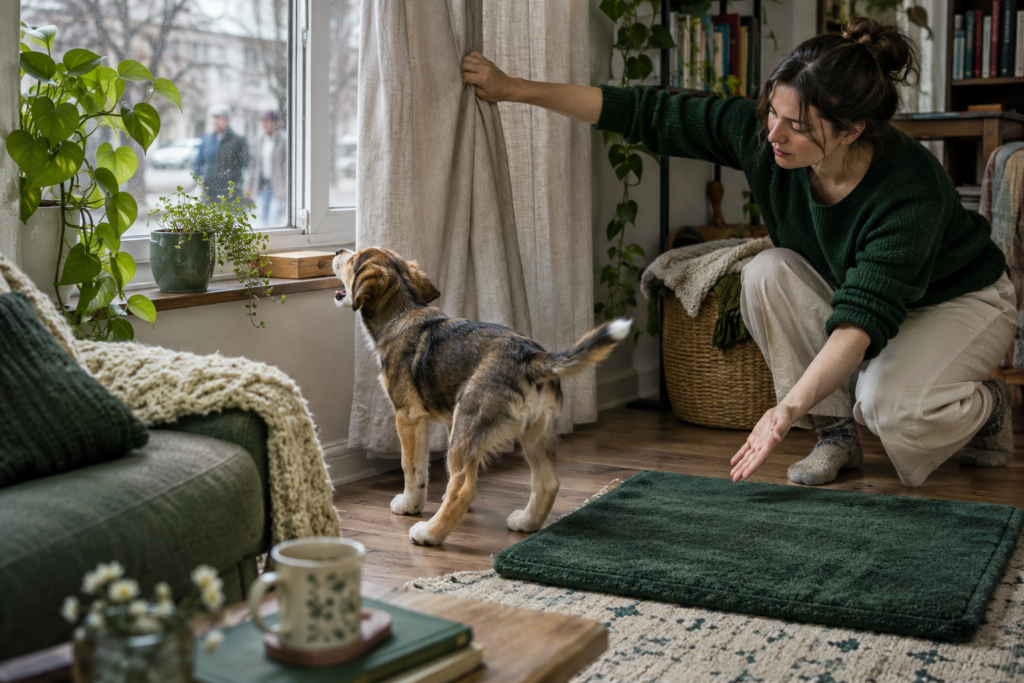
For window guards, try removable plastic film or a spray-on glass coating, as the ASPCA suggests. Closing the curtains works too.
For the door, the ASPCA teaches “go to your spot.” Pick a spot at least eight feet away, if your space allows. Keep it within sight. A mat, a crate or the top of the stairs works.
- Say “go to your spot” and toss a treat onto it. Repeat 10 to 20 times.
- Fake the toss, then reward her when she lands on the spot.
- Add a sit or down there, then a short stay.
- Once she holds a 30-second stay, start stepping toward the door.
- Practice with friends knocking, again and again.
When real guests arrive, wait about a minute before you release her to say hello. A leash helps if she jumps. For the full routine, see puppy barking at visitors.
Dog over 6 months who still barks at every knock? Our handheld deterrent gives a brief cue at the first bark. Then send her to her spot and reward. Click Here To See How It Works →
In the car: a travel crate limits her view and her reason to bark, the ASPCA says. A head halter is another option, but only while you supervise.
On walks, offer soft treats before she starts barking. Our guide to dog barking at other dogs covers the space you’ll need. Can’t see a trigger at all? Try why is my dog barking at nothing.
Living in an apartment, or worried about the neighbors?
Lower the noise she hears, practice with small doses of it, and give the neighbors a heads-up.
Thin walls let in doors, footsteps and other dogs. That’s a lot of triggers for one small puppy.
- Tell the neighbors she’s in training. They’re more likely to be patient while she learns, Dogs Trust says.
- Give her the quietest room. Cover windows and mask outside sounds with a friendly radio, as Purina suggests. Watch how she responds when left alone with it.
- Other dogs barking? Play music to drown them out, and use treats or play when they start. The ASPCA suggests this when she joins in with other dogs.
- Desensitize one sound at a time. Start where she notices it but doesn’t bark, and feed treats. Move closer slowly, Humane World advises.
- Skip a trigger for now. If deliveries set her off, collect your shopping instead, Dogs Trust suggests.
When do puppies start barking, and why is she suddenly barking at everything?
Puppies often find their voice early, but timing varies. Sudden new barking deserves a closer look.
Puppies start to bark at about 8 weeks old. They often start with a little “yip” as they bond with people, Purina says.
Some dogs are more vocal. Research suggests some breeds bark because of old herding and guarding roles, Dogs Trust notes. Personality, health and past experience play a part too.
Suddenly barking at everything? Start with your vet. A sudden change can mean a medical problem, and pain can make some dogs sensitive to sounds, Dogs Trust explains.
If she’s healthy, look at her week. After a stressful day, like a vet visit, expect her to bark at every trigger for 24 to 48 hours. Dogs Trust suggests a quiet route and play at home until she settles. Then match the new bark to the table above.
Should you ignore puppy barking or interrupt it?
It depends on the bark. Here’s a rule you can use.
For calm attention barking, Purina and VCA back ignoring it and rewarding the quiet. Fear, pain, panic and potty needs are the exceptions.
When you interrupt, keep it gentle. Dogs Trust suggests a positive interruption followed by a familiar calm behavior. Fear, pain and panic call for help, not a quiet drill.
Use this rule: calm and asking for something means wait for quiet. Scared, hurting or panicking means help her now. Unsure? Help first, then train later.
Should you use a bark collar on a puppy?
Not as a first step. The ASPCA calls anti-bark collars punishment devices.
Collars aren’t a first choice, especially for barking from fear, anxiety or compulsion, the ASPCA explains. Noise collars are ineffective with most dogs.
Virtually all dogs turn “collar-wise,” quiet with the collar on and barking once it’s off. VCA adds that owner-held devices help most during quiet training. Without retraining, many dogs soon ignore them.
For a puppy under 6 months, stick with management and rewards. Our handheld deterrent’s supplier doesn’t recommend it for younger puppies.
| Tool | When it works | Main limit | Fearful barking |
|---|---|---|---|
| Bark collar | Only while she wears it | Dogs turn “collar-wise” | Not a first choice |
| Handheld device you press | When you use it to interrupt during training | Many dogs ignore it without retraining | Not a fix for fear. Stop if she seems frightened |
| Reward-based quiet training | Builds a cue she understands | Takes several days or more | Never punish fear. Get expert help |
Sources: ASPCA, VCA and our deterrent’s product page.
What are the most common puppy barking training mistakes?
Most setbacks come from mixed signals, and most are easy to fix today.
- Asking “Who’s there?” It encourages barking at passing sounds.
- Mixed rules. Scolding barks at car doors but cheering barks at the doorbell confuses her.
- Going to her to calm her. Attention, play or petting to quiet her can reward the barking.
- Punishing fear barking. It could make her feel worse, and barking might increase.
- Telling her off. Some dogs think you’re joining in. Others may become afraid of you.
- A muzzle to keep her quiet. Never for long periods or unsupervised. A muzzle that holds her mouth shut stops panting.
From the ASPCA’s “What not to do” list, VCA and Dogs Trust.
When should you call a vet or a trainer?
- Barking that starts suddenly, or barking from pain. See your vet to rule out medical causes before training.
- Barking only when she’s alone, with pacing, destruction or accidents. Ask your vet about separation distress.
- Repetitive barking at shadows or light, sometimes with spinning or circling. The ASPCA suggests a veterinary behaviorist.
- Fear or reactive barking. Fear barking needs expert advice, Dogs Trust says. Purina suggests a professional for reactive barking.
- Quiet practice has stalled. Ask a qualified trainer or behaviorist to help identify the cause and adjust the approach.
How can you tell if barking training is helping?
Watch what sets her off, how long she takes to settle, and whether she can return to you.
- She pauses more often after your quiet cue.
- Familiar sounds bring shorter barking bouts.
- She can move to her mat and take a treat.
Progress is uneven. Sudden worsening, fear, or panic calls for a vet or qualified trainer. For a shared daily household plan, see the First 14 Days Kit.
Puppy barking training FAQ
How much barking is normal for a puppy?
A bark or two at something alerting is OK, Purina says. Barking during play is natural too. It becomes a problem when it’s excessive or too loud for your home.
Will my puppy grow out of barking?
No. Barking is normal, and puppies won’t grow out of it, Humane World says. You can still teach other ways to communicate. Starting young helps, Purina adds, because she has had less time to build habits.
How long does puppy barking training take?
Plan on days to weeks. The ASPCA says it takes time and won’t be quick. A long-practiced habit takes longer to change, Humane World adds.
Should I leave the radio or TV on to stop barking?
Purina suggests a friendly radio or TV can mask outside sounds at night. A small study covered in our puppy whining guide found puppies left alone with it on showed more anxiety signs. Watch how yours responds.
Last updated: November 6, 2026. We read page one of Google for this search, the five sources below, and the questions owners post in forums. Nobody at LoveMyPuppy is a veterinarian. This is general education, not an individual veterinary or behavior assessment.