

Short answer: Redirect biting onto a toy, then calmly pause play when teeth touch skin. Keep a toy in reach and offer it before she grabs you.
Everyone in the house uses the same response. When the biting peaks in the evening, try a nap before more play.
Teeth in your arm right now? Do this.
- Stop moving and let your hand go limp. Jerking it away makes her jump forward and grab, the ASPCA says.
- Offer a toy if one is close. If she lets go, praise her.
- Still biting? Stand up, turn away and cross your arms.
- Up a long while? She may just be overtired, the AKC says. Potty trip, then a nap.
Your forearms look like you lost a fight with a rosebush. She grabs your sleeve, then your ankle, then your son’s pant leg. The kids have started climbing onto the couch when she runs in.
By dinner it’s worse. You yelped like a video said, and she bit harder. Your partner says walk away. Now you’re wondering if this is aggression. Maybe you don’t like her much tonight, either.
Puppy mouthing is a puppy using her mouth to play and explore, often on hands, limbs and clothing. Learning how to stop puppy biting comes down to a few calm moves, done the same way by everyone. Left alone, it doesn’t stay cute. The ASPCA notes it’s far less endearing at three or four months, in a bigger puppy. It’s normal, and it’s fixable. And not liking her tonight doesn’t make you a bad owner.
We sell a printable puppy schedule kit and link to it below. Our check-in tool is free.
✓ Built on guidance from the ASPCA, the AKC, Dogs Trust and Elanco.
Why does my puppy keep biting me?
Her mouth is how she plays, explores and handles big feelings. Most of it is normal.
Puppies usually learn to soften their bites playing with other puppies, the ASPCA explains. When a littermate bites too hard, the hurt puppy yelps and the game stops for a moment. She can learn the same thing from you.
- Play. Fast movements and rough games can set off nipping, Dogs Trust says.
- Teething. Baby teeth start falling out around 12 weeks.
- Big excitement. People arriving home or getting ready for a walk can leave her overstimulated, grabbing hands and clothes.
- Too little sleep. Sleep matters as much as exercise. Puppies need 18 to 20 hours a day, and short on sleep, they often mouth more.
“Play biting does not mean your puppy is vicious.”
Dr. Jerry Klein, Chief Veterinarian for the American Kennel Club
How do you stop a puppy from biting?
Keep toys within reach and make the response to teeth on skin calm and consistent.
1. Redirect her onto a toy
Keep a suitable toy nearby before play begins. Offer it before she grabs your hands or clothing.
Praise gentle play with the toy. Avoid deliberately encouraging her to mouth your hands.
Dogs Trust recommends redirecting mouthing onto suitable toys. Supervise children and separate them from an excited, nipping puppy.
2. Briefly pause play when teeth touch skin
Keep your response calm. Stop the game and step behind a gate if she keeps grabbing you.
Return when she settles, then offer the toy again. If yelping excites her, skip it.
Check whether she needs a toilet trip, food or rest. Do not punish, pin or frighten her.
3. Give her mouth a better job
Keep a chew toy at hand at all times, the AKC says. Redirect her to it before teeth reach skin.
Dogs Trust’s signs that play is coming are bouncing, pouncing, batting with her paws, or a jump in energy.
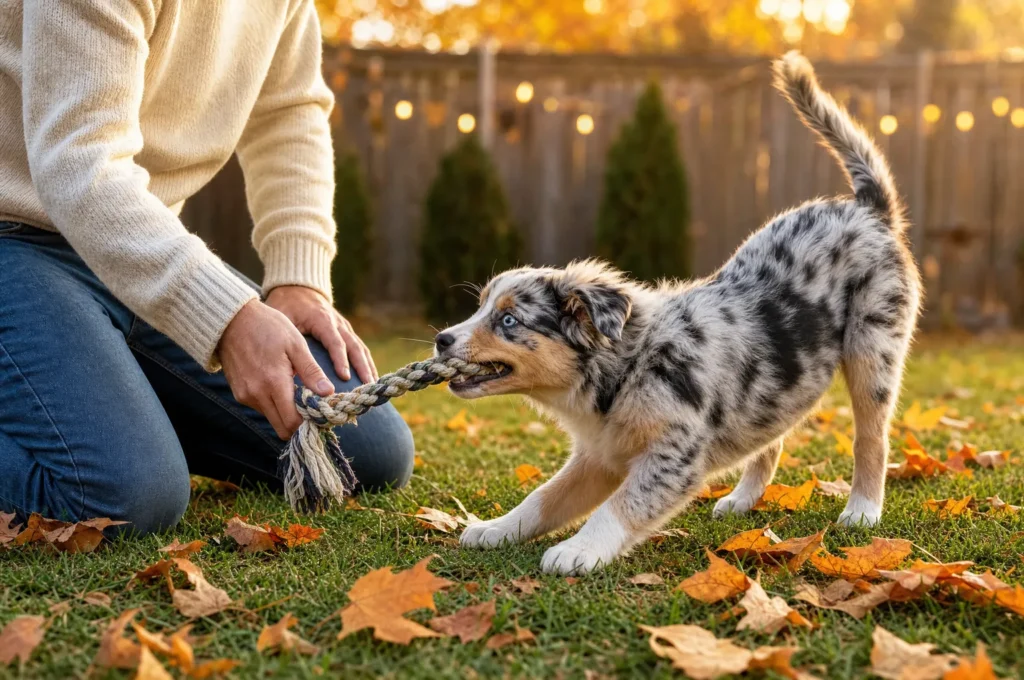
Fetch and tug-of-war beat wrestling and rough play with your hands, the ASPCA says.
4. Reward the calm moments
When she’s calm and quiet, say “good dog” or hand her a piece of kibble. The AKC calls this positive reinforcement. If she knows “sit,” ask for one and reward it with a toy.
5. Cover sleep, potty and energy
Sometimes a biting puppy needs a nap, a potty break, food or water. Still biting after several toy swaps? Take her outside and let her run. After big excitement, Dogs Trust suggests calm enrichment, like a stuffed feeder or a licking mat.
Tip: Rotate three or four toys, so each one feels new when it comes back out.
How do you stop puppy nipping at hands, feet and clothes?
Wherever she grabs, freeze, offer a toy, and reward the gentle moment.
Puppy biting hands when you pet her
Puppies often mouth hands when petted, the ASPCA says. Feed small treats from your other hand while you pet her. Don’t wave your fingers in her face to start a game. That invites more biting.
Puppy biting feet and ankles
Carry a tug toy in your pocket. When she ambushes your feet, stop and wave the toy. Walk again once she grabs it. No toy? Freeze, then praise her the second she stops.
Dog trainer Kathy Santo, writing for the AKC, suggests holding a high-value treat by your leg as you walk. Herding breeds like collies and Shetland sheepdogs may nip ankles to keep the herd moving, Elanco notes, so stand still.
My puppy won’t stop biting me and my clothes
Grabbing sleeves and pant legs is often overexcitement, Dogs Trust says. If she follows you and keeps mouthing your clothes, step behind a door or baby gate.
| Where she bites | Your first move | From |
|---|---|---|
| Hands while you pet her | Small treats from your other hand | ASPCA |
| Feet and ankles as you walk | Stop, then wave a tug toy | ASPCA |
| Sleeves and pant legs | Stay still, then step behind a gate | Dogs Trust |
| The leash, getting ready for a walk | Give her a toy before the excitement starts | Dogs Trust |
| Kids’ ankles in the yard | Kids stop and stand still | ASPCA, Elanco |
| The crate bars | See our crate training FAQ | LoveMyPuppy |
Kids scared of her? Teach them the ankle rule from the table. Rubber boots protect small ankles while you redirect her to a toy. Dogs Trust says to always supervise kids with her, and ask them not to run past her. If she keeps targeting one family member, keep them apart for now while you work on it.
Why does my puppy go crazy biting in the evening?
Owners call it the witching hour, or the bitey hour. A tired, overstimulated puppy often looks like a wild one.
Dogs Trust says overtired puppies often show extra energy, like zoomies, wanting to play, and mouthing. If she’s been fed, been to the toilet and had a full day, she’s probably overtired.
Not every puppy drops off that fast. Start with the quiet setup, and give it a few evenings.
A sample bitey-hour loop
- Spot the signs: zoomies, sleeve grabbing, begging for more play.
- End the game calmly. No scolding.
- Potty trip, and water if she’s thirsty.
- Into her crate or pen with a chew, somewhere quiet.
- When she wakes, potty first. Then a toy game with no hands involved.
Biting worst in the evenings? Our free Puppy Week Check‑In asks six quick questions once she’s home. Biting or restless evenings is one of the worries you can pick. You get one practical next step, and no email is needed.
Keep crate time-outs calm, so she never links the crate with punishment, the AKC says. Our crate training guide helps her like it. Naps get their own puppy sleep schedule guide.
Should you yelp when your puppy bites, or walk away?
If yelping excites your puppy, stop using it. Keep your response calm and predictable.
Battersea recommends calm responses and avoiding sudden movements. Offer a suitable toy and briefly pause interaction when teeth touch skin.
Everyone should use the same approach. If biting frightens you or keeps worsening, get qualified help.
What mistakes make puppy biting worse?
Five reactions that feel natural with a sore arm, and why each one doesn’t help.
- Yelling or scolding. Yelling can reward biting, because it still gets a reaction, the AKC says. Dogs Trust adds that shouting or hitting can make biting more likely.
- Saying “no bite” or tapping her nose. AKC trainers say she has no idea what “no bite” means. Nose tapping invites rougher play.
- Slapping, scruff shaking or a whack on the nose. Slapping can make puppies bite harder, the ASPCA says. Physical punishment can even cause real aggression.
- Jerking your hand away. It encourages her to jump forward and grab. A limp hand is much less fun.
- Hands and feet as toys. Dogs Trust warns against using your foot as a plaything. Puppies learn fast that it’s allowed.
When do puppies stop biting?
There’s no magic age, Dogs Trust says. Every puppy learns at her own speed.
Biting is often worst during teething, when puppies may mouth and chew more. That runs from about 12 weeks until adult teeth are in, near 7 months.
Mouthing milestones by age
Bar length shows her age in months.
Biting doesn’t usually stop on its own without guidance, though. Keep up the steps through teething. Watch for signs of discomfort, and call your vet with any concerns.
If this is straining things at home, Dogs Trust knows how hard that is. With time, consistency and a calm approach, they say you can enjoy her company, no teeth involved.
Is my puppy’s biting aggression?
Usually not. The ASPCA says most puppy mouthing is normal behavior.
Play mouthing comes with loose, wiggly body language and regular pauses, Dogs Trust says. A puppy temper tantrum looks different. Look for a stiff or frozen body, lips pulled back, a growl, and much more painful bites.
During a tantrum, don’t yelp, because it can make things worse. Growling along with the biting? Our puppy growling and biting guide walks you through it.
When should you call a vet or a trainer?
When biting isn’t easing, looks like fear, or starts suddenly.
- No better by 6 months. Dr. Klein suggests an experienced dog trainer or animal behavior specialist.
- Biting from fear or frustration. Repeated frustration biting isn’t something she’ll simply grow out of.
- Sudden new biting, or biting that eased and came back. Dogs Trust says see your vet. It could be illness or discomfort.
- Biting that injures someone or is hard to interrupt. Get expert help.
For fear or aggression, the ASPCA points to a Certified Applied Animal Behaviorist or a veterinary behaviorist.
What should you do this week?
Four small jobs, and each one takes a few minutes.
- Tonight: agree on one response as a house, and write it where everyone sees it.
- Tomorrow: stash toys in every room and one in your pocket.
- All week: notice when the biting peaks. Plan a potty trip and a quiet nap before then.
- Book a class: the AKC suggests S.T.A.R. Puppy or another well-run class.
Puppy biting FAQ
Does a taste deterrent spray stop puppy biting?
It can help when time-outs don’t work, the ASPCA says. Spray the skin and clothes she targets before you play. When she mouths, stop moving and wait. Praise her when she lets go. Keep it up for at least two weeks.
My puppy bit me and drew blood. What should I do?
If a bite breaks the skin, get medical advice, Dogs Trust says. Then keep the house calm and quiet for a while, because another bite is more likely right after one.
Is it okay for my puppy to bite our older dog?
Some biting during play between dogs is normal, Dogs Trust says. Look for loose bodies, taking turns, and natural pauses. If the older dog seems distressed, call your puppy away and give her a break on a lead.
How long does puppy biting last?
Most puppies mouth a lot less once teething ends, around seven months, Dogs Trust says. If you can’t manage it by 6 months, the AKC’s Dr. Klein suggests a trainer. Keep the same steps going until then.
My puppy bites my legs when I walk. What should I do?
She may be overexcited and trying to get you moving, Dogs Trust says. Some breeds bred to herd or chase may enjoy it. Your moving legs are the reward, so stop and stay still. When she pauses, redirect her to a toy, then walk on slowly.
About this guide: Sources are linked beside the advice and listed below. This is educational guidance, not an individual assessment or a hands-on product test.