

Short answer: Pitbull puppy training starts the day she comes home, with rewards instead of force. For the AmStaff, the AKC calls early socialization and puppy classes a necessity, given its strength and exuberance.
Teach a loose leash and four paws on the floor while she’s small. Socialize her gently. Then plan for an adult who may not enjoy every dog she meets.
Your puppy is busy with a leaf. She has no idea the man ahead just swerved to the other sidewalk. You noticed, though, and it stung.
Skip the basics, and the puppy who leaps at knees can grow into a 55 to 70 pound AmStaff male. Also, pulling gets harder to stop as the body behind it grows.
Is a pit bull one breed, and how big will she get?
“Pit bull” names a type of dog that covers more than one breed. The AVMA calls the pit bull type particularly ambiguous as a “breed”.
The AKC registers the American Staffordshire Terrier and the smaller Staffordshire Bull Terrier.
Sources: AKC American Staffordshire Terrier and Staffordshire Bull Terrier pages. An AmStaff stands 17 to 19 inches; a Staffy stands 14 to 16 inches.
How to train a pitbull puppy: what to teach first
Your new puppy is learning during every waking moment, VCA’s behavior team writes.
| Skill | Why it matters for her | How to start |
|---|---|---|
| Her name, with a marker | Gets her focus before excitement wins | Say her name. When she turns toward you, say “yes” and give a treat |
| Sit | She can’t sit and jump at the same time | Hold a treat just above her nose, then move it up and back |
| Four paws on the floor | Jumping that earns touch gets repeated | Reward the sit or the stand, not the leap (see below) |
| Loose leash | A bigger dog pulling hard can injure you | Stop when it goes tight (see below) |
| Ignoring other dogs | She may not enjoy every dog as an adult | Good puppy classes teach ignoring as well as polite greeting |
Tip: For pitbull puppy training, use tiny, high-value treats about the size of a pencil eraser, as VCA suggests. Start inside the house, then the yard, then a quiet street.
How do you teach a pitbull puppy to come?
Build it from her name. While she sniffs nearby, call her name and hold a treat under her nose. Then back up a few steps as she follows, feeding bits of treat.
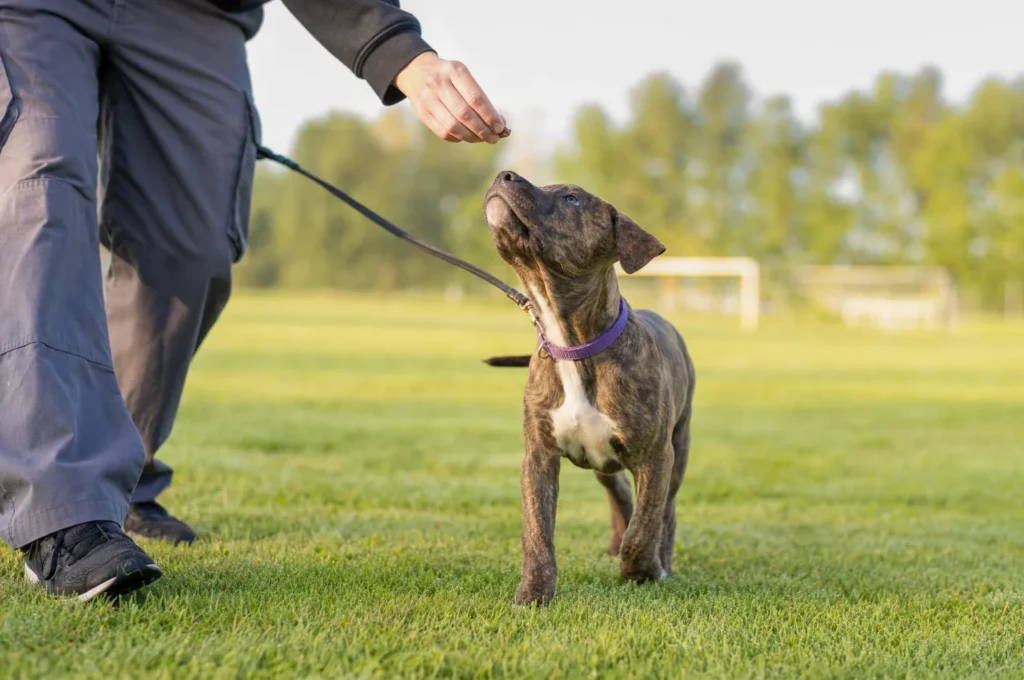
Add the word “come” only when she’s about to step toward you anyway. Start somewhere with few distractions, with her leash on, and always reward her when she responds.
With most puppies, VCA says, you can switch to an empty hand within 5 to 10 repetitions.
How to potty train a pitbull puppy
Potty training a pit bull puppy takes consistency, supervision, a predictable schedule and rewards. Take her out after she wakes, eats, drinks or plays, and before bed. That can mean trips every one to two hours while she’s awake.
The AKC gives two numbers for how long she can hold it. About one hour per month of age is the normal stretch, up to about 9 months to 1 year. Her age in months plus one, in hours, is the outer limit. So treat that second number as a ceiling.
- In pitbull puppy training, praise her the second she finishes outside, with a small, high-value treat.
- Catch her mid-squat indoors? Calmly carry her outside, and reward her if she finishes there.
- Skip punishment. It works less well than rewards and prevention, the same guide says.
Headed past 50 pounds? Our guides to potty training large breed puppies and crate training a puppy go deeper.
Not sure when she’s due? Our free Potty Break Timer takes her age and last trip, then shows her next trip time and hard limit.
We sell this kit and the 3 to 6 Month Puppy Plan further down.
How do you stop a pitbull puppy from jumping on people?
A puppy leaping at your knees is cute. However, the same greeting from a grown AmStaff could knock over a grandparent.
Pushing her off backfires, VCA’s behaviorists explain. She jumps, you touch her and say “off.” From her side, jumping got your attention, so she’ll try it again.
- Keep hands and voice still while she leaps. Mark and treat the instant all four paws touch down, or she sits.
- Ask guests to do the same. After all, a visitor who cuddles a jump rewards it.
- Leash her for visitors at first, so she can’t practice jumping.
How do I stop my pitbull puppy from biting and mouthing?
Nipping is normal for a teething puppy, and you can train it away. Puppy mouthing is generally a form of social play, VCA’s team explains, so start with plenty of daily play. These pitbull puppy training steps draw on the AKC, VCA and ASPCA.
- Keep a toy within reach. When teeth land on fingers or toes, offer the toy and reward gentle play.
- Let teeth on skin end the game. Give a loud, high-pitched “ow,” pause play, and praise her when she backs off.
- Does “ow” wind her up? Turn quietly and walk away. If she follows and keeps biting, leave the room for 30 to 60 seconds.
- Ankle attacks? Freeze, wave a tug toy, and start walking again once she grabs it.
- In pitbull puppy training, skip slaps and scruff shakes. Hitting can make a puppy bite harder, and physical punishment can even cause real aggression.
Everyone in the house needs the same rule, VCA stresses. Also keep an adult close to kids, whose reactions can invite more chase.
As a result, this builds bite inhibition, her control over how hard she bites. If any adult dog mouths someone in pain, the AKC says, that skill likely keeps it harmless.
A stiff, frozen body, pulled-back lips or a growl can signal a temper tantrum, the ASPCA says. Puppies don’t simply outgrow repeated bouts, so call a qualified professional.
How do you teach leash manners to a strong pitbull puppy?
A larger dog who pulls hard enough can even injure you, the AKC warns.
- Stop the moment the leash goes tight. Plant your feet and wait.
- Wait for slack. The leash should hang in a J shape, with her attention back on you.
- Reward at your side, then walk on. At first you may stop every step or two.
- Stay consistent. Each pull she gets away with sets training back to square one.
Socializing a pit bull puppy with other dogs
Socialization is safe, pleasant exposure to the people, places and animals she’ll meet as an adult. VCA puts the sensitive period between 3 and 16 weeks of age. Waiting for every shot can mean missing it, so ask your vet about low-risk outings.
Start socialization in pitbull puppy training at a distance from anything that might worry her. Then move closer if she looks calm, and back off if she doesn’t.
“There’s no need to rush. Let your puppy set the pace.”
Ellen Lindell, VMD, DACVB, veterinary behaviorist, and colleagues writing for VCA
Choose healthy, vaccinated, gentle dogs as her friends, and skip dog parks. One unexpected growl or snap from an unfamiliar adult dog can permanently traumatize a sensitive puppy, VCA warns.
Why your grown pit bull may not like every dog
Dog aggression can develop even in well-socialized AmStaffs, the AKC says. Never leave an AmStaff alone with other dogs, it also adds. That’s hard to read about a puppy asleep in your lap.
With a Staffy, watch for escalation in enthusiastic play, especially after maturity. Yet the AKC calls socializing Stafford pups with other dogs vital, so they learn canine manners.
Some pit bulls were bred to fight, the ASPCA says. They may be more likely than other breeds to fight with dogs. Still, that doesn’t mean they can’t be around other dogs, or that they’re unpredictably aggressive.
Socialization is considered key to preventing aggression, the ASPCA adds. That makes it the part of pitbull puppy training you can’t skip. Puppies who learn to play with people and dogs are less likely to show it later.
What helped our puppy on a busy block?
A story from Michael Northcutt, our founder:
Every dog on our block was a magnet, and our puppy was a little ball of iron.
She’d spot one across the street and then lock on. Her whole body would lean forward, and the leash would go tight as a guitar string.
Other owners crossed the street fast, or let their dog walk right up. The second was worse. Once, the other dog wasn’t friendly. There was a snap, and I scooped her up while the other owner said, “Sorry, he doesn’t like puppies.”
In the end, what helped was distance and a plan. When I saw a dog coming, I turned and walked the other way, cheerfully, like it was my idea. First, I tossed a few treats on the ground for her to sniff out.
Then we’d watch the dog from far away. Every time she looked at it and then back at me, she got a treat. Close enough to see. Far enough to think.
She still pulls a little when she sees a big dog. But now she looks back at me first.
His puppy was plain over-excited, and space helped. However, lunging, growling or real panic is a call for your vet or a qualified trainer.
The stares, the kids and being her ambassador
The ASPCA asks people to judge dogs by their actions, not their DNA or looks. So give the neighbors a calm sit at the curb to judge.
Pit bull-type owners face a strong breed stigma, the AVMA notes. Pit bull types are identified more often in the rare very severe or fatal bites. That may relate to local popularity, reporting biases and how owners treat the dog. Still, controlled studies haven’t found the group disproportionately dangerous.
As her ambassador, ask before she greets anyone. Keep the leash loose, and skip any greeting she isn’t ready for.
Are pitbulls good family dogs?
Plenty are. The ASPCA says pit bulls bred for work and companionship have long been popular family pets. It also notes their gentleness, affection and loyalty. The AKC calls the Staffy patient with family.
Every dog is still an individual, the ASPCA stresses, and any dog needs conscientious supervision. Let her meet children old enough to be gentle, as VCA suggests.
Renting or insuring her? Ask before she grows
Many landlords require renters insurance, San Diego Humane Society notes, but some insurance companies will not cover certain breeds. It found that State Farm, for one, does not ask about breed. For others, coverage varies by state.
- Call the insurer directly, and ask about coverage for your area and her breed.
- Get the landlord’s or HOA’s okay in writing before she moves in.
How do you discipline a pitbull puppy?
With rules and rewards. Staffy pups need clear, consistent, positive training from the beginning, the AKC says. Despite their tough look, they can be quite sensitive and don’t respond well to harsh methods. Show her what to do, then pay her for it.
Chewing, digging and toys that don’t last
Chewing and digging may be hard to resolve in an AmStaff, the AKC warns. Our puppy chewing guide covers the trade-and-praise method step by step.
Tip: Toys in shreds within minutes? Supervise chewing and check toys periodically, as the AKC’s teething guide advises. That is, she shouldn’t be able to chew off chunks or pull out stuffing.
How do you tame a wild pitbull puppy?
Start with exercise, then rest. A Stafford usually settles right in after a good exercise session, per the AKC.
When to call a trainer or vet behaviorist
Say she takes a treat from a stranger, then backs away. VCA calls that puppy frightened, in need of a custom plan and professional guidance. Also, never force her to face her fears.
Past 16 weeks, keep going. Calm, positive social experiences still matter through adolescence, from 6 to 18 months.
Pitbull puppy training FAQ
Are pitbull puppies easy to train?
Often, yes. The AKC credits the AmStaff’s intelligence and desire to please. A Staffy learns easily but may respond best to an experienced owner or trainer.
How long does pit bull puppy training take?
The basics come in stages. For potty training, the AKC notes some puppies build reliable habits within days, and others need months.
How much exercise does a pitbull puppy need?
A Staffy thrives on vigorous exercise, the AKC says. Wait until after 18 months for running beside a bike or jogger, so growth plates can close. Staffies can be heat intolerant, so never overwork her in warm or humid weather.
Where this guide comes from: In October we read the pages below, Google’s top results and pit bull owner threads. Nobody on our team is a vet or certified trainer. If her health or behavior worries you, call your vet first.
Sources
- AKC: American Staffordshire Terrier, plus Staffordshire Bull Terrier and its potty, crate, teething and leash guides
- VCA: Socialization and Fear Prevention, plus Training Basics and Play Biting in Puppies
- ASPCA: Position Statement on Pit Bulls, plus its puppy mouthing guide
- AVMA: The Role of Breed in Dog Bite Risk and Prevention
- San Diego Humane Society: Breed-Inclusive Renters Insurance