

Short answer: A puppy training schedule is a plan for what to teach at each age. Start the day she comes home, usually around 8 weeks. Fit three to five short sessions into her day.
Early weeks go to trust, safe new experiences, her name and “sit.” Recall, polite play and time alone come next. Reliable basics take most of her first year.
What should you teach a puppy at each age?
Find her age, then pick 3 or 4 skills from that row.
| Her age | What to work on | Based on |
|---|---|---|
| First days home, often around 8 weeks | Trust and a safe space before any commands. Her name, gentle handling and crate comfort. | AKC, K9 Top Performance |
| 8 to 16 weeks | Car rides, traffic sounds, people of all ages and vet visits. Sit before meals and play. Bite inhibition and leash training. Naps or solo play in a crate or pen. A suitable puppy class after your vet confirms vaccine timing and local risk. | AKC, K9 Top Performance, Purina, AVSAB |
| 4 to 6 months | Polite play and “drop it,” steady potty progress, short stretches alone and a recall she loves. She sits to ask for everything she wants. She’s still teething, and she may act a bit rebellious. | AKC, Purina |
| 6 to 12 months | Sit, down and stay with distractions. Practice recall in a securely enclosed space. Loose-leash walking, “drop it” and “leave it.” She may get easily distracted and forget some training. | AKC, Purina |
The stages come from the AKC’s puppy training timeline, built with Kate Naito. She’s a certified trainer and Canine Good Citizen evaluator. Purina calls 8 to 16 weeks the prime age to begin leash training. K9 Top Performance adds crate comfort and bite inhibition in the early weeks.
Treat the stages as a guide, since milestones vary with each dog and each home. Teaching your puppy where to toilet runs alongside all of it. Our puppy potty training schedule covers it by age.
She’s 9 weeks old. You saved a chart with 30 commands on it, and she can’t sit for two seconds. Your partner says “no” for everything. A video says you’ve already missed the window.
Every schedule you find says something different, and you wonder if you’re behind. Waiting does cost something. AVSAB, the vet behavior society, calls behavior problems the number one reason dogs are surrendered to shelters.
You’re not behind. A few minutes at a time is enough to start. For a longer reference to follow between sessions, the comparison of puppy training books explains the different formats and approaches.
We sell a printable puppy schedule kit, and we link to it below.
✓ Built on guidance from the AKC, AVSAB, Preventive Vet, Purina and K9 Top Performance.
Puppy came home this week? Start here.
- Make her feel safe with you first. Naito puts trust before commands.
- Ask for a sit before every meal. The AKC calls that the minimum habit.
- Play the name game. Say her name once. When she looks, say “yes,” your marker word, and treat.
- Stop each session on a win, while she still wants more.
When should you start training a puppy?
The day she comes home. Simple, reward-based lessons can start as early as 8 weeks.
The AKC says training can begin as soon as your puppy comes home, often around 8 weeks old. Purina agrees you can start the moment she enters your life. Naito’s one condition is positive reinforcement. The new puppy checklist covers the supplies and first-week jobs to organize alongside training.
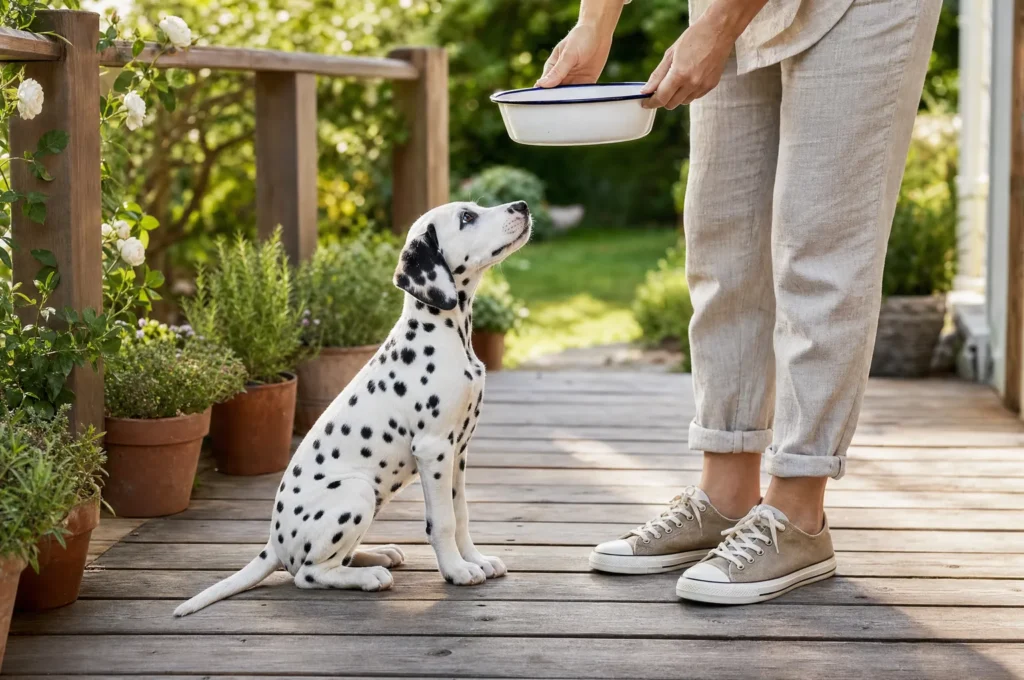
Her first real lesson is impulse control, and a simple sit is how most owners start it. Naito compares it to a child learning to say “Please, may I have that?” instead of “Gimme that!”
What are puppy milestones by week?
K9 Top Performance splits the early months into smaller steps. It also says what success looks like at each one.
- 8 to 10 weeks: she looks toward you when called and settles briefly in the crate. She starts to follow a predictable potty routine.
- 10 to 12 weeks: she recovers from new sights and sounds and accepts touch. She starts answering simple cues at home.
- 3 to 4 months: she pauses before doorways and walks short distances without constant pulling. She relaxes on a mat for brief periods.
Their team puts calm ahead of tricks. A 10-week-old who sits on cue but panics during nail handling is, in their words, “not ahead.”
How long should puppy training sessions be?
A few minutes, and shorter for young puppies.
Cathy Madson, a certified trainer and behavior consultant, keeps them short, especially for young puppies.
“The magic number is 3 or 4 minutes per training session.”
Cathy Madson, MA, FDM, CBCC-KA, CPDT-KA, writing for Preventive Vet
Start at 3 minutes and stop while she’s still keen. K9 Top Performance gives young puppies one to five minutes, and older puppies five to ten. Madson lists the signs she’s had enough:
- She loses interest, or takes longer to respond to cues.
- Treats and toys stop working.
- More nipping.
- Sniffing, yawning or shaking off.
When you see them, give her a break or a chew, or call it a day.
How many times a day should you train a puppy?
For young puppies, K9 Top Performance suggests three to five mini sessions a day. Madson also prefers lots of mini sessions over one long block. Her examples are a few minutes of “down” while lunch heats up, and recall games after a potty break.
Out at work all day? Madson’s point is that a few minutes here and there is more realistic than blocking out an hour. A session before you leave and one after you’re home both count.
For your household: Agree on one calm response and share concerns with your vet or qualified trainer. Consistency helps everyone notice changes sooner.
His routine sits close to both sets of numbers. Start there, and add only if she’s still asking for more.
When is the puppy socialization window?
Mostly before 16 weeks, so safe outings start the week she comes home.
AVSAB says this is when sociability outweighs fear. It wants puppies to meet new people, animals, sounds and places, as many as can be done safely. It also warns against overstimulation. Excessive fear, withdrawal or avoidance means she’s had too much, so back off.
Naito wants a puppy to learn that the world is fun, not scary. AVSAB says to skip dog parks and spots busy with dogs of unknown vaccine status.
Where does training fit in a puppy’s day?
Inside the loop she already runs: potty, a little learning, play or a meal, potty, nap.
One loop, with no clock times
- She wakes up: straight out to potty.
- Back inside: a 3-minute session. Name game or “come.”
- Meal or play: sit before the bowl goes down, or before the toy comes out.
- Potty again, then a nap or solo play in her crate or pen.
- Repeat through the day, and skip the session when she’s wound up or sleepy.
Built from the AKC’s sit-before-meals habit, Preventive Vet’s mini sessions and AVSAB’s scheduled alone time.
AVSAB’s statement asks owners to schedule time for puppies to play alone or nap in a crate or pen. It teaches her to amuse herself, and it may help prevent over‑attachment. Our puppy sleep schedule shows how naps fit around the evening bitey hour.
How do you make a puppy training plan?
Training a puppy on a schedule works best on one page, with a few skills at a time.
- Pick 3 or 4 skills from her row in the table above.
- Choose one word per skill, and everyone uses it.
- Tie each session to something that already happens, like a meal or a potty break.
- End on a win. Finish with something easy she loves.
- Make it easier when she struggles. Move farther from the distraction, then build back up.
Choose a routine that fits her needs and your household. Keep the detailed daily plan in your existing kit.
What should a puppy training planner include?
A useful puppy training planner maps her day. It shows her age, when she naps and eats, and who does each job. It also needs the words everyone uses. Without that, sessions get skipped or taught three different ways. Want an app instead? Our best puppy training app roundup covers the options.
Our kit won’t teach her commands. It holds schedules for 8 to 16 weeks, one shared log, and who feeds, walks and logs each day.
Why do puppy training plans fall apart in a busy house?
Usually because everyone in the house runs a slightly different plan.
If one person allows jumping, another corrects it and a third rewards it by accident, the puppy gets confused. That’s how K9 Top Performance puts it. AVSAB links positive, consistent training to fewer behavior problems and better obedience. Common slips, and what to do instead:
- Different words for the same job. Pick one word per cue, and write it where everyone sees it.
- Repeating her name. K9 Top Performance says it turns her name into background noise. Say it once, then mark the look with “yes.”
- Rewarding the pushy stuff. Naito warns that barking, jumping or nipping for attention sets up trouble as she grows.
- Too many sessions. Michael’s twelve-before-lunch week shows how that goes.
- Scolding. Naito says a puppy who learns not to trust people is an uphill battle later.
Where do the experts disagree?
The AKC page you probably just left, next to the other sources.
| Question | AKC timeline | Others | Our rule |
|---|---|---|---|
| How long is a session? | Gives no session length | K9 Top Performance: 1 to 5 minutes for young puppies. Preventive Vet: 3 to 4 minutes per skill. | Start at 3. Go longer only while she’s keen. |
| What comes first? | Naito: exposure first, then a simple sit | Purina: 8 to 16 weeks is the perfect age to start cues | Both, in tiny doses. Outings and handling daily, a sit before meals. |
| Best age to start? | As soon as she comes home, as early as 8 weeks | Purina: 0 to 8 weeks is the best age to begin | Ask the breeder or shelter what she’s done. Start from there. |
Most puppies come home around 8 weeks, so Purina’s best age is mostly the breeder’s time. A sit before meals takes seconds, so it fits around the calm outings Naito puts first.
What if your puppy is 4 to 6 months and forgetting everything?
That’s often adolescence starting. Make lessons easier for a while, then build back up.
Purina calls 4 to 6 months the beginning of the “adolescent years”. Your puppy might act a bit rebellious. From 6 months, Purina adds, she grows more independent and may forget some training. It’s fixable.
K9 Top Performance says to go back to easier versions of the skill, reward the right choices and rebuild. Past about 4 months? Our 3 to 6 Month Puppy Plan maps every week from 12 to 26.
Starting late? Naito says it may not be too late to teach particular behaviors. She adds that rude habits can often turn around quickly when you teach a new, enjoyable way to behave. Redirect a sock thief to “drop it” and a treat. For mouthy play, see our guide to redirecting puppy biting during play.
When should you call a trainer or the vet?
When fear shows up, or when a keen puppy suddenly can’t focus.
- Fear, avoidance or aggression. AVSAB names these as the later risks of poor early socialization. It says a puppy showing fear needs veterinary guidance, so call your vet early.
- A puppy who shuts down in every session. Madson suggests asking whether she might be tired or not feeling well. If it lasts, call your vet.
- A plan the house can’t agree on. AVSAB calls puppy classes before three months an excellent way to improve training. Bring everyone who handles her.
This week: pick 3 skills from her row in the table. Agree on one word for each. Run three to five short sessions a day, each tied to a meal or a potty trip. Add one calm new place or sound every day.
Puppy training schedule FAQ
What is the 7-7-7 rule for puppies?
It’s the Rule of Sevens, a socialization checklist from SPCA of Wake County. It lists what a puppy should have done by 7 weeks old. That includes 7 locations, 7 people, 7 kinds of toys and 7 surfaces. That’s mostly before she comes home, so ask your breeder or shelter what she’s seen.
Can my puppy go to training classes before all her shots?
Sometimes. AVSAB supports carefully managed early classes after initial vaccination and deworming. Ask your vet about local disease risk and timing. Choose a reward-based class with hygiene rules and healthy puppies.
Can I use her regular kibble for training?
Yes. K9 Top Performance suggests part of her regular food for easy skills like sit, down and her name. Save higher-value treats for harder moments, like recall away from a toy. Our potty training treats guide covers treat size.
How long does it take to fully train a puppy?
Expect months. Purina says it takes several months, with most training done within the first year. The AKC’s own list runs to one year.
Last updated: October 24, 2026. We checked current search results and reviewed the guidance linked in this article. This is general education, not an individual veterinary assessment.
Sources
- AKC: puppy training timeline, with trainer Kate Naito
- K9 Top Performance: puppy training timeline by month, with a weekly schedule
- American Veterinary Society of Animal Behavior: position statement on puppy socialization
- Preventive Vet: short training sessions and training fatigue, by Cathy Madson
- Purina: puppy training schedule by age