

Short answer: Border collie puppy training works best as short, varied sessions. Add plenty of sleep and a “settle” you teach on purpose. Puppies usually sleep 18 to 20 hours a day. A wired one may need a nap more than a run.
For herding nips, freeze, hand her a toy, and stop her from practicing the chase.
The kids run for the back door, and a ten-week-old ball of black and white locks onto a sneaker heel. At nine that night, she’s still staring at you, wide awake.
Herding nipping is a herding dog’s urge to control movement by chasing, circling and nipping heels. Left alone, it becomes a habit.
How do you train a border collie puppy?
Learning how to train a border collie puppy starts on day one, with tiny lessons woven into her day. The AKC calls early socialization and puppy classes essential for this breed. Ask your vet which shots she needs before class.
- Keep sessions short and mixed. Woofz, the top-ranking guide, suggests up to 15 minutes, with play built in.
- Pick one word per cue. She learns fast, so “down” from you and “off” from your partner teach two things.
The breed’s hallmark is the “herding eye,” a fixed stare at anything that moves. When it locks on, redirect her.
Why does my border collie puppy nip ankles and herd the kids?
Any dog can nip heels, but herding breeds like corgis are more likely to. Without a job, trainer Mikkel Becker explains, their motion sensitivity finds other outlets, like running children.
“This behavior is unlikely to stop on its own.”
Mikkel Becker, trainer, writing for Vetstreet
In fact, most border collies show their instinctive desire to work between eight weeks and one year. A nipping ten-week-old is normal, but she still needs a plan.
When she grabs your ankles as you walk
So you can start the ASPCA’s ankle steps tonight.
- Carry her favorite tug toy in your pocket.
- When she ambushes your feet, stop moving.
- Pull out the toy. Once she grabs it, start walking again.
- No toy handy? Freeze and wait. The second she stops, praise her and offer a toy.
When she herds the children
Supervise every minute she’s with kids. The more a child screams and runs, the more exciting it gets, Becker notes. So homes with older, well-behaved children suit the breed best.
Also, teach a down stay on leash in a quiet spot. Add a walker, then a jogger, then the backyard. Until it holds, Becker says to avoid the moments she’d normally chase.
Michael Northcutt, our founder, on a friend’s puppy and twelve kids: My friend’s daughter was turning seven, and twelve kids came to her party. The new puppy was four months old.
Within ten minutes, he’d been picked up five times. A girl shrieked when he grabbed her sleeve. Soon two kids were crying, and he was hiding under the deck.
She called me that night. “I almost ruined my kid’s birthday and my puppy in one afternoon.”
So for her son’s party the next spring, she planned ahead. He had his own room with a baby gate. He got ten minutes of “meet the puppy” time near the start. Kids sat on the floor, one at a time, with a treat on a flat hand. A grown-up stood right there.
Then he went back to his room with a chew. She told me the puppy slept through the cake.
Plan the same way for a border collie puppy: a gated room, a chew, and short, seated, supervised meet time.
Border collie puppy biting hands
Hand biting is normal puppy mouthing. For hard bites, the ASPCA suggests a high-pitched yelp and a limp hand. Later, any tooth on skin gets a yelp, and you walk away for 30 to 60 seconds. Never slap her. However, hitting a puppy for playful mouthing can make her bite harder. For biting with evening zoomies, see our puppy zoomies guide.
Border collie puppy chasing cars, bikes and runners
Becker lists bikes, cars and running children as chase targets. A puppy doesn’t know cars are dangerous, so the leash and your distance protect her.
So walk where you can see bikes and runners coming from far off. Step aside early, before she locks on. Then reward her for looking back at you.
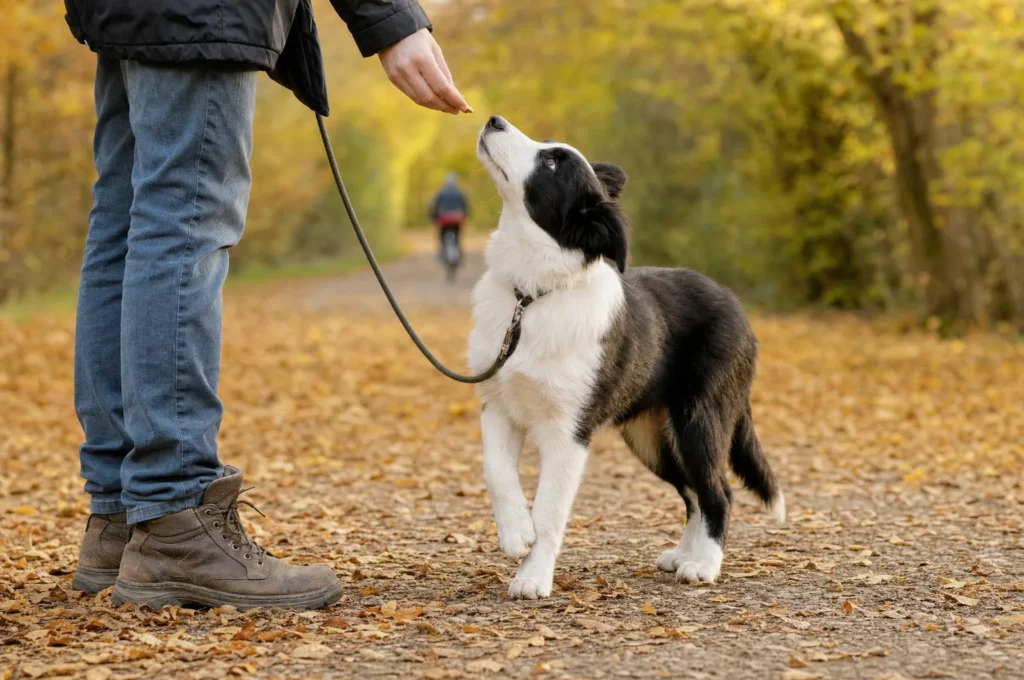
Teaching your border collie puppy to come when called
The AKC’s recall steps start indoors, on leash, with her name.
- In a quiet room, say her name happily when she looks away. When she turns, say “yes” and treat.
- From a few feet away, say her name, then “come.” Praise like crazy and give chicken or tug.
- Add distance, then a quiet room off leash. Run backward as you call.
- Outside, use a 6-foot leash, then a long line. Sound happy, never angry.
Overtired and never switches off? Teach the settle
For example, a wild puppy at 8 p.m. may be short on sleep. Too much stimulation and exhaustion can lead to unfortunate behavior, writes Jan Reisen for the AKC.
Then give naps a safe spot, like a crate, dog bed or quiet room. If she won’t drift off, teach the settle. These steps come from Battersea.
- Put a mat or towel down. Toss treats onto it, then reward two paws on it, then four.
- Ask for a down on the mat, and reward it.
- Wait for her head to rest on the mat before the treat comes.
- Add a couple of seconds at a time, then one step of distance.
- Practice in new rooms, so the mat becomes her cue to settle.
Tip: Practice when she’s already tired. If she gets up, Battersea says to go back a step.
A mat by the couch and two or three short practices a day is a fair start. For where naps fall by age, see our puppy schedule.
Two products below are ours: this kit and the 3 to 6 Month Puppy Plan.
Mental work or miles of running: where the experts split
Border collie puppy training advice splits on two questions.
| Question | What they say | Our rule for a puppy |
|---|---|---|
| Should you play tug? | ASPCA: redirect mouthing to a tug toy. Becker: structured tug games burn off energy. | Tug with a toy only. Teeth on skin ends the game. |
| How much exercise? | AKC: substantial daily exercise plus mental work. Becker: a walk around the block often isn’t enough. | Sniffing, games and training first. Ask your vet before any running. |
Instead, for a growing puppy, lean on brain games. Hide kibble in a snuffle mat, teach a new trick, or let her sniff a new street slowly.
Is my border collie puppy sensitive to sounds and motion?
She may be. A research grant from the AKC Canine Health Foundation notes noise phobia appears in particular frequency in Border Collies. Their health foundation calls them reactive to movement.
Give her early, positive exposure to people and situations. In border collie puppy training, keep each new sound quiet and brief, paired with treats. Sensitive, high-drive pups like the Belgian Malinois need the same slow start. If she hides or won’t take treats, back off. However, if storms or fireworks bring panic, call your vet.
Potty, crate and brushing: the everyday basics
How to potty train a border collie puppy
The normal stretch is about one hour per month of age, up to about 9 months to a year. Her outer limit is age in months plus one, in hours.
Our crate training steps show how to make a crate her quiet spot for naps and nights.
Brushing is training too
Rough or smooth, both coat types are double coats. So use a pin brush once or twice a week, and daily in shedding season. Finally, end each short session with a treat.
Did I get too much dog? A first-time owner’s worry
Asking this at midnight doesn’t make you a bad fit. Border collies can be challenging for first-time owners, the AKC admits.
The AKC breed page says they still settle down for cuddle time when the workday is done.
Call a trainer early if nips draw blood, chasing gets worse, or she seems afraid. Becker says fear-based heel nipping needs professional help right away, starting with your vet.
Border collie puppy training FAQ
When do border collie puppies stop biting?
Some of it is teething, and the AKC calls nipping a normal part of that stage. Herding nips come from instinct, so they need training as well as time.
Are border collies easy to train?
Usually, yes. The breed’s health foundation calls them intelligent, eager to please and easily trained.
My border collie puppy nips other dogs. Is that normal?
Herding instincts may shape how they act around other animals, the AKC notes. Keep meetings short and step in early. If it keeps happening, ask a trainer who knows herding breeds.
How big will my border collie puppy get?
The AKC lists adults at 18 to 22 inches tall and 30 to 55 pounds.
Where this came from: This October we read the pages listed below. None of us at LoveMyPuppy is a vet or a dog trainer. If a nip breaks skin or her fear grows, call your vet first.
Sources
- American Kennel Club: Is the Border Collie Right for You?, plus its breed page, puppy sleep, potty training, crate accident, teething and recall pages, and the AKC Canine Health Foundation noise phobia grant
- Border Collie Health and Education Foundation: Choosing a Border Collie
- Vetstreet: How to Stop a Dog From Nipping at Your Heels, by trainer Mikkel Becker
- ASPCA: Mouthing, Nipping and Biting in Puppies
- Battersea: My Dog Won’t Settle