

Short answer: Buy the crate for her adult size, then use a divider to shrink it to her size today. She should stand without ducking, turn around and lie down flat.
Starting estimates only: Yorkie, 18 or 22 inches. Beagle, 36 inches. Lab or Golden, 42 inches. German Shepherd, 48 inches. Those are MidWest’s sizes, and the breed chart adds PetSmart’s ranges. Measure your dog and check usable interior dimensions before choosing. Breed alone cannot confirm fit.
You’re on a crate page and the sizes read 24, 30, 36, 42 and 48. Your puppy weighs nine pounds. The breeder says she’ll be seventy.
Buy small, and you’re shopping again soon. Buy big, and you worry she’ll pee in the back corner. Then two size charts put the same breed in two different crates.
A crate’s size is its length in inches. For a puppy, you pick that length for the dog she’ll grow into. Buy for the puppy on your lap, and PetSmart warns you’ll need a new one in a few months. Two charts disagreeing is normal, and her own measurements settle it.
We sell the puppy planning kit and washer-cleaner tablets linked below. We do not sell the crates discussed here.
✓ Built on guidance from Cornell’s canine health center, the AKC, PetMD, MidWest and PetSmart.
What size crate does a puppy need?
She needs a crate sized for the dog she’ll grow into, blocked down to fit the puppy she is now.
Cornell’s canine health center puts the fit test in three parts. She stands without ducking her head, turns around, and lies down comfortably. PetSmart adds one more check. Lying down, her legs should stretch out fully.
PetMD’s vet-reviewed sizing guide adds height and width. When she sits, she needs at least 2 inches of clearance above her head. She should also walk through the door easily. Its chart lists a 42-inch crate as 28 inches wide and 30 tall, so check all three numbers. A crate mat or bed takes up room too, so plan for it when you measure.
“Enough space to stand up without ducking their head.”
Cornell Richard P. Riney Canine Health Center, College of Veterinary Medicine
For a puppy, Cornell advises a kennel big enough to fit her as an adult. That saves you buying several crates.
Too much room has a cost. A crate that’s too large could encourage your dog to eliminate inside it, away from the mess, the AKC warns. A divider keeps her space small until she grows into it. Our crate training guide covers the basics, and this page covers the numbers.
Need help checking the measurements?
Use our dog crate size calculator for a starting estimate. Confirm the usable interior dimensions and your puppy’s actual fit before buying.
Where will the crate fit at home?
Before ordering: Mark the crate’s footprint on your floor. Check the doorway, ventilation and space for its door to open.
Choose another location if the correctly sized crate blocks your route. Do not buy a cramped crate to fit the room.
Her crate had to fit inside that corner. Measure your floor spot before you order, too. Our apartment potty guide and crate plus playpen guide help you plan it.
How do you measure a puppy for a crate?
You take two measurements, add a few inches to each, then estimate her adult size.
What you need
- A soft tape measure
- A handful of small treats, to keep her standing still
- A helper, if she’s wiggly
- Her breed’s adult weight, or her parents’ sizes if you know them
1. Measure her length
Stand her on all four paws. The AKC measures from the tip of the nose to the tip of the tail.
PetSmart and MidWest stop at the base of the tail instead.
2. Measure her height
The AKC measures from the top of her head to the bottom of her feet. PetSmart uses the top of the head or the ear tips, whichever is taller.
3. Add a few inches to each
The AKC adds 3 to 4 inches to each measurement. PetSmart adds 2 to 4 inches for the minimum crate size.
MidWest calls for “a few inches.” Measure more than once, PetSmart suggests.
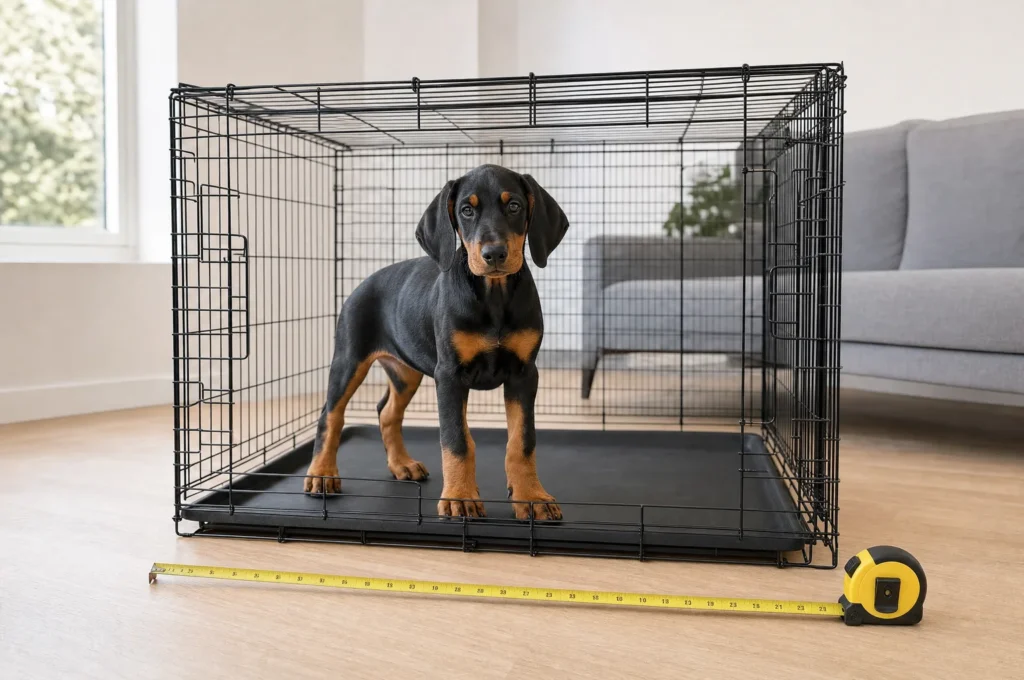
4. Estimate her adult size
MidWest points you to her breed’s adult size on the AKC or another reputable resource. Males and females can differ, and her parents’ size helps too. Mixed breed with unknown parents? Ask your rescue or vet which breeds she may be.
Tip: Write today’s length and height on a sticky note inside a kitchen cabinet. Measure again each month to see how fast she’s growing.
Tail tip or tail base? Follow the measurement method specified by the crate manufacturer. Different charts use different methods. Check the actual fit rather than combining measurements from incompatible charts.
Rather check the numbers together? Our crate measurement tool and fit card help you record the dimensions. Treat breed estimates as a starting point.
Dog crate size chart by adult weight
Shopping in centimetres? Common nominal lengths are 61 cm (24 inches), 76 cm (30), 91 cm (36), 107 cm (42) and 122 cm (48).
These rounded conversions describe listed lengths, not guaranteed interior space. Check the manufacturer’s usable dimensions.
MidWest gives one crate length for each weight band, while PetSmart gives a range and uses its own bands.
| Adult weight, MidWest bands | MidWest Homes for Pets | PetSmart |
|---|---|---|
| 1 to 6 lbs | 18 in. Tiny | 18 to 22 in. Extra Small, under 10 lbs |
| 7 to 11 lbs | 22 in. XS | 18 to 22 in. Extra Small, under 10 lbs; 24 to 30 in. Small, 11 to 25 lbs |
| 12 to 20 lbs | 24 in. Small | 24 to 30 in. Small, 11 to 25 lbs |
| 21 to 40 lbs | 30 in. Medium | 24 to 30 in. Small, 11 to 25 lbs; 30 to 36 in. Medium, 26 to 40 lbs |
| 41 to 70 lbs | 36 in. Intermediate | 36 to 42 in. Large, 41 to 70 lbs |
| 71 to 90 lbs | 42 in. Large | 42 to 48 in. Extra Large, 71 to 90 lbs |
| 91 to 110 lbs | 48 in. XL | 48 to 54+ in. XXL, 91+ lbs |
| 110+ lbs | 54 in. XXL | 48 to 54+ in. XXL, 91+ lbs |
Sources: the MidWest crate sizing guide and PetSmart’s crate size chart.
Length alone is not enough. Check usable height, width, door opening and space taken by bedding.
What do 24, 30, 36, 42 and 48 inch crates mean?
The number is the crate’s length in inches. The names don’t line up, though. MidWest calls 36 inches Intermediate and 42 inches Large. PetSmart’s Large runs 36 to 42 inches.
So a “medium” or “large” crate means different things at different stores. Shop by inches, and check the listed height too.
Crate size by breed
Both brands list breeds by size. MidWest usually lands at the top of PetSmart’s range, and sometimes past it.
| Breed | MidWest breed chart | PetSmart chart |
|---|---|---|
| Yorkshire Terrier | 18 or 22 in. | 18 to 22 in. |
| French Bulldog | 30 in. | 24 to 30 in. |
| Beagle | 36 in. | 30 to 36 in. |
| Border Collie | 42 in. | 30 to 36 in. |
| Labrador or Golden Retriever | 42 in. | 36 to 42 in. |
| German Shepherd or Doberman | 48 in. | 42 to 48 in. |
| Great Dane | 54 in. | 48 to 54+ in. |
MidWest’s breed chart adds a warning. Depending on sex and mixed ancestry, your dog may need a larger or smaller crate than listed. Use breed as a starting point, and let her measurements decide.
When the two charts split, take her estimated adult measurements, add the inches, and pick the crate that clears both. Still between two sizes? PetSmart advises sizing up. The divider handles the extra room for now.
How do you use a crate divider as she grows?
Wire crates often come with dividers, Cornell notes, so young dogs can grow into their adult kennel size. According to MidWest, its panel lets you buy one crate for her lifetime. Its steps, in order:
- Set the first spot. Slide the panel in until she can stand, turn around and lie down without excess space.
- Fit it across the width. The panel should fit extremely snug across the width of the crate, not the length.
- Check her often. Check her size regularly and move the panel back gradually.
No divider? Use a secure panel designed for that crate model. Do not improvise a partition with loose pillows or bedding. A different crate may be necessary if no compatible divider exists.
Lab or Golden on the way? A 42-inch crate can look huge next to a small puppy. On one Labrador forum thread, a moderator’s son sent a 42-inch back for his Golden because it was huge. Another owner kept hers and found it a bit too big at first. Her pup used half of it as a toilet, and she suggested a divider. A third owner said her 42-inch served them well and never felt too big. The panel handles that, keeping her space small now and moving back as she grows.
Tip: Each time you move the panel, put a strip of masking tape on that wire and date it. Everyone in the house can see where it belongs.
Is her crate too big or too small?
Signs the crate is too big
Cornell and PetSmart describe the same first sign.
- She pees or poops at one end and sleeps at the other. Cornell describes a puppy using one side as a bed and the other as a toilet. PetSmart describes the same split.
- Housetraining has stalled. PetSmart warns that a too-large crate can slow it down.
Move the divider in first. Then wash that end with an enzyme cleaner, since leftover scent can pull her back to the same spot. Our enzyme cleaner guide explains how. Divider already snug and she still pees? See our list of other reasons puppies pee in the crate.
Puddles at the back even after you moved the panel? She may have been in longer than she can hold. Our free Potty Break Timer takes her age and last trip and shows when she needs out next.
Is she house-trained, with the crate there only to stop chewing? Then Cornell allows a larger crate with room to stretch out.
Signs a dog crate is too small
- Her head touches the top when she stands, or she hunches.
- She has to struggle to turn around.
- She can’t lie down with her legs fully extended.
Those are PetSmart’s signs. It adds that if a dog seems uncomfortable or anxious in her crate, size might be the issue. Puppies grow fast, so recheck after each growth spurt.
Is wire or plastic better for a puppy crate?
Wire often offers a compatible divider and folds for storage. Plastic provides solid sides but may be harder to store.
Fabric is a poor choice for a puppy who chews it. No material makes a distressed dog safe to leave confined.
Listed dimensions may describe the exterior. Confirm usable interior space, door clearance and the exact divider compatibility before ordering.
Buy big now, or buy twice?
Cornell, the AKC, MidWest and PetSmart all point you to her adult size. PetSmart calls a divided adult crate a one-time purchase that saves money.
PetMD offers a second route. Buying several crates as she grows is a good option when her adult size is hard to estimate.
Renting is a third route. Your local animal shelter may rent out crates, Humane World for Animals notes. You trade up as she grows, then buy one at her adult size.
Which should you pick? Know her breed, and the crate has a divider? Buy once at adult size. Mixed breed with unknown parents? Buy or rent as she grows, and you never pay for a size she may not reach.
Once it’s set up, our step-by-step crate training guide helps her like going in.
When should you call a vet or a trainer?
Some dogs may be highly stressed when confined or left alone, Cornell warns. Never force a dog to stay crated alone if she’s barking nonstop, pacing, panting, drooling or eliminating. Those dogs may do better in a pet-proof exercise pen, or with a pet sitter.
Work with your vet or a qualified trainer to help her settle. Is it protest or panic? Our crate anxiety guide walks through the difference.
Your crate plan for this week
- Today: measure her length and height, and write both down.
- Before you order: estimate her adult size, check both charts, and confirm the crate takes a divider.
- Set up day: fit the panel snug, then check her fit each time you measure.
Check her fit regularly as she grows. An adult-sized crate with a compatible divider may avoid repeat purchases, but growth estimates can change.
Puppy crate size FAQ
Should I cover my puppy’s wire crate?
A cover helps some dogs settle. Keep ventilation open and fabric beyond chewing reach. Remove it if she becomes hot or distressed.
Should I put a bed in my puppy’s crate?
Yes, if she doesn’t chew it. The AKC suggests a machine-washable bed or mat for dogs who don’t regularly chew fabric.
Can two puppies share one crate?
Give each puppy a separate crate or resting space. Each needs room to settle, move and rest without being crowded.
What size crate do I need for flying with my puppy?
Airline rules vary, so check the exact dimensions before you buy, PetSmart says. If you plan to fly, the AKC suggests an airline-approved plastic crate.
Editorial review: Updated October 23, 2026 after reviewing search results and relevant source guidance. This is an editorial guide, not a product test or individualized professional advice.
Sources
- Cornell Riney Canine Health Center: Dog crates, when to use them and how to pick one
- American Kennel Club (AKC): How to Choose the Best Crate for Your Dog
- PetMD: How To Choose the Right Crate Size for Your Dog or Puppy
- MidWest Homes for Pets: Crate sizing guide and breed chart
- PetSmart: Dog Crate Size Chart, Finding the Perfect Fit