

Short answer: A crate offers a small resting space. A playpen offers more room for supervised practice and short absences.
Many homes use both. Neither replaces regular toilet breaks, company and care during a workday.
The crate is in the living room. The pen came yesterday and is still in its box. Your sister swears by the crate. A friend says pens are kinder.
Meanwhile she’s peeing in the kitchen corner. You start work Monday, and nobody has said which one she should live in.
Hearing both camps in week one is normal, and so is the corner puddle. Each one does a different job, and the first step is matching the job to her day.
A puppy playpen, also called an ex-pen, provides more space than a crate. It needs careful setup and supervised introductions. Choose it around her comfort and care needs, not just your absence length.
We sell a printable puppy schedule kit and the Washer Cleaner Tablets, and link to both below. Our potty timer is free.
✓ Built on guidance from Preventive Vet, Dogs Trust, the AKC, Humane World for Animals and VCA Animal Hospitals.
When is a crate better than a playpen?
A crate wins for short stretches, sleep and travel, where a snug space helps her hold it.
A crate sized so she can stand up, turn around and lie down supports potty training, the AKC explains. Too large, and she can eliminate in one end and sleep in the other. Our puppy crate size guide covers fitting one.
- Naps and quiet breaks. Humane World suggests a crate with an interactive toy when guests come over.
- Car rides and vet visits. Safe transport is one of a crate’s jobs, the AKC notes.
“Anytime your dog approaches their crate, toss a treat inside.”
Rachel Lane, M.Sc., CPDT-KA, CBCC-KA, writing for the AKC
Crate training can take days or weeks. Humane World’s milestone is about 30 minutes, quiet, with you mostly out of sight. The steps live in our crate training guide.
Is a crate cruel, or is a pen kinder?
Your friend’s worry is fair, and it depends on how each one is used. A crate can look like a cage. Still, dogs “can learn to love their personal den,” per the AKC. Humane World is firm that crates “should never be used for punishment.”
Lane calls crate comfort “an important life skill,” since it’s highly unlikely she’ll never spend time in one. A pen isn’t kinder by default. Dogs Trust introduces the crate or pen the same positive way, with treats.
If she panics in either, stop. Crates aren’t for “dogs experiencing panic or severe anxiety,” the AKC warns, so work with a trainer or behaviorist.
When does a playpen win?
A pen with planned care breaks
Published crate limits are not targets for every puppy. Some need much shorter intervals. A larger pen provides room, but regular care and toilet opportunities still matter.
Pens for people who can’t get down to a crate
A low crate means kneeling on the floor many times a day. Bad knees or a sore back make that hard. A pen with a walk-through gate opens standing up.
For your household: Agree on one calm response and share concerns with your vet or qualified trainer. Consistency helps everyone notice changes sooner.
If kneeling is hard for anyone in your house, pick the gate style before the size.
Can you use a crate and a playpen together?
Yes, and several sources favor it. Preventive Vet puts the crate on one side of the pen, door open. Easy access builds a good feeling about the crate. She learns the door isn’t always closed on her. Dogs Trust also suggests a playpen around the crate, for a larger space to roam.
| Situation | Crate | Pen | Crate inside the pen |
|---|---|---|---|
| Nap while you’re home | Good fit | Works | Good fit |
| Away longer than she can comfortably manage | Arrange a helper | Still needs care visits | More room, not a substitute for care |
| Working from home all day | Short spells only | Good fit | Best fit |
| She panics in a crate | Stop and seek help | Try only if she stays comfortable | Open door; do not force entry |
| Car rides and vet visits | Good fit | Not built for it | Take the crate |
How do you set up a puppy playpen?
What you need
- An exercise pen she can’t scale
- Her crate, or a bed for one corner
- Pads or a turf patch, if she’ll go inside
- A spill-proof bowl, chews and a stuffed food toy
1. Choose the spot
Preventive Vet suggests an easy-to-clean floor, clear of anything you don’t want chewed. A laundry room or bathroom you can gate works.
2. Anchor it
Attach the ex-pen securely to her crate, or set it against a wall and other anchor points. Otherwise she can knock it over and escape.
3. Put the bed at one end
Place the bed or open crate at one end. Avoid tape, loose ties and bedding she chews or swallows.
Skipping the crate entirely? Our guide to potty training without a crate covers supervision, safe spaces and toilet access.
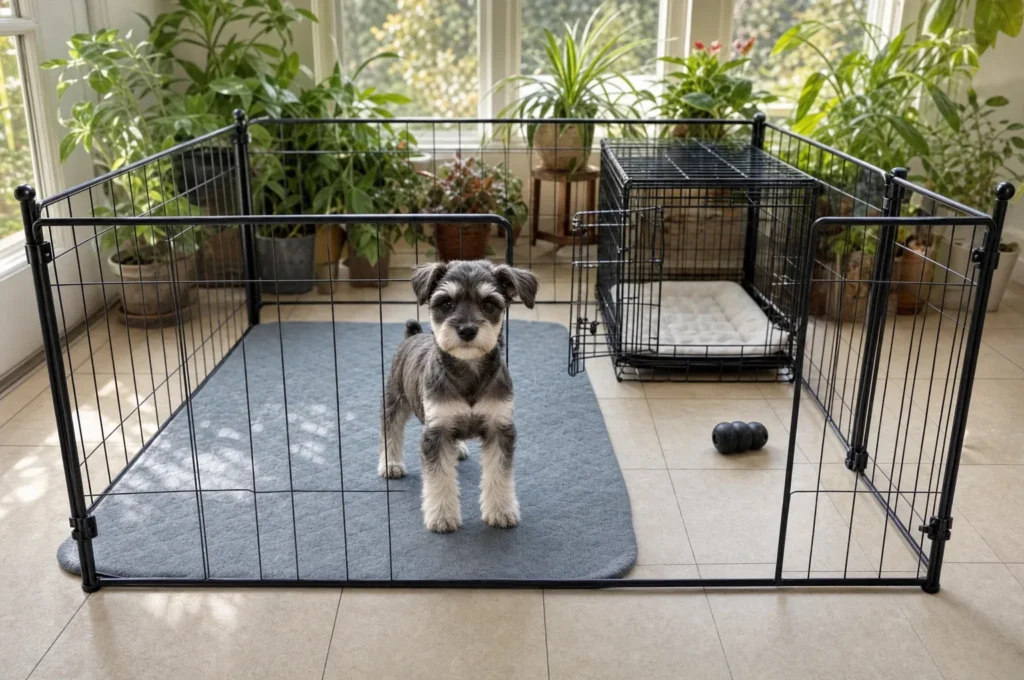
4. Put the potty spot at the other end
Keep it as far from the crate as possible. A tray with raised edges stops toys being pushed into it.
5. Add water, chews and a food toy
Provide fresh water in a stable bowl. Test toys while supervising first. Do not tether toys with cords inside the pen.
6. Teach her to settle in it
Potty trip first. Then put her in with a stuffed chew and leave for a few minutes, with no fuss. Let her out before she finishes it, and keep your return low-key. Repeat daily, slowly stretching the time.
Tip: A walk or a game of tug before pen time helps. Preventive Vet says a tired puppy is more likely to nap than bark.
How big should a puppy playpen be?
Make it big enough for her to stretch out, and small enough that the potty spot is her only bathroom.
Dogs Trust wants it to fit a comfortable resting space where she can stretch out, with room to move around. Preventive Vet sets the other limit. It shouldn’t be so big that she has accidents outside the potty area.
Size it to her, not the box. Height matters too. For gates, VCA suggests a height she can’t easily scale if she jumps. Pen panels need the same.
Shopping for a puppy playpen? Any sturdy pen you can anchor and she can’t climb will do. VCA lists exercise pens and play yards as crate alternatives, and many are expandable.
Should you put pee pads in a puppy playpen?
Pads make sense if she’ll be penned longer than she can hold it, or you’re pad training on purpose. Preventive Vet describes two setups. In one, pads cover the floor only to protect it, and the puppy trains outside.
That puppy had one accident in his pen during potty training. The other uses one clearly defined potty spot. They recommend it if she’s penned long without a break, shreds pads, or isn’t watched.
If she isn’t housetrained yet, Dogs Trust advises cleaning any mess in the pen as soon as possible. Pad placement and the move outside are covered in our puppy pad guide.
Can you use a playpen while you work from home?
Short, comfortable pen sessions can build confidence while you work nearby. They do not guarantee prevention of separation anxiety. Start with seconds and respond if she becomes distressed.
The AKC calls it unfair to expect a puppy to go from constant company to an eight-hour workday alone. Start alone time while you’re still home. Feed her meals in the pen, so the space means good things.
Arrange care visits that match her needs. A pen adds space; it does not replace those visits.
How long can a puppy stay in a playpen?
There is no universal safe duration for every puppy. Plan around toilet needs, meals, comfort and human contact. A pen does not make an eight-hour absence appropriate.
Past that, she’ll likely go in the pen, so give her the clearly defined potty spot from the pad section. Even then, Dogs Trust wants plenty of chances to leave the pen to practice house training outside.
Back-to-back calls, and you’ve lost track of her last trip? Our free Potty Break Timer takes her age and her last trip, then shows when she needs out next.
What if she cries in the pen or won’t stay in it?
Calm words through the panels are fine. Preventive Vet warns that expecting her to “cry it out” can create separation or isolation distress. Still, don’t make a habit of letting her out when she fusses, the AKC cautions. Shorten her time instead.
Whining or scrabbling to get out is a sign of worry to Dogs Trust. Go back to a stage where she felt comfortable, then build up again. Our sister guide on puppy whining covers why she cries.
Is a puppy playpen safe? Climbing, chewing and tipping
Safety depends on the puppy and setup. Supervise first, check for climbing and chewing, and remove entanglement hazards.
- Climbing out. Some pens include a ceiling panel to stop dogs climbing out, VCA notes.
- Tipping. Freestanding gates can be easily knocked over, VCA warns. Fasten barriers to something solid.
- Chewing the pen. Dogs who chew wire can hurt their teeth or jaws, per VCA. A determined puppy could chew through mesh, Preventive Vet adds.
Before she goes in, get down to her eye level and look around. Move cords, plants and anything she can reach through the panels.
Tip: Paws on the top rail mean a climber in the making. Add a lid or a taller pen before her first escape.
Should a puppy sleep in a playpen or a crate at night?
Sources split on this, and the tiebreaker is whether she still needs night trips.
Humane World suggests starting nights with the crate in your bedroom or a nearby hallway. Puppies often need out at night, and you want to hear her. Dogs Trust sees it another way. Playpens can be more appropriate at night, in their view, because they offer more room to move.
Keep her sleeping space close enough to hear her wake. A secure pen or familiar crate can work. Do not tether her to furniture while you sleep.
Once she sleeps through dry, a pen with the crate door open works. Our crate guide covers where the crate goes at night.
When can your puppy move from the pen to more of the house?
Grow her space in steps. Humane World advises crating her until she can be alone without accidents or destructive habits. Then graduate her to an enclosed area like the kitchen, and the full house after that. Preventive Vet suggests making the pen area larger as she matures.
Dogs Trust notes a playpen is unlikely to be used as your dog gets older. If accidents return after a step up, go back a step.
When should you call a vet or a trainer?
Call when confinement seems to frighten her, not just bore her.
- Panic signs. The AKC lists pacing, shaking, scratching or biting at the door, long bouts of howling or barking, and drooling.
- Very distressed in training. VCA advises ending the session and getting guidance from your vet or a veterinary behaviorist.
Unsure if it’s protest or panic? Our guide to dog anxiety in the crate walks through the difference.
What should you do this week?
- Today: anchor the pen to the crate or a wall.
- Tonight: decide where she sleeps, as a house, and stick to it.
- Every day: a few short pen sessions with a stuffed chew.
- Before your first long day: line up a lunch visit if she can’t hold it that long.
Playpen and crate FAQ
Is a playpen better than a crate for potty training?
Each helps in its own way. A properly sized crate can support potty training “by limiting opportunities for accidents,” the AKC explains. A pen with a defined potty spot covers stretches longer than she can hold it.
Do I need a crate if I use a playpen?
It helps, Dogs Trust explains. Making her comfortable with a crate young will help her feel relaxed if she has to use one later.
Can I use a baby gate instead of a playpen?
Yes, if the room is puppy-proofed, according to VCA. For most dogs, fasten it to a door jamb.
Can I use a playpen outside?
Preventive Vet uses a portable pop-up pen outdoors, even for early socialization. Ask your vet where it’s safe before vaccines are done. Don’t leave her alone in a mesh pen.
Last updated: October 24, 2026. We checked current search results and reviewed the guidance linked in this article. This is general education, not an individual veterinary assessment.