

Short answer: Puppy zoomies are short, wild bursts of running, often in circles. Their official name is frenetic random activity periods, or FRAPs. They’re normal and most common in puppies and young dogs.
Keep her away from stairs, slick floors and clutter, then let a happy burst run out. Don’t chase her. If teeth join in, she may be overtired, so offer a quiet nap spot.
Dinner is done. Instead of winding down, she tears around the coffee table, lap after lap, then grabs your ankle.
Of course, zoomies themselves won’t hurt her, Cornell’s vet school says. A puppy racing through clutter still can slip, hit a corner or break something.
Why does my puppy get zoomies?
“There is no known specific cause of FRAPs in dogs.”
Dr. Pamela J. Perry, DVM, behavior resident, Cornell University College of Veterinary Medicine
Instead, spare energy and stress relief are the likely reasons. Zooming is a normal way for a puppy to get rid of excess energy, writes AKC trainer Stephanie Gibeault. Petplan UK’s guide puts overexcitement and pent-up energy at the top of its causes.
Source: AKC, How Much Do Puppies Sleep? Awake hours are 24 minus her sleep.
Puppies nap a lot, yet they also have huge bursts of activity each day. In general, the younger the dog, the more often zoomies seem to show up.
Also, bursts tend to land at predictable moments, which Cornell and Petplan list.
- When you get home from work
- Late in the evening, or right before bed
- During play, or in training when she’s overstimulated
- Right after she poops
- After a bath, maybe from relief or from trying to dry off
- After meals, in puppies who live for food
Why are puppy zoomies worse at night?
Puppy zoomies at night often follow a quiet day. A puppy crated all day, or given too few chances to exercise, runs the moment she can (AKC). Before bed, she may be burning off pent-up energy.
When the laps land around dinner every night, many owners call it the puppy witching hour. Cornell’s list of owner nicknames adds crazy eights and midnight madness.
Zoomies at awkward times, like while you sleep, may mean she needs more exercise and mental stimulation, Dr. Perry says.
A story from Michael Northcutt, our founder: At 8:05 p.m. she tucked her tail, flattened her ears and took off. Around the coffee table, behind the couch, over my feet. Her ears were inside out, and the rug bunched up behind her like a wave.
The first time, I thought something was wrong. I stood up so fast I spilled my tea. By the third night I knew when it was coming. Right after dinner, after a bath, and after she pooped outside, like she’d won a race.
A friend told me zoomies are normal, a way of burning off energy. Nobody mentioned the coffee table corner. Then one night she clipped it and yelped. Normal didn’t mean I had to leave the room set up like an obstacle course.
So I made the path boring and safe. The table got pushed back, and the loose rug got a grip pad. The chew toy basket also moved out of the race lane. After a bath, she zoomed on a towel in the hallway, away from the wood floor by the stairs.
Now when her ears flip back, I lift my mug and let her go.
So tonight, decide where she can run safely, as he did.
Are puppy zoomies safe? Set up her running lane
Zoomies are normal, and the AKC lists only two concerns: obstacles and frequency. For obstacles, Dr. Perry advises keeping zooming dogs away from stairs, slippery floors, obstacles and the road.
- Pick the footing. Grass is best, then carpet or packed dirt. Hard floors raise the risk of a slip.
- Keep her off the stairs at her usual zoomie time.
- Clear the lane of breakables and table legs she could bump.
- Outside, use a fenced yard, and fill or mark any holes.
- On a walk, keep the leash on. Head for open spaces, where she can run and play safely while still leashed (Purina).
Tip: No yard? Then make a carpeted hallway her zoom spot.
How do you calm puppy zoomies?
In a safe space, Cornell’s advice is to let her party on. When a burst lands in the wrong place, try these steps in order.
- Let a happy burst finish if the space is safe, and step out of her path.
- Don’t chase her. She’s likely to think you’re playing along and keep running away, Purina’s guide warns. Call her and run the other way so she chases you. Reward her with a treat when she catches you.
- Redirect her with a favorite toy and a game of tug (Petplan). A short lead adds control.
- Offer quiet time after, calmly, so she can settle and her crate never feels like punishment.
For fewer bursts, the AKC advises a routine with play, training, activity and naps. However, skip strenuous exercise and jumping, which can damage growing bones. Our puppy schedule by age shows where naps and play fit.
Brain work helps too. Cornell’s ideas include a new trick or a scent game. For example, hiding one treat for her to find takes almost no setup, and it tires her brain without any jumping.
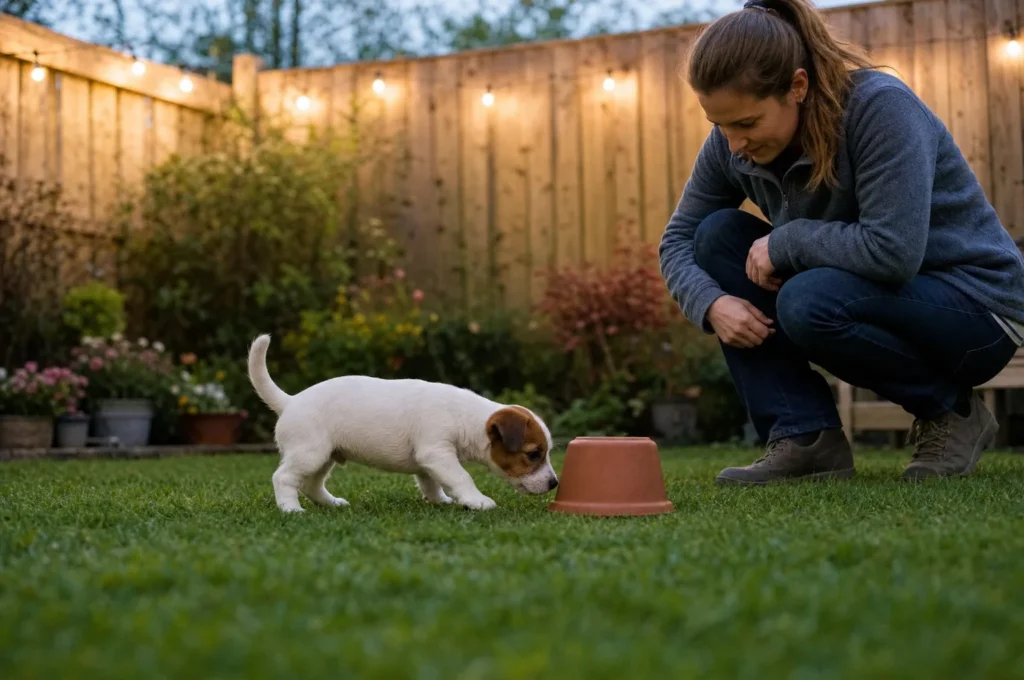
Tip: If you’re gone all day, a neighbor or pet sitter can give her a midday break and some play.
Our free Puppy Week Check-In gives one practical next step for rough evenings. Pick “Biting or restless evenings” as your concern. It asks six quick questions once she’s home and needs no email.
Why does my puppy bite during zoomies?
Some puppies get so worked up that the running turns into nipping. Herding breeds like the border collie are known for it. Petplan UK calls it common and nothing to be too worried about.
Biting can also mean she’s running on empty. Some bitey puppies are really overtired and need a quiet space or crate for a nap, the AKC explains. Other times, though, she needs a potty break, food or water.
The same AKC biting guide also covers what to do in the moment.
- Teeth on skin ends the game. Even a yell gives her a response, which can reward the bite.
- Fold your arms. Trainer Kathy Santo suggests turning around and tucking your hands into your armpits.
- Also keep a chew toy in reach to offer first. See our teething chew toys.
- Skip the roughhousing that winds her past control.
So when her evening laps end in biting, look first at the nap before them.
When do puppies grow out of zoomies?
None of our sources gives an age, but they point the same way.
- AKC: zoomies usually drop as her energy level drops.
- Petplan UK: most dogs outgrow them at a fairly young age.
- Cornell: some adults still get dog zoomies now and then for life.
Meeting her physical and mental needs means less need to frap.
When are puppy zoomies a problem?
Zooming all the time can point to a compulsive habit or a lot of stress (AKC). In that case, a trainer or behaviorist can help. More often it means too little exercise.
Her posture during and after a burst tells fun from fear.
| Sign | Happy zoomies | Scared or upset |
|---|---|---|
| Body | Loose, even wiggly | Tense |
| Tail | Often tucked while she runs | Tucked tight to the belly, even when she stops |
| Face and ears | Tongue may flap out | Wide eyes, ears folded back |
| When she slows down | Bounces around you, may play bow | Head carried low |
| What you do | Let her finish in a safe space | Calm her down. If she seems in pain, frightened or anxious, call your vet. |
Ears can fly back mid-run, as Michael’s puppy showed. What counts is a loose, bouncy body once she stops. In contrast, a scared puppy stays tense, with her tail tucked tight and her head low.
The AKC’s chief vet, Dr. Jerry Klein, draws a line at 6 months. If play biting hasn’t eased by then, bring in an experienced dog trainer or animal behavior specialist.
For a puppy past 16 weeks, however, our plan maps every week from 12 to 26.
Puppy zoomies FAQ
Are puppy zoomies normal?
Yes. To Cornell’s vet school, FRAPs are normal and most common in puppies and young dogs. If she seems in pain, frightened or anxious during a burst, call your vet.
How long do puppy zoomies last?
Usually a short while. Petplan UK describes a frenzied spell that can end as abruptly as it began.
When do puppies grow out of zoomies?
There’s no set age. Most dogs outgrow them fairly young (Petplan UK), though some zoom now and then for life. More exercise and brain work can mean fewer bursts.
Is it zoomies or aggression when my puppy bites mid-run?
Usually it’s overexcitement, a common pattern in Petplan UK’s guide. Redirect her to a toy, or offer a nap if she seems overtired. If play biting hasn’t eased by 6 months, the AKC’s chief vet suggests a trainer or behavior specialist.
Should I put my puppy in her crate to stop zoomies?
Only to help her calm down, never as punishment. For a wound-up, bitey puppy, a few calm minutes in the crate can help (AKC). Sniffing out kibble on a snuffle mat is another quiet option. Our crate training guide helps the crate feel like her quiet spot.
What about puppy zoomies after a spay?
Hold them off while she heals. VCA’s vets advise leash walks, lots of rest, and no running, bathing or swimming after surgery. Most dogs can resume normal activity 5 to 10 days later, so ask your vet when laps are OK.
How we checked these facts
How we made this guide: In October 2026 we read three AKC guides and Cornell’s vet school page on FRAPs. We added Petplan UK, Purina’s zoomies guide and VCA’s spay page. We also read the pages Google ranks for puppy zoomies. Nobody at LoveMyPuppy is a veterinarian. If her zoomies look frantic, painful or constant, ask your vet.
Sources
- American Kennel Club: Why Does My Puppy Go Wild at Night?, by Stephanie Gibeault, MSc, CPDT, plus How to Stop Puppy Biting and How Much Do Puppies Sleep?, by Jan Reisen
- Cornell University College of Veterinary Medicine, Riney Canine Health Center: What Are Zoomies?, with Dr. Pamela J. Perry, DVM
- Petplan UK: How to Manage Dog Zoomies
- VCA Animal Hospitals: Spaying in Dogs, by Tammy Hunter, DVM, Krista Williams, BSc, DVM, and Ernest Ward, DVM
- Purina Canada: Dog Zoomies: Where Does All That Energy Come From? (updated June 2024, no author listed)