

Short answer: Young puppies often sleep around 18 to 20 hours across a day and night. Individual needs vary as they grow.
Watch how your puppy behaves when awake, not just the clock. Sudden changes, weakness or difficulty waking need veterinary advice.
She’s asleep again. She was asleep an hour ago too. You’re relieved. You’re also googling “is it normal for a puppy to sleep a lot” with a hand on her ribs.
Or it’s the other puppy. The one who hasn’t slept since lunch and is biting your ankles at 6 p.m. like something’s wrong.
Both puppies are usually normal. Puppy sleep is the total hours she spends asleep in a day, naps and night combined. It shrinks as she grows. Skip her naps and you get a cranky, destructive puppy who learns slower. That’s fixable.
We sell a printable puppy schedule kit and link to it below.
✓ Built on guidance from the AKC, Trupanion, VCA Animal Hospitals, Embrace Pet Insurance, The Kennel Club and Chewy’s Dr. Laci Schaible, DVM.
Worried right now? Check these three things.
- Check that she wakes and responds normally. Call your vet if she seems weak, unwell or unusually difficult to wake.
- Think back over today. Did she eat, drink, pee and poop about like yesterday? VCA lists changes in appetite and potty habits as signs to watch.
- Breathing hard, limp, gums pale, refusing food, vomiting or diarrhea with the sleepiness? Call your vet now. Don’t wait for morning.
How much sleep does a puppy need by age?
Veterinarian Dr. Melody Conklin explains that young puppies may sleep 18 to 20 hours daily. This includes naps and nighttime sleep.
| Age or stage | What to expect | What to watch |
|---|---|---|
| Around 8 weeks | Frequent naps and short active periods. | Normal waking, eating and interaction. |
| 3 to 6 months | Patterns change gradually; published ranges differ. | Your puppy’s usual pattern and opportunities to rest. |
| Growing toward adulthood | Sleep may become more consolidated. | Sudden changes or symptoms, rather than a birthday cutoff. |
What does normal sleep look like at eight weeks?
Many short naps can be normal. Give your puppy a quiet resting place and take her outside after waking.
The AKC describes naps lasting 30 minutes to two hours. Those are examples, not a schedule every puppy must match.
Does sleep suddenly drop at three months?
No single birthday establishes a new sleep requirement. Avoid keeping her awake to match a chart.
Notice her appetite, play, responsiveness and usual rest pattern. Discuss persistent concerns with your vet.
What about a four, five or six month old puppy?
Allow quiet breaks even when she seems eager to keep playing. An exciting household can make settling difficult.
Use our puppy sleep schedule for organizing rest opportunities rather than enforcing a daily total.
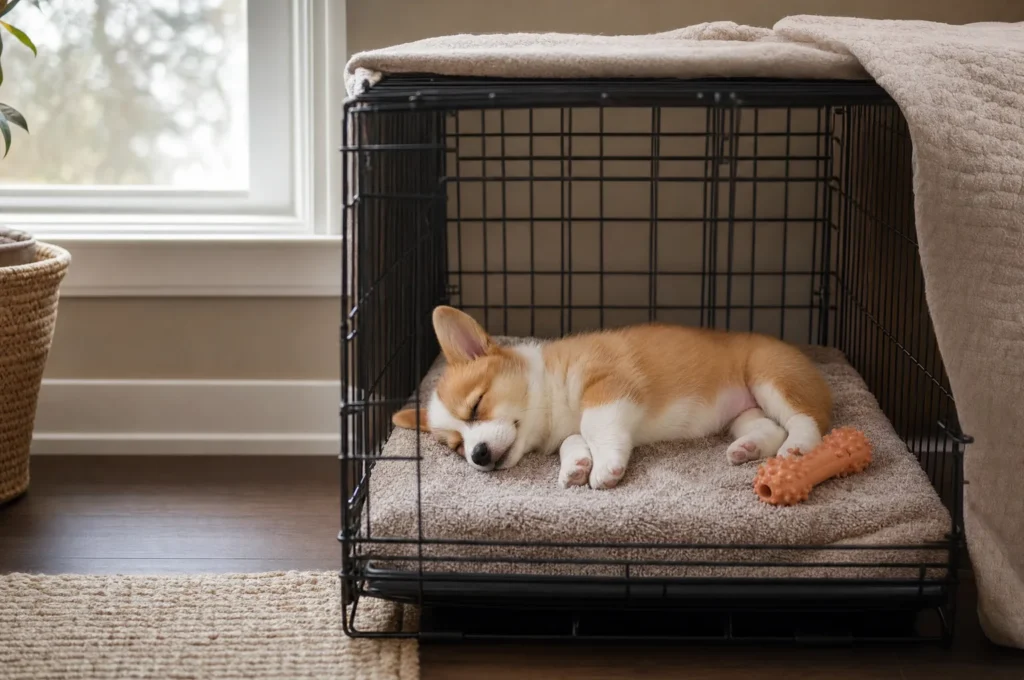
How long does a puppy sleep at night?
Young puppies sleep in stretches at night and wake for potty trips. Longer nights come with age, usually around 4 months.
Trupanion expects a 12 week old to still need a potty break or two overnight. It puts sleeping through at around 4 months. Embrace’s vet says 4 to 5 months.
So an 8 week old who wakes you twice is on schedule. Bladder size sets the pace. The AKC’s rule of thumb is about one hour of holding per month of age. The outer limit is her age in months plus one hour. Our night potty training guide turns that into a quiet, boring night trip.
Why does my puppy sleep all day and stay up all night?
Chewy’s vet says puppies wake more at night, then adjust to your schedule. Dr. Brister at Embrace suggests three ways to tip the balance toward nights.
- Fill her awake time with play, simple training and new things.
- Don’t stop daytime naps altogether. She needs them to grow.
- When she wakes at night, skip the cuddling, chatting and play. Potty trip if she needs one, then straight back to bed.
Tip: Count her night sleep from when she drops off, not from when you went to bed. If she’s out at 9 and you’re up until 11, those two hours count toward her total. They also explain the 5 a.m. start.
Why does my puppy sleep so much?
Because growing is work, and her body does much of it while she’s asleep.
The AKC says sleep contributes to the development of the central nervous system, brain, immune system and muscles. The Kennel Club adds that growth hormone is released during deep sleep. Puppies also process the day’s new information while they snooze.
Then there’s plain overload. Every room, person and sound is new to her. Dr. Brister notes that more excitement can mean more sleep. Puppies often drop off right after playing, eating or meeting people.
“As with human babies, puppies need quite a bit more sleep than adult dogs.”
Jacqueline Brister, DVM, small animal veterinarian, writing for Embrace Pet Insurance
What are the signs of an overtired puppy?
Chewing things she shouldn’t, getting unruly, and trouble settling, per Chewy and The Kennel Club.
The AKC warns that too much stimulation and exhaustion can lead to unfortunate behavior. Its advice is to guide her to her crate or bed and help her wind down.
| What you see | Most likely | Do this now |
|---|---|---|
| Chewing, unruly, won’t settle, late afternoon or evening | Overtired. She’s been awake too long. | Potty trip, then quiet time in her crate or pen with a chew. No more play. |
| Wild, but she napped well all day | Pent-up energy | A short sniffy walk or a game, then a chew. |
| Sleeping more than usual, but bright and hungry when awake | A big day or a growth spurt | Let her sleep. Watch meals and potty. Reassess tomorrow. |
| Sleeping more, and limp, off her food, or breathing hard | Possible illness | Call your vet today. See the list below. |
When her awake stretch runs long, put her down before the meltdown.
What if she only naps on you, or won’t nap at all?
The AKC admits a puppy asleep in your lap is hard to resist. It still says not to let her depend on you to fall asleep.
- When she looks drowsy, or her awake stretch runs long, move her to the same safe spot each time. A crate, a dog bed or a quiet room all work.
- Keep it quiet, with few distractions and a puppy-safe chew.
- Walk away once she’s settled. Dr. Brister says you can’t make a puppy sleep, only set up a quiet place for it.
- Give it time. She’ll come to know that spot as the place for sleep.
If the crate itself is new, our crate training guide covers the first steps.
Our free Puppy Week Check-In asks six quick questions and gives you one next step for her routine. No email needed.
If only you know when she last slept, her naps get skipped when you leave the room.
Why do puppy sleep charts disagree?
Sources group ages differently and describe different puppies. Their figures are guidance, not diagnostic thresholds.
Your puppy’s normal behavior and any sudden change are more useful than chasing a precise total.
When should you call the vet about puppy sleep?
When the change is sudden, or the sleepiness comes with other symptoms like a poor appetite or hard breathing.
Trupanion says suddenly sleeping much more than usual, or struggling to sleep, could be signs of pain or illness. VCA adds that excessive tiredness or lethargy can be a sign of a medical condition. Between them, they list these signs.
- Hard to wake, or limp and dull once awake.
- No interest in food or play, or changes in potty habits.
- Breathing trouble while asleep or awake.
- Heavy snoring or gasping in a flat-faced breed. VCA says brachycephalic puppies may be at risk of sleep apnea, which can leave them tired during the day. Snoring a lot or gasping at night means a call to your vet.
- Restless nights that keep happening, after you’ve ruled out a full bladder.
- Vomiting, diarrhea or pale gums with the sleepiness. Chewy’s vet lists these as signs heavy sleep may be illness. Call your vet now, whatever the hour.
Too little sleep is a call too. The Kennel Club flags a puppy who can’t settle when she ought to be sleeping. One who can’t settle for days despite quiet time and a steady routine is worth a vet visit. If she panics in the crate, our crate anxiety guide covers that.
Tip: Before you call, note when the change started and roughly how much more she’s sleeping. Add her meals, water and potty. “About 4 extra hours since Tuesday, and she skipped breakfast twice” gets you a better answer than “a lot.”
What should you do this week?
One sleep sheet, one nap spot and one house rule.
Notice whether long awake stretches come before your puppy’s difficult evenings. Use the nap spot steps above. Then tell the kids, your partner and grandma the house rule: a sleeping puppy stays asleep.
Puppy sleep FAQ
Do puppies sleep a lot, and is it normal for a puppy to sleep all day?
Yes. The Kennel Club says a puppy that sleeps a lot is no cause for alarm. Bright and hungry when awake is normal. Limp or off her food is a vet call.
Should I wake my puppy up to pee or eat during the day?
Usually, let a healthy puppy rest and offer a toilet trip after waking. Follow your vet’s advice about feeding, medication or scheduled breaks.
Can I let my puppy sleep as much as she wants?
Mostly yes. Trupanion says it’s fine to follow her lead. A sudden change, or long sleep with a dull puppy when awake, gets a vet visit.
Is it normal for my puppy to twitch or snore in her sleep?
Usually, yes. Twitching or paddling is REM sleep, the dreaming stage, Dr. Brister writes. She adds that snoring is usually no big deal. Flat-faced puppies who snore a lot or gasp are the exception, per VCA.
About this guide: Sources are linked beside the advice and listed below. This is educational guidance, not an individual assessment or a hands-on product test.