

Short answer: A dog training clicker only works after you “charge” it. Click, then hand over a tiny treat within a second. Repeat until she expects food at the sound.
Then click once, right as she does something you like, and pay her every time. A cheerful “yes!” can do the same job.
You click. Your puppy stares at you, then wanders off to chew the rug. Or worse, she jumps at the snap and hides under the couch.
Quick pick: On paper, the PetSafe Clik-R. It has a finger band, and some reviews call its click not too loud. See all three clickers.
Simply put, a clicker is a small plastic noisemaker used to mark the exact moment your puppy gets it right. But click at random, and the sound turns into noise. Scare her with it, and you may have a new fear to undo. Fears are super easy to create and very hard to get rid of, warns dog writer Eileen Anderson.
So below is how to use a dog training clicker with a puppy, step by step. Besides, you don’t need to be a pro to do this well.
The Amazon links on this page are affiliate links.
How do you charge a dog training clicker?
First, charging, or “loading,” gives the click its meaning. These steps follow PAWS Chicago’s clicker guide.
What you need
- A clicker
- Many small, soft treats she really loves
- A pouch or bag to hold them
- A quiet room, before a meal, while she’s hungry and alert
- Load your hands. Hold about ten treats in one hand and the clicker in the other. Keep the treat hand behind your back.
- Click, then treat. Bring the treat out as a separate motion. If the treat hand moves first, she watches the food instead.
- Pay fast. The treat arrives within a second of the click.
- Repeat in short sets. Do sets of ten over a couple of days. Stop before she loses interest.
After about 10 to 20 repetitions, she learns the click predicts a reward, writes Stephanie Gibeault, CPDT, for the AKC. Altogether, it’s a few minutes of your evening.
Tip: Move on once she expects a treat every time she hears the click, Best Friends says.
Charged it, and she still ignores the click?
- The treat isn’t worth it. If she doesn’t really want the reward, she won’t be motivated to learn, PAWS says. Try bits of chicken or cheese, if her diet allows.
- The room is busy. Best Friends charges the clicker someplace quiet, with no distractions.
- She might not hear it. For a hearing-impaired dog, the AKC suggests a light or a gentle tap instead.
What are the first 3 behaviors to clicker train a puppy?
So start with easy things she already does. PAWS names eye contact and sitting. Karen Pryor, founder of Karen Pryor Clicker Training, adds touching your hand with her nose.
| Behavior | How you get it | Click the moment she | Add the word when |
|---|---|---|---|
| Watch (eye contact) | Say her name once, or wait in a quiet room | Looks up at you, even for a split second | She’s offering the look to get the click |
| Sit | Raise a treat slowly over her nose so her rear drops | Sits on her own, while she’s sitting | She starts to sit; say “sit” right then |
| Touch (nose to hand) | Bring an open palm about ¼ inch from her nose | Touches your hand | She’s reaching for your hand |
Source: PAWS Chicago Clicker Training Basics.
How to clicker train sit
First, lure her into a sit a few times. Then stand still with the treat behind your back. When she offers a sit, click while she’s sitting, then treat. No sit? Go back to the lure for a few tries.
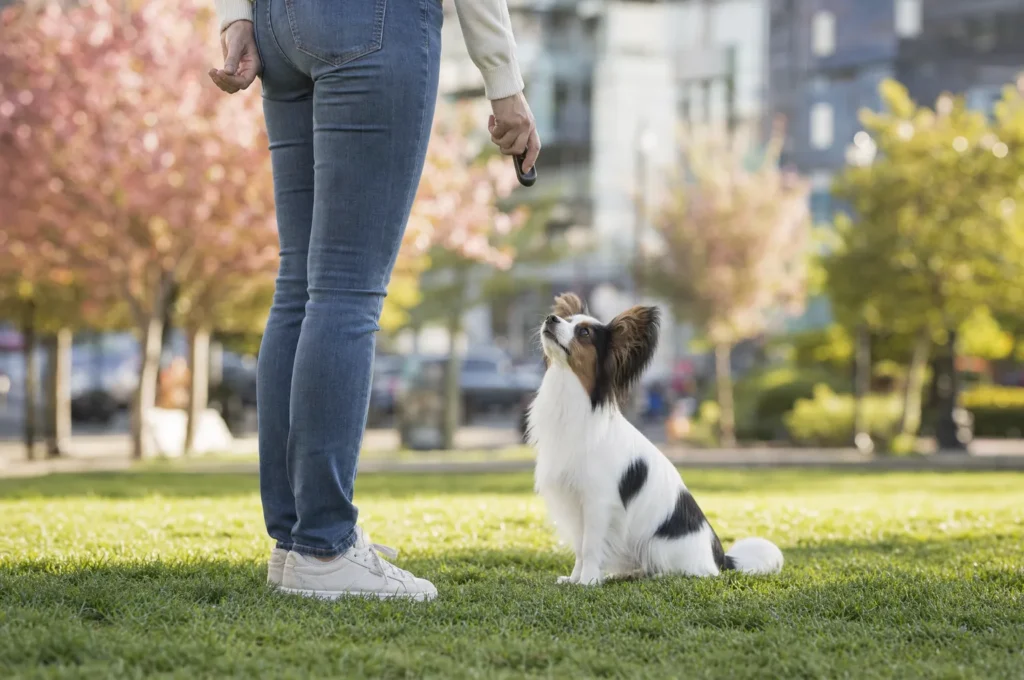
Luring, capturing and shaping
Luring uses a treat to guide her nose into position. Capturing clicks something she does anyway. Shaping clicks small steps toward a bigger behavior, like one paw on a mat, then two. Don’t wait for perfect, Pryor says. Click small moves in the right direction, then ask for a bit more.
The kit below and the 3 to 6 Month Plan are ours.
Which dog training clicker timing mistakes slow a puppy down?
Karen Pryor’s fifteen tips flag each of these slips.
- Clicking after the behavior. Click during it. A late click can mark the wrong moment, like her standing back up.
- Clicking twice to say “great job.” Click once. To show extra delight, give more treats, not more clicks.
- Repeating a cue she ignores. If she doesn’t respond, she hasn’t learned the cue yet.
- Long sessions. Five one-minute sessions teach more than an hour of boring repetition. End while she still wants more.
- Training while you’re angry. If you get mad, put the clicker away. Scolding mixed in can cost her confidence in the clicker, maybe in you.
Feeling slow is normal. If you’re stuck, you’re probably clicking too late, Pryor says. Ask someone to watch you.
Tip: If you click too early by accident, deliver the treat anyway. PAWS says not to worry.
What if the dog training clicker scares your puppy?
A story from Michael Northcutt, our founder
I bought a training clicker because everyone online said it was the best tool. The first time I clicked it, our puppy jumped about a foot and ran under the couch.
It was so loud. A sharp little snap.
I felt bad and threw it in a drawer.
Later, I learned you can use a softer sound. For example, some people use a clicker with a quieter button. Similarly, some use a click from a pen. Some just say “yes!” in the same happy voice every time, then give a treat.
That’s what we do now. “Yes!” and a treat. Same word, every time. She loves it.
The clicker is still in the drawer. Not every tool fits every puppy. That’s okay.
However, Best Friends and Eileen Anderson give different next steps.
- Try a softer click. Pick a clicker whose noise does not startle your pet, Best Friends Animal Society advises. Some pets need a very soft click, like a ballpoint pen.
- Stop clicking for now. Eileen Anderson taped a box clicker for a scared rat terrier, and the dog fled after one soft click. Her advice now is to switch to a verbal marker.
If she flinches, hides or runs, put it away and use “yes.” Still, a one-time startle may fade with time, Anderson says. A qualified trainer can help you try the clicker again later.
Clicker or a marker word like “yes”?
In clicker training for dogs, the AKC says any distinct marker works. Many people use “Yes” or “Good.”
PAWS Chicago leans the other way. A clicker marks a behavior with more precision and consistency than a voice can, its guide says.
Research is mixed too. A 2016 study by Chiandetti and colleagues compared a clicker, a spoken word and food alone. However, on its main question, using the skill on new setups, it found no pronounced difference. Ken Ramirez of Karen Pryor Clicker Training pointed out a detail in its data. Specifically, the clicker dogs learned the first task in fewer tries and less time.
Average attempts to learn it, approximate
Average minutes to learn it, approximate
Source: Chiandetti et al., 2016, approximate averages as reported by Ken Ramirez, KPCT. Dogs learning to open a breadbox, before the main test.
“There is no magic in the clicker; it is just a toy noisemaker.”
Ken Ramirez, biologist and chief training officer, Karen Pryor Clicker Training
In short, use a dog training clicker if the sound doesn’t bother her and you like the precision. Instead, use a word if your hands are full, she’s sound sensitive, or you’ll forget the clicker. Either way, the best marker is one every trainer can copy easily, Ramirez writes.
Keep everyday praise apart. Praise isn’t specific to training, the AKC notes, so a training-only marker is clearer. In a busy home, one person says “yes,” another says “good girl,” and a third clicks. So pick one marker, and have everyone use it.
Do you have to treat after every click?
While she’s learning, yes. Still, the experts split only on what counts as the treat.
- Food every time. “A treat always follows a click,” says PAWS.
- Any reward she values. A click needs a reinforcer, not always food, writes Melissa Alexander for Karen Pryor Clicker Training. The AKC agrees. If she’d rather play tug than eat chicken, play tug.
Pay every click. At home, use food. Outside, though, a toy or a quick game can be the pay, if she loves it. Also, Alexander notes food can be cut into tiny pieces and eaten quickly.
When can you stop using a dog training clicker?
Once a behavior is learned, you won’t need the marker for it, the AKC says.
Alexander waits until a behavior is fully shaped, on cue and strong. Then a verbal marker or release word replaces the click. Keep rewarding it at least now and then. Even so, that reward doesn’t have to be food.
Keep the clicker for new skills. Besides, short sessions fit between naps, and our puppy schedule shows a sample day by age.
Not sure what else your house needs this week? Try the free Puppy Week Check-In. No email needed.
Which dog training clicker should you buy?
Almost any dog training clicker works, and PAWS calls clickers inexpensive. So pick a sound your puppy can handle, in a clicker you’ll actually carry. On paper, these three dog training clicker picks fit a puppy home.
| Clicker | Price | Good for | Watch out for |
|---|---|---|---|
| PetSafe Clik-R | $5.48 | A finger band keeps it in your hand. Some reviews call it not too loud. | Others call it very muted, or say it broke fast. |
| Starmark Pro-Training Clicker | $6.96 | A stainless steel clicker element and a keychain fit, plus a training guide | Reviews praise a loud click, and some say it scared their pets. Sold by a third-party seller. |
| OYEFLY 2-pack with wrist straps | $4.49 for two | One for you, one for a partner, each on a wrist strap | Some reviews say the click is faint and the straps break quickly. |
All three were in stock when we checked, the PetSafe with only 15 left. Prices change. Also, review notes come from each listing’s own customer summary.
Alternatively, for everything in one box, Karen Pryor’s dog training kits start at $19.95. Meanwhile, the Puppy Training Kit Plus runs from $39.95 (October 19, 2026). A plain clicker, small treats and a pouch work too.
Prefer your phone? Our puppy training app guide names Dogo as the pick for clicker training.
Stuck? When to bring in a trainer
Above all, get help if she seems afraid of the clicker, of training or of you. Anderson watched a click fear spread to the signs of training and, for a while, to her. Likewise, if one behavior stalls, a positive reinforcement trainer or a puppy class gives you a second pair of eyes. Also, if she’s sensitive to many sounds, Anderson says to work with a veterinary behaviorist. However, pain or illness is a vet visit first.
Dog training clicker FAQ
Can I use a whistle instead of a clicker?
Yes. The AKC lists snapping your fingers, blowing a whistle or clucking your tongue as markers. Pick a sound you don’t use around her outside of training.
How old does a puppy need to be for clicker training?
Any age works. You can clicker train an animal of any age, and puppies love it, Karen Pryor wrote.
Can a clicker help with potty training?
It can. Pryor suggested clicking the puppy for relieving herself in the right spot, then treating. Our potty training guide covers the rest of the routine.
Can clicker training stop barking or jumping?
Click what you want instead. Pryor’s examples are clicking for silence, and for paws on the ground, not on visitors.
Where this came from: In October 2026 we read the five sources listed below. We also went through Google’s first page for this search and owners’ clicker threads in puppy forums. We didn’t test the clickers hands-on. Nobody at LoveMyPuppy is a veterinarian or a certified trainer. For health worries or a new fear, call your vet first.
Sources
- PAWS Chicago: Clicker Training Basics (Training Protocols PDF)
- American Kennel Club: Mark and Reward Dog Training Using Clickers, by Stephanie Gibeault, MSc, CPDT
- Karen Pryor Clicker Training: Fifteen Tips for Getting Started with the Clicker, plus Is a Clicker Necessary?, by Ken Ramirez and “You Have to Use Treats Forever” and Other Dog Training Myths, by Melissa Alexander
- Best Friends Animal Society: A Guide to Clicker Training Pets
- Eileen Anderson: My Dog Is Afraid of the Clicker. What Should I Do?