

Short answer: Puppy crying in crate at night is often a normal response to a new crate. Give a mild whine a minute or two to settle.
If it builds, or she wakes crying after a long sleep, take a quiet potty trip and come straight back. Panting, pacing or scratching at the door means comfort her now.
It’s 2 a.m., your puppy is whining in the crate beside your bed, and your alarm is hours away. Your partner says leave her. Every page says something different.
Open the door for every cry, and she can learn that noise is the key. Ignore a full bladder, and an accident in the crate can set house training back.
Why is my puppy whining in the crate?
A puppy crying in her crate or kennel wants something she can’t reach: company, comfort or a potty spot. Until she came home, she likely slept beside her mother and littermates every night.
Dr. Wailani Sung, a veterinary behaviorist writing for PetMD, gives five usual reasons:
- Fear. The crate is new, and she can’t leave.
- Missing her littermates, often at bedtime.
- Distress at being home alone.
- Attention. The family is moving around without her.
- A full bladder after a long stretch inside.
When crying starts within minutes of the door shutting, stress is the likely cause. Crying after she’s been settled for a while leans toward boredom, hunger or the bathroom.
Puppy crying in crate at night: is it to pee, or to get out?
Trainer Cathy Madson of Preventive Vet sorts crate noise into three kinds, and PetMD adds a fourth.
| What you see and hear | Likely meaning | What to do |
|---|---|---|
| A short call right after you walk away, then quiet | Contact calling: checking you’re nearby | Wait. If she settles in a few minutes, stay away. |
| Restless shifting, then whining, after a long sleep | Needs a potty break | Go now. A calm trip out, then straight back in. |
| Repeated barking while she stares at you | Demand barking: she wants out | Wait for a few seconds of quiet before you move. |
| High-pitched, nonstop crying with pacing, panting or escape attempts | Distress | Comfort her calmly, and stay close. |
Source: Preventive Vet (distress, demand and potty cues); PetMD (contact calling).
Timing is another clue, too. For example, whining that starts as soon as she finishes a Kong is probably nuisance whining. A puppy who sleeps quietly for 30 minutes, then wakes up crying, probably needs to go out. A night-shift card is part of our puppy starter pack.
How long can she hold it in the crate?
Her age gives you two numbers. A normal stretch is about one hour per month of age, while her age in months plus one hour is the outer limit.
2 months old
3 months old
4 months old
Source: AKC rules of thumb, applied by age: about 1 hour per month (normal) and months plus one (limit).
Most puppies can comfortably sleep about seven hours without a bathroom break, by Humane World’s count. However, very young puppies often can’t yet. In fact, Preventive Vet calls potty crying common up to four or five months old. So puppy crying in crate at night after hours of sleep is worth a trip.
Tip: A potty cry often starts as restless shifting in the crate. Keep the crate within earshot to reach her before the whining starts.
What finally worked on our first night?
A story from Michael Northcutt, our founder: Twelve minutes. That’s how long our first puppy stayed quiet on her first night home. Then a thin, high cry came through the wall.
I lay there doing math. Does she need to pee? If I go to her, am I teaching her to cry? I sat on the cold floor in my socks and slid two fingers through the wire. She went quiet, then started again before I pulled up the covers. We did that dance until a little after three.
The next afternoon I said out loud, “We tried to make every decision at 2 a.m. That’s the problem.” So we made them in daylight. We moved the crate right next to the bed, too. Whenever she woke and fussed, it was out the door, potty, and straight back in. No talking. No playing.
Then I wrote four words on an index card and taped it to the top of the crate. Out. Potty. Back. Quiet. Night two wasn’t silent. But when she cried, I read the card and did what it said. In the end, that made the night shorter for all of us.
In short, what helped most got decided in daylight, such as where the crate sits and what happens when she cries.
Puppy crying in crate at night: how do you stop it?
Set the crate up before bedtime, then answer every cry with the same dull loop.
Set up the crate before bedtime
- Crate placement. Start with the crate in your bedroom or a nearby hallway. You’ll hear her whine to go out, and she won’t feel shut away. Once she sleeps through the night, you can then move it slowly.
- Crate size. She should be able to stand up and turn around. A crate too small “often results in being unable to settle and whining or barking,” Preventive Vet warns. Too big invites accidents, so a divider panel helps a growing puppy.
- A chew toy. Give her a puppy-safe chew or a stuffed toy, so she has a quiet job in there. Saving special chews for the crate also builds a positive association.
- A tired puppy. A fairly long play session can help her fall asleep faster. Don’t overdo it right before bed.
- White noise. A fan or a white noise app masks the small sounds that wake her up.
Tip: Fewer wake-ups start at dinner. Give dinner three to four hours before bedtime. Lift the water bowl about two and a half hours before.
Answer each cry the same way
- Pause first. If she settles within a few minutes, then you don’t need to go back in.
- Answer with your voice. If it runs past about two minutes, however, a brief word can help. Repeat it two or three times.
- Offer the potty phrase. If she’s still crying, say her going-out word. If she gets excited, go.
- Wait for quiet at the door. Open it during a second or two of silence, not mid-bark.
- Keep the trip dull. Stand in her usual spot and wait. No playtime.
- Straight back in, calm and matter-of-fact.
In Preventive Vet’s video, puppy Finnegan needed about four minutes to lie down again after a night trip. So each trip costs you a few quiet minutes, done the same way each time.
However, if she’s truly distressed, skip the waiting and go to her.
“It’s important to comfort a puppy if they’re in distress.”
Wailani Sung, MS, PhD, DVM, DACVB, veterinary behaviorist, writing for PetMD
Reach your fingers in to pet her and speak softly. In short, comfort without coddling, and keep her inside if you can.
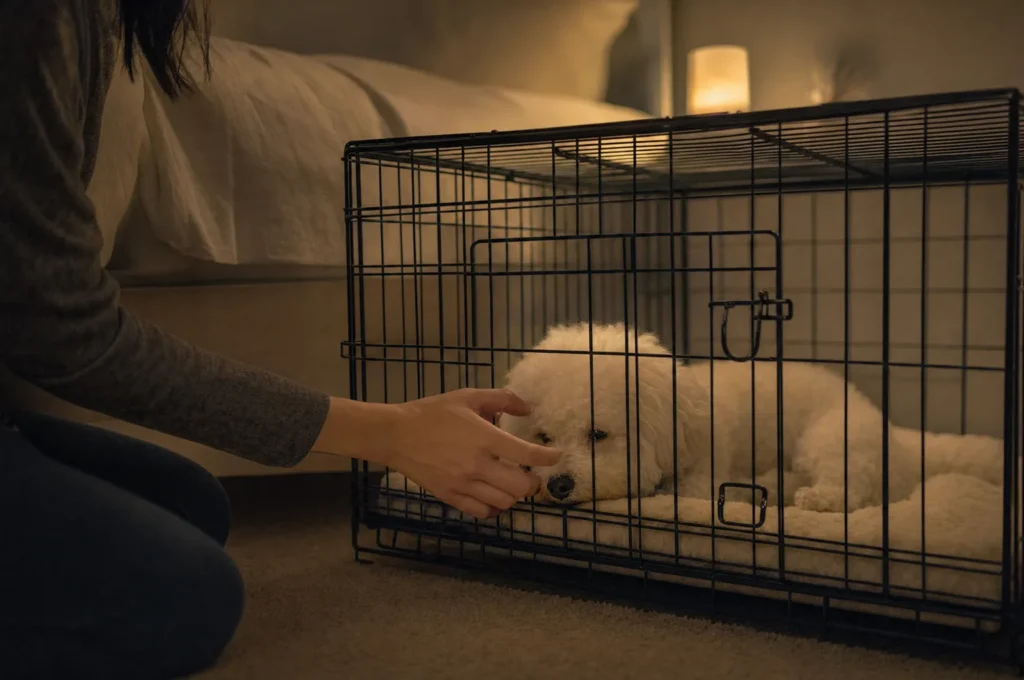
That loop for puppy crying in crate at night holds best when every adult in the house runs it the same way.
How long should you let a puppy cry in the crate at night?
Rule out a potty need first. After that, four trusted sources draw the line in different places, in their own words:
- AKC crate guide: “Never force your dog inside or leave them to cry it out.”
- Dr. Sung, PetMD: it’s “OK to let a puppy cry for a few minutes.” If whines “persist or escalate to louder, desperate cries, then it’s time to check on them.”
- Cathy Madson, Preventive Vet: “I only wait one minute at most to see if a puppy settles on their own.” That rule is for demand barking. She also tells owners to consider whether the puppy really needs a potty break.
- Humane World: if she’s never been let out for whining, “try to ignore the whining.” If it runs several minutes, use her potty phrase. If you’re “convinced that your dog doesn’t need to eliminate,” ignore her until she stops. “Never punish them for whining.”
How long until puppy crying in crate at night stops?
The Blue Ridge Humane Society’s trainer column gives a clear target. “Ideally, the puppy maybe cries for less than thirty minutes and then settles down.”
If she whines past thirty minutes and keeps building, the column says to go back some steps in training. After all, letting a puppy stay upset in the crate risks a negative association with it.
Across nights, there’s no fixed count. Crate training can take days or weeks, depending on her age, temperament and past experiences. So move to the next step only once she’s happy at this one.
Why does she whine in the crate during the day?
Whining to be let out during the day can mean you’ve increased the time too quickly. So try a shorter stretch next time. Two AKC habits also help. Meet her potty and exercise needs first, and crate her when she’s already calm or sleepy.
The full method is in our crate training guide.
My puppy keeps whining in the crate and won’t stop. Now what?
She may be alone longer than she’s ready for. So PetMD advises working more gradually on leaving her alone. If it becomes unmanageable, Humane World says you may need to start crate training over. A pen with the crate door open inside it can also work better for longer stretches.
Day or night, knowing when she last went out tells you whether a cry could be a potty cry.
When is puppy crying in crate at night more than normal?
The AKC’s Rachel Lane and Preventive Vet list these signs of stress or panic:
- Pacing, shaking, or scratching and biting at the door
- Long bouts of howling or barking, or drooling
- Panting, escape attempts or heavy licking of herself
Most puppy crying in crate at night is normal. Still, never crate a dog if it causes stress or panic, Lane says. So if you see these, stop and read our guide to dog anxiety in the crate.
Hours of screaming could mean she’s scared, hurt, hungry or needs to go. If you think she’s hurt, call your vet. If she stays very scared and crate work isn’t progressing, PetMD points to a board-certified veterinary behaviorist.
For the daytime potty routine, see our guide on how to potty train a puppy.
Puppy crying in the crate FAQ
What should I do on my puppy’s first night in the crate?
Put the crate in your bedroom or a nearby hallway, and take her out to potty first. Expect some crying while she settles in. On his first night, Preventive Vet’s puppy Finnegan calmed once his owner sat with him for just under ten minutes.
What if my puppy cries all night in the crate?
Crying that lasts all night and keeps building means slowing down and going back some steps in crate training. Check her potty timing, keep the crate near your bed, and comfort real distress. If she stays very scared, ask a board-certified veterinary behaviorist.
Should I cover my puppy’s crate at night?
It can help. A blanket can make a calm, den-like space and block distractions, PetMD says. The AKC adds that some dogs prefer a wire crate so they can see out.
Can crying in the crate cause separation anxiety?
Short, mild crying while a puppy adjusts is normal. With real distress, Dr. Sung warns that stressful events early in life can hurt a puppy’s ability to cope later. So comfort real distress, and slow the crate steps down.
Why is my older dog whining in the crate?
Dogs who haven’t learned to relax in a crate often whine or bark there, the AKC notes, puppy or not. Go back to short, rewarding sessions with the door open. If she panics, a pen or gated room is safer, with a trainer or behaviorist.
How we made this guide: In October 2026 we read the five sources listed below. The cue table, setup list and night loop use only those sources. Nobody at LoveMyPuppy is a veterinarian. Call your vet about anything that worries you.
Sources
- PetMD: Is Your Puppy Crying in Their Crate?, by Wailani Sung, MS, PhD, DVM, DACVB
- Preventive Vet: Crate Training at Night for Puppies, by Cathy Madson, MA, FDM, CBCC-KA, CPDT-KA
- American Kennel Club: How to Crate Train Your Dog, by Stephanie Gibeault, MSc, CPDT, with trainer Rachel Lane, plus How to Potty Train a Puppy and Dear AKC: My Dog Pees in Her Crate
- Humane World for Animals: Crate Training 101, plus How to Potty Train Your Dog or Puppy
- Blue Ridge Humane Society: Ask Crystal: Whining Puppy Woes, trainer Q&A column, April 2022