

Short answer: Put the outdoor dog potty area close to the door you use most. Keep it away from the patio and vegetable bed, too. Cover a small, edged patch with pea gravel or undyed mulch. Then lay it over a base that drains, sloped away from the house.
Then teach it: take her there on a leash every trip, wait, and reward her right there. Choose one consistent spot and always use a leash, advises Humane World for Animals.
There are yellow circles in the lawn now, all in the places she picked herself. Her paws also come in brown after every rain. And at 6 a.m. you’re walking the whole yard in slippers, waiting for her to choose.
Left to choose, she picks the spot for you. When a dog squats, she leaves concentrated urine in a small area, so that can injure or kill the grass there (Colorado State University Extension).
An outdoor dog potty area is one small, marked patch of yard she uses as her bathroom on every trip. Some people also call it a dog poop area, a potty yard or an outdoor potty area for dogs. The good news is you can sort this out, since she does most of the learning on the leash.
We don’t sell potty-area products, and this page has no affiliate links. We do, however, sell a printable puppy schedule kit, linked below.
✓ Built on guidance from Colorado State and Penn State Extension, Humane World, the AKC and trainer Mikkel Becker.
Where should you put an outdoor dog potty area?
Close to the door you use most, and away from where you eat or garden. After all, nobody wants to grill or eat near a used potty yard, and the garden shouldn’t sit downhill from it. That advice comes from trainer Debbie DeSantis, CPDT-KA, in her Puppy in Training build guide.
- Hot summers? Pick a shady corner.
- Snowy winters? Keep it near the house, so you aren’t shoveling a long path to it.
- Side yard nobody uses? Some owners put the spot there instead, along the house.
While you house train, keep her on a leash in the yard too (Humane World). So treat the yard like any other room in the house. If you find a tick on her after yard time, our guide on how to remove a tick from a dog covers the safe steps.
Why does the walk to your outdoor dog potty area matter?
A story from Michael Northcutt, our founder: Seven wooden steps led from my friend’s back door down to his yard. He’s in his seventies, but his knees are not. By the end of the first week, he’d done those steps more than forty times, carrying a squirming puppy.
“I didn’t think about the steps,” he said. “I thought about the puppy.”
So we looked at his house with fresh eyes. The front door, on the other hand, had one low step and a patch of grass beside the walk. It was twelve feet from his favorite chair. We moved the potty spot there.
He clipped the leash to a hook inside the front door, next to a little basket with bags and treats. The puppy slept in a crate right next to him, so the 2 a.m. trip was a short walk out the front.
“I spent two weeks being stubborn about the backyard,” he laughed later. “The puppy didn’t care where she peed.”
In the end, he fixed it by shortening the walk. So pick the spot you can reach fast, half asleep, in the rain. The chart shows how often you’ll make that trip.
2 months old
3 months old
4 months old
Source: normal stretch is about 1 hour per month of age (AKC, Humane World). Outer limit is months plus one hour (AKC, Humane World).
In short: a 2 to 4 month old puppy can usually hold it 2 to 4 hours. Months plus one is the limit.
How big should a dog potty area be?
Big enough for her to circle and still miss old piles. That’s because dogs circle before they poop, and they don’t want to step in feces. DeSantis suggests an eight-by-eight-foot area may be enough for a medium dog. A Chihuahua needs less, while a Great Dane needs more.
What is the best ground cover for a dog potty area?
Pick a cover that drains for your outdoor dog potty area. For lawn spots, Colorado State’s extension calls a mulch or gravel area the only sure fix. Otherwise, its advice is to pick a spot where you can live with the damage. The table sizes up four common picks for the best ground cover for a dog potty area.
| Cover | Best if | Drainage | Cleanup | Watch out for | Relative cost |
|---|---|---|---|---|---|
| Pea gravel | You want fast drainage and easy hosing | Urine drains through right away | Scoop, then hose down | Stones stuck in some big dogs’ pads; spreads without edging | Higher |
| Undyed or cedar mulch | You want a softer, lower-cost top | Drains well | Scoop; top it up as it breaks down | Absorbs urine and will smell in time; some dogs eat it | Lower |
| Artificial turf | You can build a base that drains well | Only as good as the base under it | Scoop, rinse, plus a cleaner for odor | Gets hot in full sun; odor if urine pools | Highest of the four |
| Real grass | You can water the spot after every pee | Normal soil drainage | Scoop; water the spot after she pees | Brown or dead patches | Lower |
Sources: Install-It-Direct and Puppy in Training (pea gravel, mulch, turf), Colorado State and Penn State Extension (grass). Cost is relative only: Puppy in Training ranks grass and mulch lower, gravel higher. Turf ranks highest in Install-It-Direct’s installed prices.
Is pea gravel good for a dog potty area?
For most yards, yes. Pea gravel is smooth, rounded stone, typically 3/8 inch. Urine drains through immediately, and the stones hose down easily (turf installer Install-It-Direct). Air between the stones also keeps it cooler than decomposed granite in sun.
DeSantis prefers it to driveway gravel, which has sharp edges that can hurt a dog’s feet. Smooth river rock is another choice, though some dogs play with it or swallow it.
- How deep: DeSantis spreads pea gravel two to four inches deep, over a drainage layer.
- Edging: Pea gravel wanders, so it needs a border tall enough to hold it in.
- Paws: Some larger dogs get small stones stuck between their paw pads (Install-It-Direct).
- Cleanup: Poop sticks to any gravel, so scoop carefully and hose often.
Mulch for a dog potty area: which kind is safe?
Choose plain, undyed mulch with no added chemicals. Cedar chips are soft underfoot but break down over one to two years (Install-It-Direct). Mulch also absorbs urine and will eventually smell (DeSantis).
Skip cocoa bean mulch entirely, because it contains theobromine and caffeine, like chocolate, and it can poison dogs (National Capital Poison Center). DeSantis adds that a dog who eats any mulch may choke or get a blockage. So watch a puppy who loves to chew wood.
Artificial turf for a dog potty area: what to get right
A poorly graded base lets urine pool and causes an odor that’s hard to fix later, Install-It-Direct cautions. Rinsing helps, but it doesn’t break down the dried urine residue. Turf can also get too hot for her pads in long sun.
Can you keep real grass in a dog potty area?
Yes, with a hose nearby. The brown spots come from nitrogen in urea, not pH, writes Penn State Master Gardener Carol Lugg. For spots on the lawn itself, the fix with research behind it is watering the spot right after she pees. So if she goes on a leash, carry a jug of water.
For dead patches, Lugg suggests raking them out, then reseeding with your lawn’s grass type.
How do you build drainage into a dog potty area?
Slope your outdoor dog potty area away from the house and away from anywhere you sit or garden. Then build it in layers, following DeSantis’s general steps. In fact, she calls the build not too difficult. First, clear the square of rocks, grass and weeds with a shovel or pick ax. Then the layers go on in order.
What you need: string, a shovel or pick ax, weed cloth, edging, sand or drainage rock, and your top cover.
- Mark and clear it. Use string to mark the square, then remove grass, weeds, rocks and sticks.
- Lay weed cloth. It blocks weeds and lets urine pass through.
- Add a border. Garden edging, outdoor-treated boards or low cinder blocks hold the gravel in.
- Add a drainage layer. Sand or drainage rock goes under the top cover.
- Top it. Spread your pea gravel or mulch last. She puts pea gravel two to four inches deep.
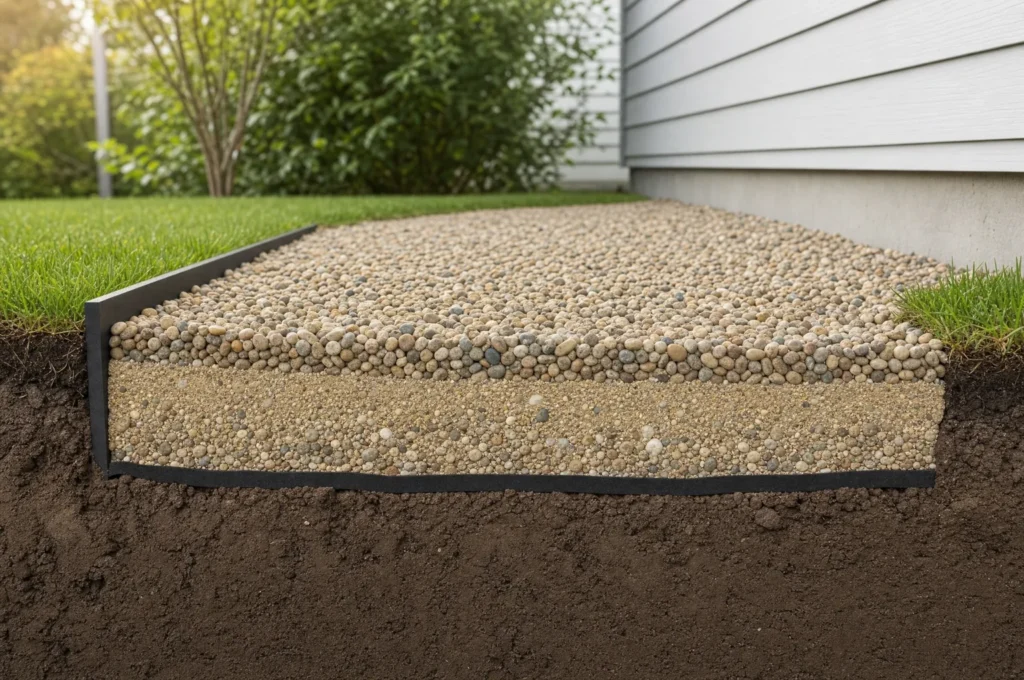
Layers from the bottom up: cleared soil, weed cloth, sand or drainage rock, then pea gravel on top. The border goes in after the weed cloth and holds the layers in.
Tip: Have a boy who marks? Penn State suggests placing a vertical element in the gravel or mulch area. For example, a post or a big rock you already own can do the job.
Renting? Make a potty spot without digging
Check your lease before you dig or lay gravel for an outdoor dog potty area. That’s because a landlord may count it as a change to the yard. You can still give her one clear spot.
- A marked corner. Use the same patch on every leash trip. Humane World’s rule is one consistent spot.
- A small pen near the door. A portable pen marks the spot with no digging. Dogkind Training also notes portable fencing is relatively affordable. Make sure the fencing is secure and holds her.
- A covered porch. If you have one, Dogkind calls it a good setup already.
No ground at all, only a balcony or patio? Our grass patch for dogs guide covers that.
How do you teach a puppy to use the potty spot?
Walk her there on a leash, every trip, the same way. These steps, from Humane World, the AKC and trainer Mikkel Becker, teach a puppy to pee outside in one spot.
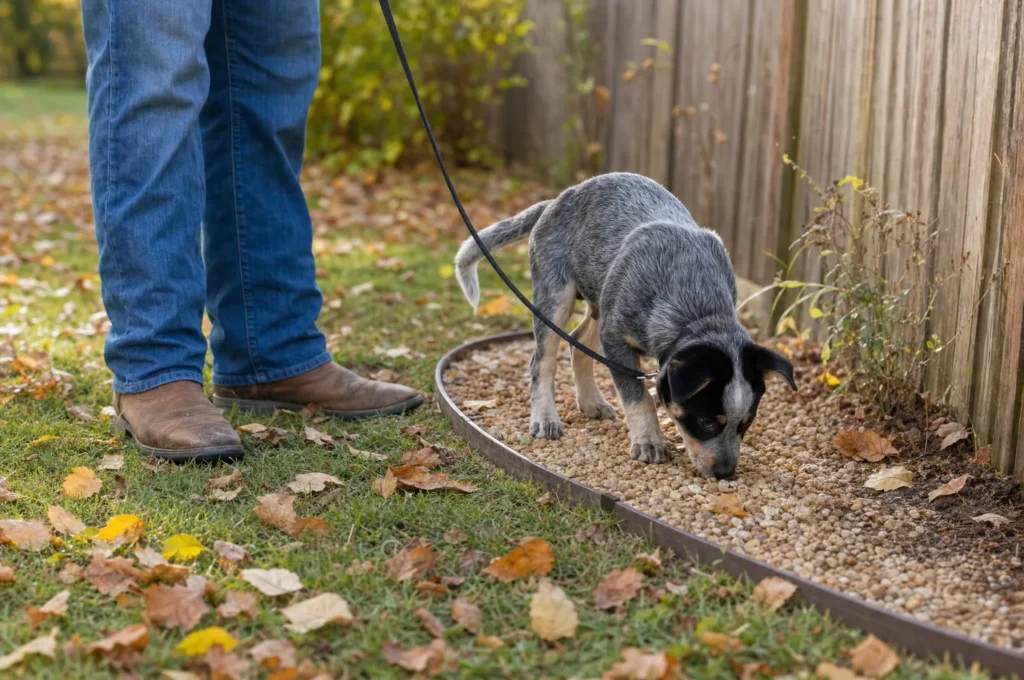
- Go straight to the spot. If she’s been confined for hours, head right there.
- Stand still and wait. Stand in one spot and wait, as Humane World’s crate guide puts it.
- Say a short cue as she starts. Becker suggests a phrase like “be quick.”
- Reward her right there. Praise her at once and give a small, high-value treat (AKC).
- Then the fun part. Becker rewards a finished potty with a short walk or play.
Had an accident inside? Put the soiled paper towels on her outdoor spot, a Humane World tip. The scent helps her link that patch with the job. Then clean the floor with an enzyme cleaner for dog urine, since lingering odor draws her back (AKC).
“Teaching your dog proper potty habits starts in puppyhood.”
Mikkel Becker, dog trainer, writing for Vetstreet
Do this on every trip, and she learns which patch is hers. DeSantis suggests leash trips for two weeks, or until your dog understands. Keep the leash on until she heads there every time. For the bigger picture, our how to potty train a puppy guide covers the whole first month.
One spot or many surfaces? Where the advice splits
Humane World asks for one consistent spot. Becker encourages puppy potty breaks on grass, concrete, sand and gravel, so they’re less picky later. Still, you can do both. Use the home spot for every yard trip, while walks show her other surfaces.
What if she won’t go on the gravel?
Does she pick the deck or the driveway instead? A dog taught on one surface or in one place can struggle somewhere new, Becker explains. She once moved a dog’s pad an inch a day toward the yard. It took several weeks. For a grass lover moving to concrete, she sets grass on top and shrinks it bit by bit. The same slow idea can work on gravel.
A nervous dog may need a smaller space. In that case, Dogkind Training suggests fencing a small area near the door. Opaque sides, like towels over a pen, can help too.
Tip: Text a photo of the spot to anyone who walks her. The sitter then uses the same corner you do.
How do you keep a dog potty area clean?
- Pick up poop promptly. Bag it and bin it, and never compost it (Penn State).
- Hose it down weekly. If it isn’t cleaned regularly, she may not want to use it (DeSantis). Expect a strong smell while it’s wet. It should fade once it dries.
- Refresh the top layer. Replace soiled gravel from time to time, and top up mulch as it breaks down.
- Share a yard? Keep a pooper scooper and a lined waste can beside the spot, so every pile goes straight in.
What about rain, snow and winter?
Mud after rain points to grading and drainage more than the ground cover (Install-It-Direct). For snow, an outdoor dog potty area near the door keeps your shoveling short. Dogkind Training suggests a covered area, such as a porch or a tarp over a pen. Stretch a tarp tight, since one flapping in the wind can scare her off.
The AKC says pads can be useful for very small dogs in severe winter weather. Our best puppy pee pads guide covers that.
When should you call the vet?
- She ate cocoa bean mulch. The Poison Center lists vomiting, diarrhea, a very fast heart rate, tremors and seizures. So any dog with symptoms needs a vet right away.
- Training isn’t fixing a potty problem. In fact, Becker starts any potty training issue with a veterinary checkup.
Building a routine around the new spot? Our puppy potty training schedule lays out trip times by age.
Outdoor dog potty area FAQ
What is the cheapest ground cover for a dog potty area?
DeSantis names grass and mulch as two of the cheapest. Grass burns from urine, though, and mulch may need topping up or replacing every year or two.
Do dog rocks stop yellow grass?
Penn State lists “dog rocks” among products sold to change urine pH, and pH isn’t the cause. Colorado State says no supplement is proven to reduce the spots. Ask your vet before trying any of them.
What if she digs in the gravel?
Dogs dig from boredom, to reach cooler soil or to chase burrowing animals, Install-It-Direct explains. For a steady digger, it suggests a separate digging zone, like a sandbox. Keep potty trips on the leash, and save play for after she goes.
How we made this guide: In October 2026 we read lawn guides from Colorado State and Penn State Extension. We read Humane World’s housetraining and crate guides too. We also read two AKC pages, Mikkel Becker’s Vetstreet answer and the Poison Center’s mulch warning. Page one of Google, including build guides from a trainer blog, a turf installer and Dogkind Training, shaped the sections. Questions owners post in forums did too. We did not test any surfaces or products. Nobody at LoveMyPuppy is a veterinarian.
Sources
- Colorado State University Extension: Dog Urine Damage on Lawns, GardenNotes #553
- Penn State Extension: Dogs vs. Lawns, by Carol Lugg, Master Gardener
- Humane World for Animals: How to Potty Train Your Dog or Puppy, plus its crate training guide
- American Kennel Club: How to Potty Train a Puppy, by Mara Bovsun, plus My Dog Pees in Her Crate
- Puppy in Training: How To Make an Outdoor Dog Potty Area, by trainer Debbie DeSantis, CPDT-KA