

Short answer: Run Self Clean, Samsung’s built-in washer cleaning cycle, in an empty drum about once a month. Samsung says you don’t need to add cleaner.
Save bleach for a mildew smell. On a front loader, clean the pump filter monthly too. If your washer has no Self Clean, any washer cleaner will do, so follow its label.
Crate pads, this morning’s muddy towels, the blanket she dragged outside. They all come out of your Samsung smelling faintly sour.
Moisture and detergent residue trapped inside the washer may promote the growth of mold and mildew. Until you clear them out, each load of towels goes round in that smell.
Before you buy a Samsung washing machine cleaner, look for a Self Clean button. It targets areas of the tub where moisture and detergent residue may accumulate. A normal cycle may not reach them.
Most of the fix is one button and an empty drum. It runs about an hour on a top loader and four on a front loader. You don’t have to stand and watch it.
Two links below go to things we sell, our washer cleaner tablets and the First 14 Days puppy kit.
✓ Built on guidance from Samsung Support, Maytag, TODAY, Washington State Department of Health and GSVS Veterinary Emergency Care.
How do you run Self Clean on a Samsung washer?
What you need
- An empty tub and a few paper towels
- Liquid chlorine bleach, only if you smell mildew or see mold
These steps come from Samsung’s US cleaning guide.
- Empty the tub. No towels, blankets or detergent go in.
- Press Self Clean, then Start.
- Let it run. It takes about one hour on a top loader and about four hours on a front loader. Start a front loader after the day’s last load, so crate pads aren’t left waiting.
- Watch for suds or residue. If you see either during the cycle, run another Self Clean afterward.
- Leave the door and detergent drawer open so moisture can’t linger.
Self Clean+ also cleans internal areas around the tub. Some models sold outside the US call the cycle Drum Clean or Eco Drum Clean. Samsung’s page for that cycle says to add no cleaning agents.
Why is the Self Clean light blinking on my Samsung?
That’s the reminder light. It comes on after 20 washes on a top loader or 40 on a front loader. Run Self Clean the next time the drum is empty. A week of accident blankets and muddy towels can push that count up fast.
Do you add soap, cleaner or bleach to Samsung Self Clean?
Routine Self Clean generally runs with no laundry or added cleaner. Follow your exact model manual for other cleaning cycles.
Samsung’s own pages disagree on Pure Cycle. The cycles page says no detergent or bleach should be used in it. The mildew guide lists Pure Cycle for its bleach method. The safest choice is to run Pure Cycle empty and check your manual before adding bleach to it.
Bleach is only for a mildew smell or visible mold, using the mildew steps below.
A story from Michael Northcutt, our founder: I heard the jingle of her tags going full speed down the hallway. I knew. She had a sock.
It was always a sock. Somebody’s dirty gym sock out of the open laundry basket, carried like a trophy. And we chased her, every one of us.
Then one night she didn’t run. She tried to swallow it. I got my fingers on the end of it just in time. I’d read enough to know a swallowed sock means calling the vet right away, not waiting to see.
The chase was teaching her to grab and run, and when we got close, to gulp.
So we changed two things. We got a laundry hamper with a lid. And we stopped chasing. If she had something, we went the other way and opened the treat jar loudly. Most of the time, she dropped the sock and came running.
That lidded hamper also gives towels and crate pads one home on the way to the washer. Empty the drum as soon as each cycle ends. Wet laundry left sitting is one of the most common sources of odors, per Samsung’s smells guide.
Can you use washing machine cleaner or tablets in a Samsung?
Choosing between cleaner types? Our washing machine cleaner buying guide explains the options. Your Samsung model’s instructions come first.
- Your washer has Self Clean or Pure Cycle. Samsung recommends Self Clean as the main way to clean the inside, once a month. No cleaner is needed.
- Your washer has neither. Then, in Samsung’s words, “using any washing machine cleaner will do.” Follow that product’s directions, because they vary.
- Store-bought cleaners. The smells guide names Tide Washing Machine Cleaner as a recommended product. Follow the cleaner maker’s directions.
With Self Clean, you don’t need our tablets. Without it, they’re one option.
Keep bleach away from urine-soaked laundry and other cleaning products. Do not combine cleaners or assume rinsing makes mixing safe.
How do you clean the filter on a Samsung washer?
Samsung front loaders have a pump filter. Its top loaders don’t.
Where is the Samsung front load filter, and how do you clean it?
The pump filter, also called the debris filter, keeps lint and debris out of the drain system. On most front loaders, it sits on the front, near the bottom, behind a small panel. Clean it at least once per month or approximately every 40 washes, whichever comes first. A dirty one can lead to odors, mold and poor draining.
What you need
- A towel, an oil drain pan or similar container, and a soft toothbrush
- A gate or crate for the puppy while the panel is open
- Wait an hour after Self Clean, Pure Cycle or Sanitize. The water behind the filter can be very hot.
- Open the access panel near the bottom. Press its top or center.
- Drain the water. Hold the drain hose over the pan and twist off its cap. It can be tight.
- Remove the filter. Twist it counterclockwise. On some models you push in first, like a medicine bottle cap.
- Brush it clean. Look into the housing and check that the drain pump impeller is clean.
- Put it all back. Twist the filter clockwise until it sits upright. Recap the hose, clip it in and close the panel.
Expect dog fur in the filter. If these steps don’t match your washer, follow your manual.
A 5E or 5C code on the display means the washer has detected a drainage problem. Samsung UK names a blocked filter or a kinked drain hose as the most common reasons.
Tip: Set a monthly phone reminder named “Self Clean and filter.” Counting to 40 washes is easy to lose.
Where is the filter on a Samsung top load washer?
The US guide says top load washers have no pump filter. Some have a lint filter, but not every top load washing machine has one, per Samsung Australia. Your manual shows whether yours does.
Pet Care top loaders trap loosened hair in two pet hair filters. Clean them before every wash, much like a dryer lint screen.
When fur is glued to the crate pad before the wash, try our free Pet Hair Removal Finder. It asks three questions about the surface, material and your main frustration. It suggests a remover type and its tradeoff, with no email needed.
How often Samsung says to clean, in washes
Bar length is the number of washes, out of 40.
At one load a day, a top loader’s reminder would come on about every three weeks.
In a puppy house, some of those loads are crate pads from a trip that came too late overnight.
How do you clean the door seal on a Samsung front loader?
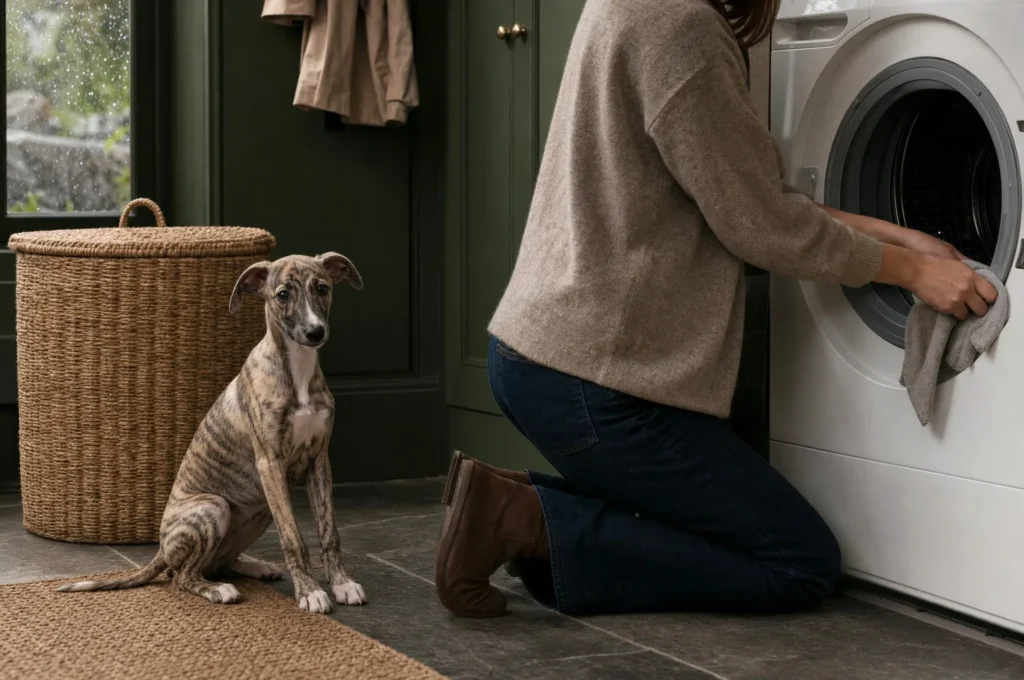
The rubber door seal, also called the gasket or door boot, is especially good at trapping moisture. Give it about a minute after each load. Take the clothes out, then wipe out the detergent drawer, tub and door seal with a clean, dry cloth. Pull any fur out of its folds too. For mold that’s already there, use the mildew steps.
How do you clean the Samsung detergent drawer?
Too much detergent can gunk up the drawer and even add to odors. Wipe it dry after each wash session and deep clean it at least monthly.
- Pull the drawer open until it stops. Lift out the dispensers and rinse them in warm water.
- Take the drawer out. On a front loader, push in on the ends of both sides at once, then pull. On a top loader, pull it out, then tip it up.
- Clean the opening. Use a soft cloth or a non-metallic brush on the drawer recess.
- Reassemble. Line the drawer up with its rails and push it fully closed. On some auto dispense models, dry the recess first.
What’s different on a Samsung top load vs front load washer?
For any brand, see our how to clean a washing machine guide.
| Part or task | Top load | Front load |
|---|---|---|
| Self Clean run time | About 1 hour | About 4 hours |
| Pump (debris) filter | None | Monthly or about every 40 washes |
| Lint or pet hair filter | Some models. Pet Care models have two, cleaned before every wash. | The pump filter does this job |
| Drying after a load | Leave the lid open | Wipe the rubber seal, leave the door open |
Black flakes on clothes from a Samsung top loader?
Residue can collect inside a washer. Run the cleaning cycle recommended for your exact model, with the drum empty.
Avoid copying vinegar or bleach quantities from instructions for another model. Ask Samsung for help if flakes keep returning.
Why does my Samsung washing machine smell?
Apart from a burning smell, the washer itself can’t create an odor, Samsung’s smells guide says. The smell comes from residue, trapped moisture or drain water. For smells on every brand, see our washing machine smells guide.
Samsung washing machine smells like mildew
Check your model manual before using bleach. Samsung instructions differ between models, including which dispenser receives it.
Use only the specified product, dose and cycle. Keep the drum empty and never mix bleach with another cleaner.
Follow the specified rinse steps afterward. Keep pets away and remove accessible residue once the machine is safe to handle.
Samsung’s cleaning guide explains routine care. The exact model manual takes priority for chemical use.
Samsung washer smells like sewage or rotten eggs
Drainage, trapped residue and water supply problems can produce similar smells. Do not assume another cleaning cycle will solve it.
Check the model’s troubleshooting guidance. Do not move heavy appliances or change hose placement without the correct installation instructions.
For persistent drain-related odor, read our washer sewer-smell guide and contact a plumber.
Samsung washer smells like burning
Stop using the washer if you notice smoke, overheating or a persistent burning odor. Contact Samsung for service.
For smoke, fire or a suspected gas leak, leave the area and call emergency services from safety.
What mistakes make a Samsung washer smell faster?
Each of these leaves residue or moisture behind, per Samsung’s prevention steps.
- Too much detergent. Stay under the MAX line. Extra soap builds scum in the outer tub, which eventually causes odors.
- Fabric softener. It causes the same buildup. Use dryer sheets instead, or a little distilled white vinegar in the washer if your manual allows it.
- Overloading. A stuffed drum can’t remove enough moisture.
To test for hidden residue, run an empty cycle with no additives. If suds appear, keep running empty cycles until they stop.
For the bed itself, see our how to wash a dog bed guide.
Tip: Powdered detergent is less likely than liquid to cause buildup. A puppy house with daily towel loads may want to switch.
When should you call Samsung or an appliance tech?
- Odor or mold remains after several attempts. Contact Samsung’s Support Center.
- A 5E or 5C code keeps coming back after you clean the filter and check the hose. The UK page points you to Samsung Repair or Support.
- Someone breathed mixed cleaner fumes and feels ill. Call a health care provider or 911.
- Your puppy swallowed a sock. GSVS Veterinary Emergency Care says to call an emergency veterinary clinic immediately. Never make her vomit without a vet’s advice.
Samsung washer cleaning FAQ
Can I put vinegar in my Samsung washer to clean it?
Check your exact Samsung manual. Do not assume a Sanitize cycle permits vinegar or a particular bleach dose.
Routine Self Clean generally needs no added cleaner. Never mix vinegar with bleach or other cleaning products.
Does a Samsung washer need HE detergent?
Yes. Samsung says skipping HE detergent causes excessive buildup. That can lead to vibration and longer cycles.
Should I ever wash in hot water in a Samsung?
If you normally wash cold, Samsung suggests an occasional warm or hot cycle. It helps slow soil and detergent buildup.
How we put this together: In October 2026 we read Samsung’s US, UK, Australian, New Zealand and Levant support pages. We also read two Samsung community answers, Maytag, TODAY, the Washington State Department of Health and GSVS. Samsung owner threads and Google’s first page decided which questions we answered. Nobody at LoveMyPuppy is an appliance technician.
Sources
- Samsung US: How to clean your Samsung washer, plus its washer smells guide, mildew guide, cycles page, pet hair guide, community answers on bleach and a rotten egg smell, and Samsung’s UK 5E/5C page, Australian lint filter page, New Zealand black particles page and Levant Eco Drum Clean page
- Maytag: Stop Using Vinegar to Clean Your Washing Machine
- TODAY: Are you cleaning your washing machine enough (or at all)? by Karen B. Gibbs
- Washington State Department of Health: Dangers of Mixing Bleach with Cleaners
- GSVS Veterinary Emergency Care: Dog Ate a Sock, An Emergency Guide to Intestinal Blockage