

Short answer: Potty training, or housebreaking, teaches your puppy to hold it until she’s in the right spot. Take her out often, to one spot, on a leash. Reward her the second she finishes.
When you can’t watch her, she’s tethered to you, crated or penned. Clean every accident with an enzyme cleaner, and never scold. Most puppies need months, not days.
We sell a printable puppy schedule kit and a puppy corner odor device, and we link to them below.
You stood in the yard for twenty minutes. Nothing. You walked back in, took off your shoes, and she squatted on the rug. Right in front of you.
Your partner says rub her nose in it, that’s how his family did it. Your sister swears by pads. A video says seven days. And it’s the third time today you’ve reached for the paper towels.
Potty training isn’t a test of how smart your puppy is. It’s a system. Give each trip outside about 5 minutes, and repeat it all day. You haven’t missed your chance. Every puppy has accidents while she learns.
✓ Built on guidance from VCA Animal Hospitals, the AKC, Humane World, Best Friends and Oregon Humane.
Accident happening right now? Do this.
- Calmly scoop her up mid-pee and carry her outside. If she finishes out there, praise her.
- No yelling. Best Friends says it can teach her to stop going in front of you, even outside.
- Clean the spot with an enzyme cleaner, not just soap. Leftover smell draws her back.
- Found it later? Best Friends says don’t punish. Just clean it up.
What’s the best way to potty train a puppy?
Frequent trips to one spot, an instant reward, close supervision, and calm cleanup. Every vet and shelter source we checked agrees on that core.
The AKC sums it up as consistency, supervision, a predictable schedule, and positive reinforcement. Here’s how that looks on an ordinary day.
1. Take her out far more often than feels necessary
The AKC lists the big moments. First thing in the morning, last thing at night, after naps, meals, drinks, chewing, play and crate time. For a young puppy, that can mean a dozen times or more each day.
Between those moments, VCA’s behavior team adds timed trips. Here’s the longest she should go.
Longest gap between potty trips
Plus a trip after every meal, big drink and nap. Bar length shows the gap.
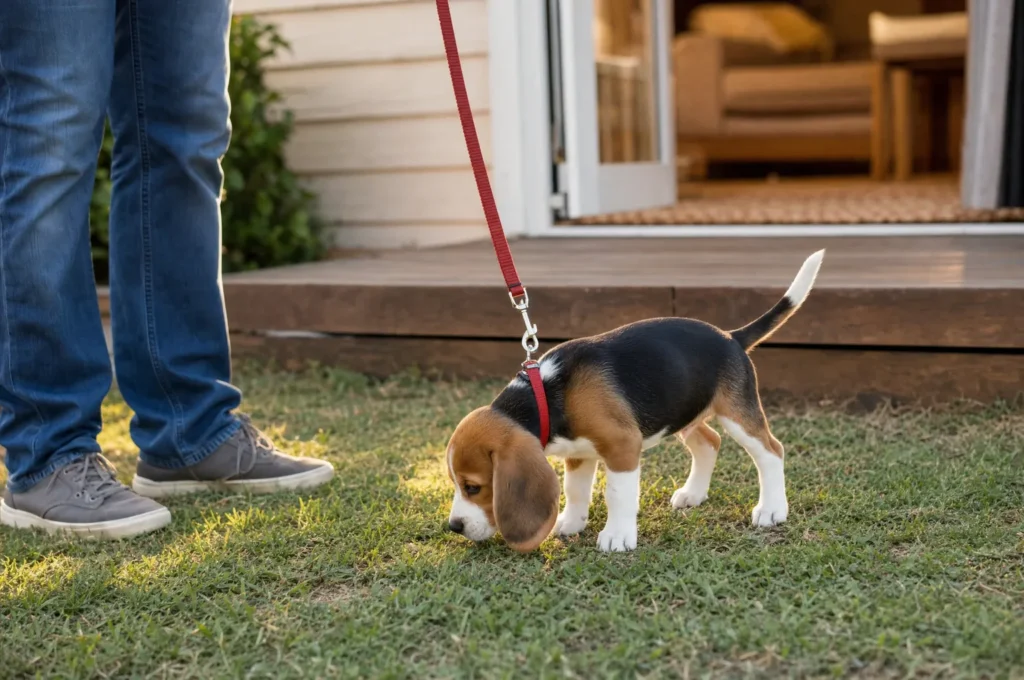
2. Use one spot, one door, one leash
Oregon Humane suggests a spot not too far from the door, and always on a leash. The same smell and the same route tell her what this trip is for.
3. Say a short cue while she goes
Pick a phrase like “go potty.” The AKC says to say it calmly as she starts going. Over time, she links the words to the job.
4. Reward her outside, within seconds
Wait until she’s completely finished, as Humane World advises, then praise and treat right there. Oregon Humane is blunt about timing: reward her immediately after she’s finished, not back inside. Keep tiny treats in your pocket.
5. Play comes after, not before
Best Friends says not to play during potty trips, so the trip has a purpose. VCA’s behavior team suggests saving yard play for after she goes. She learns to go first and sniff later.
6. Feed on a schedule
Puppies usually go soon after eating. Humane World says feeding at the same times each day makes potty times more predictable. Our puppy potty schedule breaks it down by age.
Tip: Keep the leash, treats and paper towels in one spot by the potty door. Fewer seconds hunting for a leash means fewer accidents on the way out.
Not sure how long she can wait between trips? Our free potty break timer shows her next trip time and her hard limit by age.
Thinking about an app to keep the whole house on track? Our best puppy training app guide ranks six, with prices checked.
Why does my puppy pee right after coming back inside?
Usually she got distracted outside, or the trip ended too soon. It’s one of the most common potty training complaints.
VCA’s behavior team says puppies left outside alone become distracted and do not eliminate until they are back indoors. A yard full of smells beats a full bladder, until she’s back on the warm rug.
- Go out with her, every time. No sending her out alone and watching from the window.
- Stand still and stay boring. Let her sniff in a small circle on the leash.
- No luck after 5 minutes? VCA says bring her in and watch her closely. At the first sign of restlessness, take her straight back out.
- Try again in 10. Oregon Humane suggests crating, penning or tethering her for 10 minutes, then another trip.
A story from Michael Northcutt, our founder: Fifteen years ago, someone told my neighbor to rub his puppy’s nose in its accidents. He admitted he almost did it again.
His new puppy peed on the rug, and his hand went to her collar before his brain caught up. Then he stopped. He didn’t remember that old puppy learning any faster. He mostly remembered it hiding when he came home.
So he asked his vet what people do now. Take them out often. Reward right away outside. Clean with an enzyme cleaner and don’t make a scene.
He wrote it on an index card by his coffee maker: “Reward, don’t punish. Crate is a den. Short sessions. Sleep matters. Ask the vet when unsure.”
His puppy is eight months now. “She’s never hidden from me when I come home,” he told me. “Not once.”
What do you do when you can’t watch your puppy?
She’s either supervised or safely confined. That rule prevents most accidents.
VCA’s behavior team defines supervised as tethered to you, or in sight less than 10 feet away. Anything else counts as unsupervised.
| Your situation | Best setup | Why it works |
|---|---|---|
| Home and moving around | Tether her to you on a 4 to 6 foot leash | You see the sniff and circle in time |
| Cooking, on a call, short errand | Crate, up to about 3 hours | Most puppies avoid soiling where they sleep |
| Busy for a while, home | Small gated room or pen | Room to move, little room to wander off and go |
| Gone more than 3 hours | A midday helper, or a pen with a separate pad area | She can’t hold it that long yet |
For longer absences, Oregon Humane suggests a specific place indoors. New to the crate? Our crate training guide covers the first steps.
What are the signs a puppy needs to go?
Sniffing the floor, circling, suddenly stopping play, whining or scratching at the door, and restlessness.
Those are the AKC’s list. Humane World adds heading toward the door. If you see any of them, don’t wait to be sure. Pick her up and go.
Thinking about potty bells? VCA says a puppy can learn to ring a bell on the door once she can hold it. Some dogs learn to ring it just to play outside, so keep bell trips short and boring.
Not sure where your house keeps slipping? Our free Puppy Week Check-In asks six quick questions once she’s home. You get one practical next step, and no email is needed.
What mistakes slow potty training down?
Punishing accidents, giving freedom too soon, cleaning with the wrong product, and sending her out alone.
- Scolding or rubbing her nose in it. Humane World says it only makes puppies fearful and slows progress. Best Friends adds she may stop going in front of you.
- Too much house, too soon. Every unseen accident is practice in the wrong spot. Oregon Humane says frequent indoor accidents prolong training.
- Regular cleaner. Best Friends says only enzymatic cleaners break down the scent that draws her back. Our enzyme cleaner guide covers what to look for.
- Treats back inside. Oregon Humane says the reward has to happen outside, or she won’t know what it’s for.
- Leaning on pads forever. Best Friends warns a paper- or pad-trained puppy may keep a preference for that surface. The AKC says pads can slow the move outdoors.
“Never rub a dog’s nose in an elimination.”
Ellen Lindell, VMD, DACVB, board-certified veterinary behaviorist, and Monique Feyrecilde, LVT, VTS (Behavior), writing for VCA Animal Hospitals
How long does it take to potty train a puppy?
Usually months, not days. The experts give different numbers, so here’s where they land.
| Source | What they say |
|---|---|
| Best Friends | Days to weeks, with a predictable routine |
| AKC | Some puppies within days, others several months |
| VCA behaviorists | More freedom after 8 to 12 weeks without mistakes |
| Humane World | Typically 4 to 6 months |
The spread comes from different finish lines. Best Friends talks about a puppy who’s mostly getting it. VCA and Humane World mean a puppy you can trust loose in the house.
After a week or so with no accidents, Best Friends suggests a little more freedom after each successful trip. Full run of the house waits until she’s gone 8 to 12 weeks clean, as VCA suggests.
Age matters too. The AKC notes an 8-week-old and a 5-month-old have very different bladders. The AKC’s common guide is about one hour of holding per month of age. Humane World puts the outer limit at her age in months plus one hour.
Why is my 4-month-old suddenly having accidents again?
Setbacks around this age are common, and they usually mean she got more freedom than she was ready for. The AKC says gradually increasing freedom works better than unrestricted access too early.
Go back to the early routine for a week or two. More trips, closer watching, and the pen when you can’t watch. If accidents keep coming on a steady routine, call your vet.
How do you potty train a puppy in an apartment?
Same method, shorter gaps, and a plan for the elevator.
- Carry her out. A small puppy carried down the hall can’t stop and squat on the way.
- Leave a few minutes earlier. Elevators and stairs add time her bladder doesn’t have.
- Long workdays need a plan. For absences over 4 to 5 hours, Oregon Humane suggests a pen with a separate pad spot. Our puppy pads guide covers moving from pads to outside.
- Protect your deposit. Clean every spot with an enzyme cleaner the same day.
When should you call the vet about potty accidents?
If accidents keep happening despite a steady routine, or a puppy who was doing well suddenly slips.
The AKC says dogs who stay hard to house train despite consistent training should get a vet check. If health problems are ruled out, a trainer or behaviorist is the next step. Best Friends adds that a trained dog who starts having accidents may have a medical cause.
Some accidents aren’t potty training at all. Oregon Humane lists excitement peeing at greetings, marking, fear and anxiety. Those need a different plan.
Puppy potty training FAQ
What is the 10-10-10 rule for potty training puppies?
We couldn’t find it by that name in vet or shelter guidance. The closest is Oregon Humane’s advice: if she doesn’t go, confine or tether her 10 minutes, then try again.
What is the 3-3-3 rule for puppies?
The Humane Society of North Texas uses it to describe how a newly adopted dog settles in. Expect about 3 days to decompress, 3 weeks to learn routines, and 3 months to feel at home. It recommends frequent bathroom trips in those first days. Even house-trained dogs can have accidents while adjusting, it notes.
What is the 7-7-7 rule for puppies?
It’s a socialization checklist, also called the Rule of Sevens. SPCA of Wake County’s version lists what a puppy should have done by 7 weeks old. That includes 7 places, 7 people, 7 surfaces like grass and concrete, and at least 7 times in a crate. Ask your breeder or shelter which of these she has already done.
At what age should a puppy be fully potty trained?
There’s no set age. Humane World says house training typically takes 4 to 6 months. Size, age at the start and past habits all change it.
Can you potty train a puppy in 7 days?
Some puppies get the idea within days, the AKC says. Bladder control takes longer, so expect accidents for weeks or months.
Should I wake my puppy up at night to pee?
Young puppies often need overnight trips. VCA says some need them until about 5 months old. Keep night trips quiet, with no play.
Why does my puppy pee when someone comes home?
That’s often excitement or submissive urination, not a potty training problem. Oregon Humane suggests ignoring or distracting her with a toy during greetings.
Can you potty train an older puppy or rescue dog?
Yes, with the same method. The AKC notes rescues who were confined too long may soil their crate. Go back to basics with frequent breaks.
How we put this together: We checked VCA’s veterinary behaviorists, the AKC, Humane World, Best Friends and Oregon Humane. Then we read what new owners say in reviews, video comments and puppy forums.
Sources
- VCA Animal Hospitals: Housetraining for Puppies and Dogs, by Ellen Lindell, VMD, DACVB, and Monique Feyrecilde, BA, LVT, VTS (Behavior)
- American Kennel Club (AKC): How to Potty Train a Puppy, by Mara Bovsun
- Humane World for Animals: How to Potty Train a Puppy
- Best Friends Animal Society: How to Potty Train a Puppy or Dog
- Oregon Humane: Potty Training Your Puppy