

Short answer: Crate anxiety is fear or panic about being shut in a crate. It shows up as panting, drooling, shaking, frantic escape attempts or nonstop howling. That’s distress, so stop closing the door for now.
If she only falls apart when you leave, it’s more likely separation anxiety. Both get better with tiny, calm steps. Severe cases need a pro.
We sell a printable puppy schedule kit, and we link to it below. We don’t sell crates or calming products.
There’s drool on the crate tray. A bent wire by the door. Your neighbor mentioned the howling, politely. Your landlord might be next.
You haven’t slept a full night in a week. Your partner says let her cry it out. You can’t stand to. And tomorrow morning you have to leave for work.
Dog anxiety in the crate is common, and it isn’t disobedience. You didn’t ruin your puppy. You just need to know if she’s protesting or panicking, because the fix is different.
✓ Built on guidance from the ASPCA, VCA, the AKC, Humane World for Animals and Preventive Vet.
Have to leave tomorrow? Do this first.
- Skip the closed crate. Use a puppy-proofed room behind a baby gate or an exercise pen.
- Line up company if you can. The ASPCA says most dogs with separation anxiety are fine as long as someone is with them. A friend, a sitter or daycare all count.
- Potty trip and a good play right before you go.
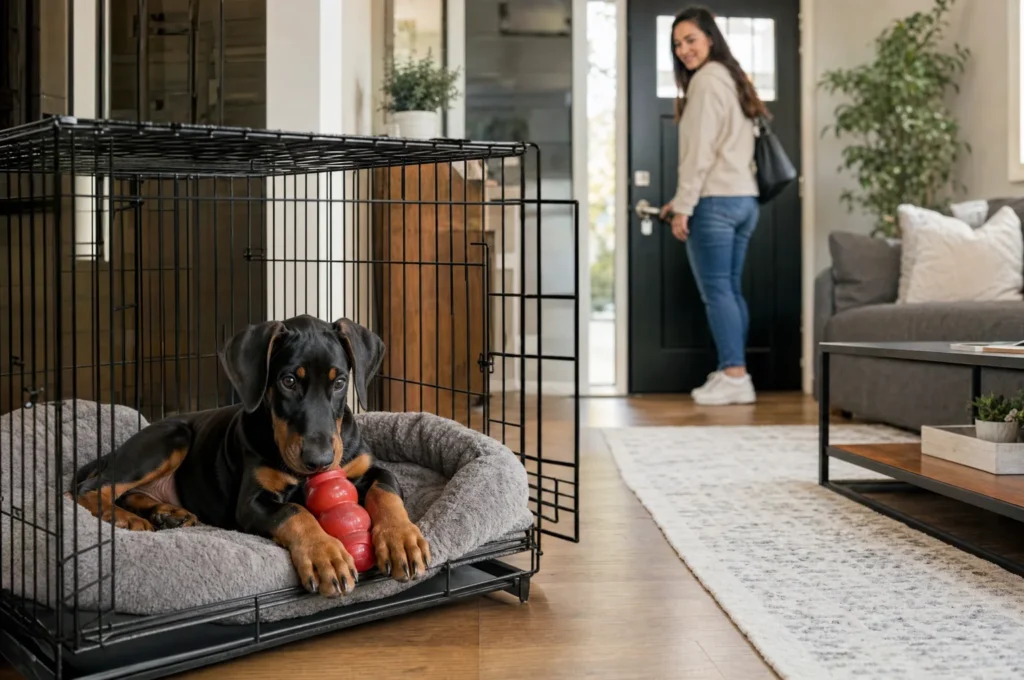
- Leave a stuffed food toy, then walk out calmly with no goodbye speech.
- If she bends bars or claws at doors, a sitter or daycare is the safest choice.
- Prop up an old phone and record. You’ll know by lunch what you’re dealing with.
What are the signs of anxiety in the crate?
Heavy panting, drooling, shaking, pacing, nonstop howling, and trying to dig or chew her way out.
The ASPCA lists the stress signs to watch for: dilated pupils, panting, yawning, salivating, trembling, pacing. Another is an over-the-top greeting when you get home.
VCA’s behaviorists add a quieter set. Some dogs refuse to eat, or become quiet and withdrawn. So a silent dog on camera may still be scared.
Escape attempts can hurt her. The ASPCA says they can cause broken teeth, cut and scraped front paws and damaged nails.
Is it protest, crate anxiety, or separation anxiety?
Watch when it starts and when it stops. That tells you more than how loud she is.
| What you see | Likely meaning | What helps |
|---|---|---|
| Whines briefly, then settles on her own | Adjusting | Keep the steps slow and boring |
| Barks after being settled a while | Boredom, hunger or a potty need | A potty trip, more exercise |
| Panics in the crate even with you in the room | Confinement anxiety | Pen or gated room, rebuild slowly |
| Fine with you home, falls apart when you leave | Separation anxiety | Alone-time training and a pro |
| Upset the moment you grab your keys | Pre-departure anxiety | Practice fake departures |
The AKC says crying that starts within minutes of going in is likely stress. Barking after she’s been settled a while is more likely boredom, hunger or a bathroom need.
Preventive Vet trainer Cathy Madson describes distress barking as high-pitched, non-stop barking or howling. Demand barking is repetitive, with your puppy looking right at you, waiting for your next move.
Why is my puppy screaming in the crate for hours?
Usually she hasn’t learned to be alone yet, the crate time grew too fast, or she needs to pee.
The AKC says crate crying is especially common in puppies who haven’t yet been taught to be alone. An 8-week-old has never spent a minute without her littermates. Hours of screaming is a sign the jump was too big.
- Check the clock. Humane World says puppies under 6 months shouldn’t be crated more than three or four hours at a time.
- Read the cry. High-pitched, nonstop crying with panting or pacing is distress. Go to her and comfort her calmly. Preventive Vet says you can and should.
- Whining while she watches you? That’s more often a request. Wait briefly, then offer a potty trip using your usual phrase, as Humane World suggests.
- Shorten the next session. Humane World says whining to get out can mean you increased the time too quickly.
- Never punish the crying, Humane World says. The AKC adds: never leave her to cry it out.
Only calm when you hold her? That’s a puppy who has never practiced being alone. Start beside the crate. AKC trainer Rachel Lane’s advice: sit next to it and toss treats in with the door open. Then slowly build the time. For nights, our crate training guide covers the first-night setup.
Why do dogs get anxious in the crate?
Usually the crate came too fast, lasted too long, or got linked to something scary. Sometimes the real problem is being alone.
- Rushed start. She went from “what’s this box?” to door-shut-for-hours in a day.
- A bad moment. Lane says a noisy door, or one that once hit the dog, can make her avoid the crate. She suggests switching crate styles.
- A big change. The ASPCA says a sudden absence, like someone moving out, can trigger separation anxiety. Going back to the office counts too.
- Too long inside. Humane World says a dog crated all day and night can become depressed or anxious.
Why is my dog biting or chewing the crate bars?
Bar biting with drool, panting or bent wires is an escape attempt. VCA’s behaviorists say this may be confinement or barrier anxiety. Stop crating, check her teeth and paws, and tell your vet. A calm puppy gnawing a bar while teething is different. Give her a chew and watch for panic signs.
Why is my dog peeing in the crate when I leave?
VCA says house soiling in a crate may be confinement anxiety. It can also be medical. The ASPCA suggests ruling out problems like a urinary infection with your vet first. Never scold her for it.
A story from Michael Northcutt, our founder: One evening I came home to a note taped to our door. “Your dog cries for hours when you’re gone. Please do something.”
My stomach dropped. Whenever I got home, she was always so happy. I figured she’d slept the whole time.
That weekend, I set up my old phone as a camera and left for twenty minutes. When I watched the video, I wanted to cry. She whined by the door the whole time.
So I went back to square one. Tiny practice sessions while I was home. A food-stuffed toy when I left. A potty trip and a good play first. A little log of how long I was gone and what she did.
I asked our vet if this was normal puppy fussing or something more. They gave me the name of a qualified trainer, just in case. A different neighbor I trust started stopping by at lunch.
Then I knocked on my neighbor’s door, apologized, and told him my plan. Two weeks later, he stopped me in the hall. “It’s gotten a lot quieter.”
Should you stop using the crate if your dog is anxious?
If she shows real distress in it, yes, for now. A gated room or pen is safer while you work on the cause.
The ASPCA suggests a test. Watch her in the crate while you’re home. Heavy panting, drooling, frantic escape attempts or nonstop howling mean crate confinement isn’t the best option for her.
“Crates should be used with caution.”
Debra Horwitz, DVM, DACVB, and Gary Landsberg, DVM, DACVB, DECAWBM, board-certified veterinary behaviorists, writing for VCA Animal Hospitals
They explain why. For dogs with separation anxiety, crates can promote intense escape attempts and fairly serious injuries. Humane World agrees a crate won’t solve separation anxiety.
Dropping the crate isn’t failing. The AKC suggests a larger, puppy-proofed gated area or exercise pen for anxious dogs. Plenty of dogs do better there. Others learn to love the crate later, once the panic is gone.
How do you help a dog with crate anxiety?
Lower the pressure first. Then rebuild in steps so small she never gets upset.
Trainers call this desensitization and counterconditioning. That means tiny doses of the scary thing, paired with something she loves. Each session takes a few minutes. Several a day fit around a workday.
1. Stop the full-blown panic
Every panic session teaches her the crate is scary. The ASPCA says she should never experience the full-blown version of what upsets her while you train. Use a sitter, daycare or a gated room for now.
2. Play the treat-toss game, door open
Toss treats in and let her wander out. Feed meals at the back. Let naps happen there with the door open. Close it only for a few seconds at first. Our crate training guide walks through the full steps.
3. Make leaving boring
Pick up your keys, then sit on the couch. Put on your coat, then make tea. VCA says that once you put everything away, your dog should lie down. Over time she stops reacting to those cues.
4. Give her a job when you go
For mild cases, the ASPCA suggests a stuffed food toy that takes 20 to 30 minutes to finish. Freeze it to make it last. If she won’t touch food when you’re gone, the anxiety is stronger than it looks.
5. Keep hellos and goodbyes flat
Skip the goodbye speech. VCA’s behaviorists say a goodbye only draws attention to the departure. When you come home, they suggest ignoring her until she settles, which may take 10 to 15 minutes.
Tip: Before a long departure, VCA suggests a good play and exercise session first. A tired puppy settles faster than a bored one.
Do calming aids help with crate anxiety?
Some can help her relax, but none fix anxiety on their own.
VCA’s behaviorists name a radio or TV, clothing with your scent, and a comfy bed. They say these can help to promote a relaxed response. They also say pheromone therapy can be useful for lowering anxiety.
For severe cases, the ASPCA says medication can be very helpful, and some dogs can’t start training without it. That’s your vet’s call. Use any calming aid alongside the steps above.
Daycare, a sitter or the crate: what’s best while you work?
For an anxious dog, company usually beats confinement. A full workday is too long in a crate for any puppy.
| Situation | Better choice |
|---|---|
| Panics when alone, any length | Sitter, friend, daycare or bring her to work |
| Calm alone, but a long day | Gated room or pen plus a midday visit |
| Puppy under 6 months | No more than 3 to 4 hours crated at a stretch |
| Adult dog, calm in the crate | Up to 4 to 5 hours, Humane World says |
The ASPCA’s options for anxious dogs: a family member, friend or sitter at home, a sitter’s house, or doggy daycare.
How long does it take to fix crate anxiety?
Expect weeks, not days. Severe cases often need a pro.
For separation anxiety, the ASPCA lays out a ladder. Start with absences shorter than the time it takes her to get upset, sometimes just seconds.
The alone-time ladder
Each rung only after she stays relaxed. Bars show the order, not the scale.
The ASPCA notes most anxious responses happen in the first 40 minutes alone, so the early rungs go slowly.
Rushing backfires. The ASPCA warns that many owners make mistakes because they want quick progress. If you see stress signs, step back to the last calm rung.
How do you know it’s working? She eats her food toy while you’re gone. She lies down when you pick up your keys. The camera shows her napping, not pacing.
When should you get professional help?
If she injures herself, panics every time, or isn’t improving after a few weeks of slow work.
For a plan, the ASPCA points to three kinds of pros. A Certified Applied Animal Behaviorist, a board-certified veterinary behaviorist, or a trainer experienced in treating fear.
Never punish the panic. The ASPCA says anxious behaviors are not the result of disobedience, and punishment can make things much worse.
Crate stress often shows up with potty setbacks too. Our puppy potty training schedule shows how often she really needs out.
Dog crate anxiety FAQ
How do I know if my dog has crate anxiety?
Look for heavy panting, drooling, trembling, pacing, nonstop howling, or trying to escape. Brief whining that stops on her own is less worrying.
How long should I let my puppy cry in the crate?
Not at all if it’s distress. Comfort her, as Preventive Vet advises. For mild whining, wait briefly, then offer a potty trip, as Humane World suggests.
Is it OK to crate a dog with separation anxiety?
Only if she’s truly calm in it. If she shows distress, the ASPCA and AKC suggest a gated room or exercise pen instead.
Why is my dog fine in the crate when I’m home but not when I leave?
That pattern points to separation anxiety, not the crate. Work on alone time in tiny steps, and talk to a qualified professional.
Why did my dog suddenly start hating the crate?
Look for a change. A door that hit her, a long stretch inside, a new schedule, or a health problem. Go back to basics, and see your vet if accidents start too.
Why is my dog panting in the crate?
Panting is a common stress sign. Rule out heat first. If it happens every time, treat it as anxiety and stop closing the door for now.
Will a crate cover help an anxious dog?
Some dogs settle better in a darker, den-like crate, the AKC says. A cover won’t fix separation anxiety, and remove it if she chews it.
Is a wire crate or a plastic crate better for an anxious dog?
No crate makes panic safe. If a door or crate style scared her, the AKC’s Rachel Lane suggests switching styles. For true panic, use a pen or gated room.
Is daycare better than crating a dog with separation anxiety?
Often, yes. The ASPCA says most dogs with separation anxiety are fine as long as someone is with them. Daycare or a sitter can bridge the gap while you train.
Can you prevent crate anxiety in a puppy?
Yes, mostly. VCA’s behaviorists suggest scheduled alone time in her own crate or bed from early on, alongside slow, happy crate training.
How we put this together: We checked the ASPCA, VCA’s two vet behaviorists, the AKC, Humane World and Preventive Vet. Then we read what owners say in dog training forums.
Sources
- ASPCA: Separation Anxiety
- VCA Animal Hospitals: Separation Anxiety in Dogs, by Debra Horwitz, DVM, DACVB, and Gary Landsberg, DVM, DACVB, DECAWBM
- American Kennel Club (AKC): Everything You Need to Know About Crate Training Your Dog, quoting Rachel Lane, M.Sc., CPDT-KA, CBCC-KA
- Humane World for Animals: How to Crate Train Your Dog or Puppy
- Preventive Vet: Crate Training Your Puppy at Night, by Cathy Madson, MA, FDM, CBCC-KA, CPDT-KA