

Short answer: Pick one pad spot. Take her to it every 2 to 3 hours, plus after naps, meals and play. Reward her the moment she goes.
Plan the move outside before day one. Shift the pad toward the door over at least a couple of weeks, never all at once.
We sell a printable puppy schedule kit and a puppy corner odor device, and we link to them below. We don’t sell puppy pads.
It’s 6 a.m. and there’s a puddle six inches from the pad. Again.
She used it twice yesterday, so you know she gets it. Then she tore a pad to confetti, napped on another one, and peed on the bath mat.
You’ve probably heard both camps by now. One says pads ruin potty training. The other says pads saved their carpet. The right answer depends on your home.
When potty training a puppy with puppy pads goes wrong, it’s usually one of three things. Too many spots, too few trips, or no exit plan.
The exit plan is the one people forget. Pull the pads too fast and puppies hunt for a new spot. Trainer Jill Vogel lists a carpeted corner or a pile of clothes as common picks.
Below is when pads make sense, including while she waits for her shots. Then the 6 steps, fixes for the usual messes, and the way off them.
Should you potty train a puppy with puppy pads?
Use pads (also sold as potty pads or wee-wee pads) if you can’t get her outside often enough. They also fit while her vet wants her off public ground. If someone’s home and you have a private yard, skip them and go straight outside.
The AKC says pads may help owners who cannot return home frequently during the day. They also help with very small dogs in hard winters.
The Animal Humane Society adds small breeds in high-rise apartments, where the elevator ride can outlast a tiny bladder.
Pads are one housebreaking route, and they come with a cost. They can sometimes slow the move to going outside, per the same AKC guide. You teach an indoor potty spot first, then a second one later.
| Your situation | Pads? |
|---|---|
| You work long days and nobody can come home | Good fit |
| High floor, toy breed, or a hard winter | Good fit |
| Shots not done yet, and no private yard | Good fit until her vet clears her |
| Someone is home and you have a yard | Usually skip, go straight outside |
| You want her outside by next month | Usually skip, or use them briefly with an exit plan |
Can you use puppy pads before her shots are done?
Yes. Until she’s fully vaccinated, pads are a safe potty spot if you don’t have a private yard.
Veterinarian Brittany Grenus, DVM, writes for PetMD. She says puppies shouldn’t walk on public ground or meet unknown dogs until two weeks after their final core shots. That’s typically 18 to 22 weeks old.
She also says your own backyard is fine as long as no sick dogs have been there recently. So if you have a private yard, use it for potty trips from day one. She learns grass early, and there’s less to unlearn later.
No yard, or only a shared patch by the building? That’s where pads make the most sense. Ask your vet which spots are safe where you live.
A story from Michael Northcutt, our founder: Our vet told me our puppy should stay off the ground in public places until she’d had all her shots. Then a trainer friend told me she needed to see the world before she was sixteen weeks old.
I stood in my kitchen thinking, “How do I do both?”
So I called the vet back and asked straight out what we could do safely. Carry her in public places. No dog parks, no pet store floors. Meet healthy, vaccinated dogs at friends’ houses.
For a few weeks, she rode in a little wagon with a blanket in the bottom. She got a treat for every new thing she saw and stayed calm.
Her last shots were done, and the vet gave the okay. On her first walk, she sniffed every blade of grass like it was a new planet. The wagon’s in the garage now. I can’t get rid of it.
How do you potty train a puppy with puppy pads?
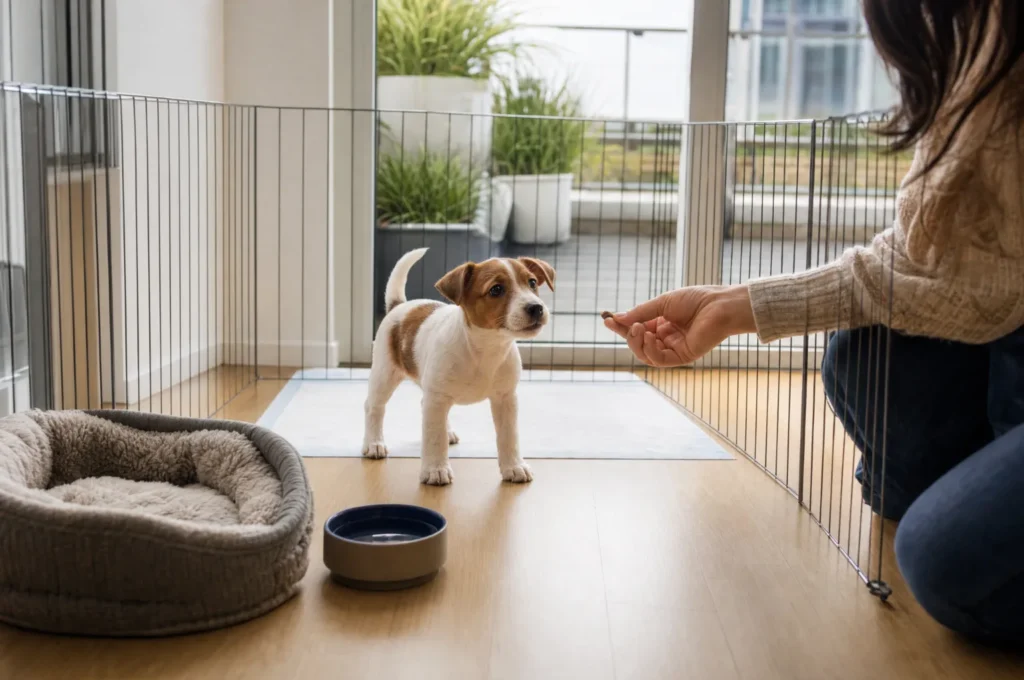
One spot, a clock and a reward on the pad. Add a small space when you can’t watch, and a real cleanup after misses.
1. Pick one pad area, in one room
Choose a low-traffic area, away from her food bowls. The AKC’s indoor potty advice points to a low-traffic area for privacy.
One area, not one per room. Pads scattered around the house teach her that every room has a bathroom.
2. Start with a big pad area, then shrink it
In that room, cover the floor with pads when you can’t watch her. The Animal Humane Society suggests this start, with her water, a toy and bedding in there too.
After 2 to 3 days, take away one pad. Every two days, take away another until one is left, as far from her bed as the room allows.
If she pees off the remaining pads, put them all back and start over. Restarting just gives her a bigger target for a few more days.
3. Take her to the pad on a clock
Don’t wait for her to find it. The Animal Humane Society recommends every 2-3 hours, plus after sleep, play and eating.
The AKC says puppies can hold it about the same number of hours as their age in months. At 8 weeks old, that’s roughly every 2 hours. Depending on her age, AKC guidance says that can mean a dozen times or more each day.
Pad maker Earth Rated calls the extra trips the 10-10-10 rule. Offer a break about 10 minutes after waking, 10 after eating, and after about 10 minutes of play.
Carry a young puppy to the pad. Set her down, stand still, and wait quietly.
4. Say one cue word, then reward on the pad
Say the same short word as she starts, every time. Everyone in the house uses that same word.
Reward her the second she finishes, right there on the pad. A treat in the kitchen a minute later teaches nothing.
Most pads carry a scent attractant she can smell, Vogel notes in her weaning guide. The scent draws her over, and your timing and treats teach her to use it.
5. Limit her space when you can’t watch her
A loose puppy picks her own spot, usually a rug. When you’re busy, put her back in the pad room or a pen with a pad at one end. The crate works for a short nap. Here’s how to crate train a puppy so she likes it.
Want the timing by age? Our puppy potty training schedule covers 8, 12 and 16 weeks. Training outside instead? Start with how to potty train a puppy.
6. Clean every miss with an enzyme cleaner
Never scold her for a miss. Just clean it well.
Dogs frequently return to areas that still smell like past accidents, according to the AKC. An enzyme cleaner breaks that smell down.
What if your puppy already used pads at the breeder?
Ask the breeder what they used and where. Then copy it for the first few days.
Same kind of pad, in a similar spot, away from her bed. She’s already lost her littermates and her home. A familiar potty spot is one less thing to relearn. Then start the steps above.
Why does my puppy pee next to the pad, or tear it up?
Usually the pad area is too small, the pad is soaked, or she’s bored. Here’s how each one shows up.
| What you see | Likely reason | Try this |
|---|---|---|
| Pees right next to the pad | The target is too small, or she’s half on, half off | Put more pads back, then shrink the area more slowly |
| Shreds or chews pads | Boredom, teething, or a game | Use a pad holder or tray, stay with her at pad time, add chew toys elsewhere |
| Sleeps on the pad | The pad feels like a bed | Give her a real bed away from the pad, and keep pads out of the crate |
| Pees on rugs, towels or bath mats | Soft things on the floor feel like pads | Pick up rugs and towels for a few weeks while she learns |
| Uses the pad but won’t go outside | She learned the pad is the only right place | Start the pad-to-door move below |
If she swallows pad pieces, take the pads away and call your vet.
Should you put a pee pad in the crate?
No. A pad in the crate is a chewing hazard and teaches her that peeing where she sleeps is fine.
“Never leave pee pads in the crate with your puppy.”
Cathy Madson, MA, FDM, CBCC-KA, CPDT-KA, writing for Preventive Vet
Madson also notes many puppies turn their pads into a bed. She says that works against their instinct not to potty where they rest.
VCA vets say short crate stays suit puppies left alone no more than 3 hours. Longer than that, use a pen with a pad at the far end.
How often should you change a puppy’s pee pad?
Swap a wet pad before she has to step in it. A soaked pad is one she may walk past.
Disposable pads go in the trash, and at a dozen trips a day they add up fast. Washable pads cost more up front and cut the waste. With washable pads, keep a spare so there’s always a dry one on laundry day.
Renting? Set pads in a tray or holder so leaks never reach the floor. That protects your floor and your deposit.
How do you move a puppy from pads to outside?
Move the pad toward the door a little each day, then just outside it, then onto the grass. Plan on a couple of weeks at least, and wait until her vet clears the outdoor spot.
Dog trainer Jill Vogel of Gulf Coast K9 warns against pulling pads away all at once. She suggests phasing them out over at least a couple weeks.
- Gather the pads. Bring every pad into the room with the door you’ll use. Then cut down to one.
- Move it daily. Shift the pad a little closer to that door each day.
- Step outside. Once she uses it right by the door, put the pad just outside.
- Go to the grass. Move the pad to her outdoor spot. A used pad there for the first few trips helps it smell familiar. Then take it away.
- Take her out more. Go out often and reward every outdoor pee right away.
Expect a few misses during the move. If accidents pile up, go back one step for a few days.
Why does the pad corner still smell?
Pads, a pen and her bedding sit in one corner all day. Even when every spot is clean, that air can smell.
Bag used pads and take them out of the room. Wash her bedding often. Here’s how to wash a dog bed so the pee smell doesn’t come back.
How long does pad training take?
It varies a lot. The AKC says some puppies build reliable habits within days, while others need several months.
The move from pads to outside adds at least a couple of weeks. Keep the same spot, the same word and the same routine the whole way.
When should you call your vet?
Call your vet if she was doing well and suddenly has many accidents. Call too if peeing looks painful, frequent or unusual. Notes on when misses happen will help.
What should you do this week?
- Pick one pad spot and one cue word, and tell everyone.
- Set a 2 to 3 hour pad routine, plus after naps, meals and play.
- Write down the day you’ll start moving the pad toward the door.
Still shopping? See the five potty training supplies worth buying.
Puppy pad training FAQ
Do puppy pee pads really work?
They can, when you use one spot, take her to it on a schedule and reward her there. They work less well without a plan to move her outside later.
How do I get my puppy to use the pee pad?
Carry her to the pad every 2 to 3 hours and after naps, meals and play. Wait quietly, say your cue word, and reward her the moment she goes.
Can I use puppy pads and take her outside too?
The AKC suggests teaching one place first, then the other, rather than both at once. Start with the one you’ll rely on most, then move to the other.
Should I put puppy pads down at night?
Not in her crate. If she sleeps in a pen or pad room, leave one pad at the far end from her bed. Very young puppies may still need a night trip.
Can I use puppy pads before my puppy’s vaccines are done?
Yes. PetMD’s vet advises keeping puppies off public ground until two weeks after their final core shots. That’s often 18 to 22 weeks. A private yard or pads work until then.
How do puppies know to pee on puppy pads?
Most pads have a scent attractant that draws her in. Taking her there on a schedule and rewarding her the moment she goes is what teaches her.
What is the 10-10-10 rule for puppy potty training?
It’s a memory aid. Offer a potty break about 10 minutes after waking, 10 after eating, and after about 10 minutes of play.
My breeder used pads. Should I keep using them?
For the first few days, yes. Use the same kind of pad in a similar spot, then follow the steps and plan the move outside.
Why does my puppy pee next to the pad?
The pad area is often too small, or the pad is soaked. Put more pads back, change wet pads sooner, then shrink the area slowly.
Should I put a pee pad in my puppy’s crate?
No. Preventive Vet’s trainer advises never leaving pads in the crate. They can be chewed, and they teach her it’s fine to pee where she sleeps.
How do I stop using puppy pads?
Don’t stop all at once. Move the pad toward the door a little each day, then outside, then onto the grass. Take at least a couple of weeks.
What can I use instead of puppy pads?
Frequent trips outside on a leash, or an indoor grass or turf tray for high floors. Some owners also use washable pads they can reuse.
How we put this together: We read the current advice from the AKC and the Animal Humane Society. We added a certified trainer at Preventive Vet, a PetMD veterinarian and a working dog trainer. We also went through what new owners say about pads in forums and reviews, so the fixes match real problems.
Sources
- American Kennel Club (AKC): How to Potty Train a Puppy
- PetMD: When Can a Puppy Go Outside Safely? by Brittany Grenus, DVM, reviewed by Molly Price, DVM
- Animal Humane Society: Potty-Pad Training Your Dog
- Preventive Vet: Pee Pad Training: Is It a Good Idea? by Cathy Madson, MA, FDM, CBCC-KA, CPDT-KA
- Gulf Coast K9 Dog Training: Weaning Your Dog Off Puppy Pads, by Jill Vogel