

Short answer: An undercoat rake pulls out loose undercoat that a regular brush skims over. Our pick for puppies is our Undercoat Rake and Dematting Comb, with free US shipping.
One side has wide blades for tangles, the other has fine blades for loose undercoat. Rake weekly, and several times a week when your dog is blowing coat.
The Undercoat Rake and Dematting Comb is our own product, so we make money if you buy it. We kept every claim to what its product page says.
You brushed her yesterday. Today there’s a fur drift under the table and a gray haze on your jeans. The brush came out nearly clean, so where is it all coming from?
It’s not your fault. Most brushes glide over the top coat. The shedding fur sits underneath it, waiting to fall out on your couch.
What does an undercoat rake (or undercoat brush) do for dogs?
An undercoat rake pulls loose undercoat out from under the longer top coat. That’s the soft fur that sheds in clumps, so you catch it before it lands on your floor.
A double-coated dog has two layers. The AKC explains that the softer undercoat sheds more often, especially during seasonal coat changes. The tougher top coat sheds less.
That big seasonal shed has a name: blowing coat. Vetstreet says blowing coat can last a couple of weeks or more than a month. German Shepherds, Siberians, Shibas and Bernese are on its list of big shedders.
Many shops call the same tool an undercoat brush for dogs. The name matters less than what touches the coat: pins or blades.
Undercoat rake vs slicker brush vs deshedding tool for dogs: which do you need?
A slicker brush handles everyday brushing, and an undercoat rake digs deeper during heavy shedding. A bladed deshedding tool removes a lot of fur fast, so it needs the lightest touch of the three.
The AKC says slicker brushes work well for dense coats. During heavy shedding, it suggests switching to a coat rake or de-shedding tool. It also says to use gentle pressure, especially with tools that have blades.
| Tool | What it does | Watch out for | Best time to use it |
|---|---|---|---|
| Slicker brush | Fine wire bristles lift dead hair from dense coats | Can glide over knots sitting underneath | Everyday brushing |
| Pin rake | Rounded pins pull out dead coat without cutting it | Digging in too deep or too hard | Shedding season, before a bath |
| Bladed undercoat rake or dematting comb | Curved blades loosen tangles and thin loose undercoat | Blades can cut hair, so no pressing into the skin | Tangles and heavy shedding |
| Bladed deshedding tool | Removes large amounts of loose undercoat | Easy to overdo on one spot | Peak shedding, short sessions |
Is a deshedding rake the same as an undercoat rake?
Often, yes. The Paragon School of Pet Grooming notes the names are interchanged all the time. What matters is the method.
A pin rake pulls out dead coat without cutting. A rake with sharp, curved blades removes undercoat but can cut the top coat on some coats. Vetstreet adds a warning about deshedding tools: don’t go overboard on one area.
Our comb is the bladed kind. Its blades can cut through tangles, and that’s part of how it works. So use short, gentle strokes, and never press the blades into the skin.
Undercoat rake vs FURminator: which is better?
The FURminator is a brand of bladed deshedding tool. It pulls out a lot of loose undercoat fast, so it works best in short sessions at peak shedding. A rake works more gently and also helps with small tangles. One simple plan: use a rake for weekly care, and save a bladed tool for the big shed.
Single row or double row?
Rake makers usually describe single-row rakes as gentler, for lighter undercoat and sensitive dogs. Double-row rakes cover more coat per stroke on thick double coats. Our two-sided comb works differently: one side for tangles, one side for loose undercoat.
How often should you use an undercoat rake?
Most double-coated dogs do well with weekly brushing. During peak shedding, the AKC says heavy shedders may need it several times a week, or even daily.
The AKC’s double-coat guide says weekly brushing helps remove loose undercoat for short and medium double coats. Heavier coats may need more during shedding periods.
Keep each session short. For puppies, our product page suggests a few minutes, two or three times a week. End with a treat while your puppy is still calm.
Undercoat rake by breed: how often in shedding season?
Coat type decides how often you rake, more than the breed name. Heavy seasonal shedders need the most raking during a blow, while short double coats need much less. Not sure which coat your dog has? Try the free Undercoat Rake Coat Check first.
| Breed | Coat type | Raking in shedding season |
|---|---|---|
| German Shepherd | Heavy seasonal shedder (Vetstreet) | Several times a week, up to daily at peak |
| Siberian Husky | Heavy seasonal shedder (Vetstreet) | Several times a week, up to daily at peak |
| Australian Shepherd | Medium double coat (AKC) | Weekly, more often at peak |
| Golden Retriever | Thick double coat, sheds year-round (AKC) | Several times a week, up to daily at peak |
| Border Collie | Medium double coat (AKC) | Weekly, more often at peak |
| Bernese Mountain Dog | Long double coat (AKC) | Several times a week, up to daily at peak |
| Corgi | Short double coat (AKC) | Weekly, more often at peak |
| Great Pyrenees | Long double coat (AKC) | Several times a week, up to daily at peak |
| Shiba Inu | Heavy seasonal shedder (Vetstreet) | Several times a week, up to daily at peak |
| Labrador Retriever | Short double coat (AKC) | Weekly; a rubber brush or mitt often fits better |
How often follows the AKC’s advice by shedding level. Your dog may need more or less, so watch how much fur comes out.
Undercoat rake for German Shepherd: work in sections
German Shepherds blow coat hard, often in spring and fall. Rake in sections: neck, back, sides, then the thick fur on the back legs. Start while your puppy is young, with a few strokes and a treat. On a grown Shepherd, plan on longer sessions spread over several days.
Undercoat rake for husky: one small patch at a time
During a blow, tufts of husky undercoat stick out and then fall off. Work one small section at a time, lifting the top coat and raking the fluff underneath. The AKC’s grooming experts advise against shaving a double coat, so raking is the kinder route.
Undercoat rake for Australian Shepherd: check the knot spots
An Aussie’s medium double coat benefits from weekly brushing to prevent matting, per the AKC. Check behind the ears, under the collar and in the armpits. Those are the spots where puppy knots start.
Undercoat rake for golden retriever: short weekly sessions
Goldens shed year-round, so a short weekly session beats one big monthly battle. Use the wide side on tangles in the leg and tail feathering. Then flip to the fine side for the loose fluff.
Undercoat rake for border collie: a weekly pass
Border Collies share the Aussie’s medium double coat. A weekly pass keeps loose fur from packing into knots. Go slow behind the ears and under the collar, where knots start.
Undercoat rake for Bernese Mountain Dog: spread it over days
Berners carry a long double coat and make Vetstreet’s list of big shedders. Rake in short sessions across several days during a blow. Check friction spots under the collar and harness for tangles first.
Undercoat rake for corgi: save it for the blow
Corgis have a short double coat, per the AKC. A weekly brush covers most of the year. Bring out the fine side of the rake when the coat starts to blow.
Undercoat rake for Great Pyrenees: patience pays
Pyrs have a long, thick double coat, so raking takes patience. Work section by section, and don’t try to finish in one night. Tight mats near the skin go to a groomer, not the rake.
Undercoat rake for Shiba Inu: keep it very short
Shibas are on Vetstreet’s list of breeds that blow coat. Keep sessions very short, a few strokes with treats, and stop before your puppy gets fussy. A calm minute today beats a fight that makes tomorrow harder.
Undercoat rake for labrador: you may not need one
Labs have a short double coat that sheds more than new owners expect. For short coats, the AKC suggests natural-bristle brushes and grooming gloves. A rubber brush or grooming mitt usually works better than a rake here.
How do you use an undercoat rake, step by step?
Check for tight mats first, then rake in the direction the hair grows. Use short, gentle strokes, keep the blades off the skin, and stop when little fur comes out.
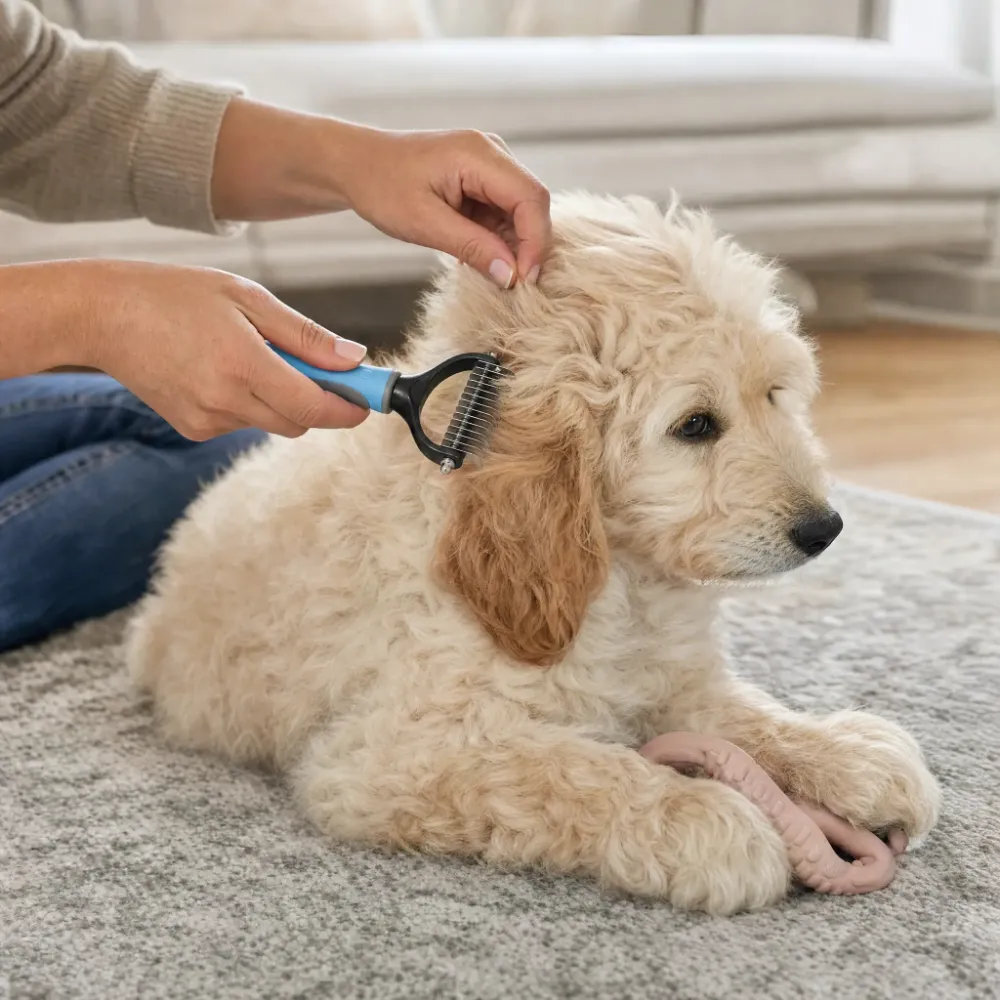
- Check for mats. Slide a finger under any knot. If it won’t lift away from the skin, leave it for a groomer.
- Hold the fur at the base. Pinch the hair between the knot and the skin, so your hand takes the pull.
- Start at the tip. Use the wide side on tangles, working from the end of the knot toward the skin.
- Flip to the fine side. Pull it through in the direction the hair grows to thin out loose undercoat.
- Go easy on thin skin. Paragon warns about thin skin at the ear base, armpits, flank and hocks.
- Stop and reward. When little fur comes out, you’re done for today. Give a treat and end calm.
- Clean the rake. Pull the fur off the blades, rinse in warm soapy water, and dry it fully before you put it away.
Raking before a bath usually works best. Paragon says undercoat rakes normally work better before bathing, or in the tub on a wet coat. For knots, our free dematting comb guide walks through each stroke.
Don’t: press the blades into the skin, rake red or sore skin, or cut mats out with household scissors. PetMD says mats often form close to the skin, so scissors can easily cut it.
And don’t shave the double coat. Teri Becker DiMarino, president of the California Professional Pet Groomers Association, told the AKC:
“Shaving doesn’t do anything to cool dogs off because a dog’s cooling system is different than ours.”
Teri Becker DiMarino, via the AKC
When should you see a groomer instead?
See a groomer or vet for mats tight against the skin, or mats near the eyes, ears, genitals or bottom. Red, swollen or smelly skin near a mat needs professional help too.
A veterinarian writing for PetMD says tight, large or sensitive-area mats should be removed by a professional. Our product page says the same: tight mats against the skin are a groomer or vet job.
Call your vet about bald patches, inflamed skin or a sudden jump in shedding. The AKC says those signs can point to a health problem.
Who is our undercoat rake for?
It suits puppies with medium, long, curly or fluffy coats that tangle or shed undercoat. Very short, smooth coats don’t need it, per our product page.
- Good fit: doodles, long coats, fluffy undercoats and collar tangles.
- Skip it: very short, smooth coats like most Labs and Beagles. A rubber brush or grooming mitt suits them better.
- Not for: mats glued to the skin. Those need a groomer or your vet.
What should you do next?
- Pick a calm time this week and rake for five minutes, with treats.
- Check behind the ears, under the collar and in the armpits for knots.
- Deal with the fur that already landed on your couch and clothes.
For the fur on your clothes, our guide to reusable vs sticky lint rollers compares the options. If the couch is the battleground, read why couch covers slide and which ones stay put.
Undercoat rake FAQ
Can an undercoat rake hurt my dog?
It can if you press too hard or rake over tight mats. Use gentle pressure, as the AKC advises for bladed tools, and go slow where the skin is thin.
Can I use an undercoat rake on a puppy?
Yes, if the puppy has a coat that tangles or sheds undercoat. Keep sessions to a few minutes, two or three times a week, and end with a treat.
Should I rake my dog before or after a bath?
Before, in most cases, because loose undercoat and small tangles come out more easily. PetMD also advises brushing out tangles before bathing and drying the coat fully after.
Will an undercoat rake stop my dog from shedding?
No, shedding is natural, and the AKC says changes in daylight and temperature trigger it. Raking just catches the loose fur before it lands on your floor.
Will an undercoat rake ruin my dog’s coat?
Not with a light hand. Paragon notes bladed rakes can cut the top coat on some coats, and Vetstreet warns not to overdo one spot. Use short strokes and stop when little fur comes out.
How do I know I have raked enough?
Stop when only a little fur comes out with each stroke, or sooner if the skin looks pink. Shedding season may need a few short sessions a week, not one long one.
Sources
- American Kennel Club: managing dog shedding, brushing frequency and choosing brushes (AKC Staff, updated Aug 2026)
- American Kennel Club: what a double-coated dog is, coat types and grooming (with master groomer Jennifer Bishop-Jenkins, updated Oct 2026)
- Vetstreet: tips to manage dog shedding season and blowing coat
- Paragon School of Pet Grooming: the difference between rakes and undercoat rakes
- PetMD: how to handle matting in dogs and cats (Dr. Jenny Alonge, DVM)