

Short answer: How often should a puppy poop? Most puppies poop three to five times a day, and 5 to 6 isn’t uncommon. So take her out 5 to 30 minutes after each meal, and the moment she wakes up (AKC).
Call your vet today if she has diarrhea before her shots are done, or vomiting, blood or black stool.
She finishes breakfast, you turn to rinse the bowl, and she’s squatting by the back door. Or she poops on the walk, eats, then goes again before you’ve hung up the leash.
A puppy’s gut is small and still developing, so food moves through it fast. Miss the timing, and the poop lands on the rug. A spot you don’t clean well can then draw her back.
No affiliate links on this page. We do, however, sell the First 14 Days Kit, linked below.
How often should a puppy poop?
The count drops as she grows. By 12 weeks it may be about 4 a day, and about 3 by 6 months.
Source: Sandra C. Mitchell, DVM, DABVP, PetMD. Her examples: typical, not targets.
A 2-week-old may go at every feeding. By her first birthday, however, she has usually settled into her own normal.
How much should a puppy poop, and what should it look like?
Healthy stool is brown and well formed, not runny and not too hard. Dr. Mitchell compares it to a soft, large Tootsie Roll. A little mucus is normal, as long as it isn’t tinged with blood.
“Healthy dog poop is a chocolate brown color and fairly consistent.”
Dr. Michelle Bourjaily, managing veterinarian at Small Door Veterinary, speaking to The Dodo
Worm pieces can look like spaghetti or grains of rice, so call your vet if you see them.
How long after eating does a puppy poop?
Usually within minutes to half an hour. The AKC’s window is 5 to 30 minutes after a meal. The younger the puppy, the sooner she should go out. Most growing puppies eat three to four meals a day, and most poop after meals.
| Source | Timing after a meal | Who it covers |
|---|---|---|
| AKC potty timeline | 5 to 30 minutes, sooner for younger puppies | Puppies |
| Michelle Bourjaily, DVM, in The Dodo | Around 15 minutes, though 5 to 60 is possible | Puppies |
| Sandra C. Mitchell, DVM, PetMD puppy guide | Wait a few minutes, then take her out | Puppies |
The windows overlap, so start the trip a few minutes after her last bite. Waking, meanwhile, is the other big trigger. Most dogs poop right after waking up.
Three or four meals plus the morning wake-up make four or five planned trips, before naps and play. Each one you catch is one less poop to scrub out of the rug.
Tip: When she wakes, take her straight from the crate to her spot. Don’t stop to make coffee first, the AKC says.
How do you get a puppy to poop outside after a meal?
If your puppy refuses to poop outside, first distinguish location preference from difficulty passing stool.
Make the trip the same every time, following the AKC’s potty timeline.
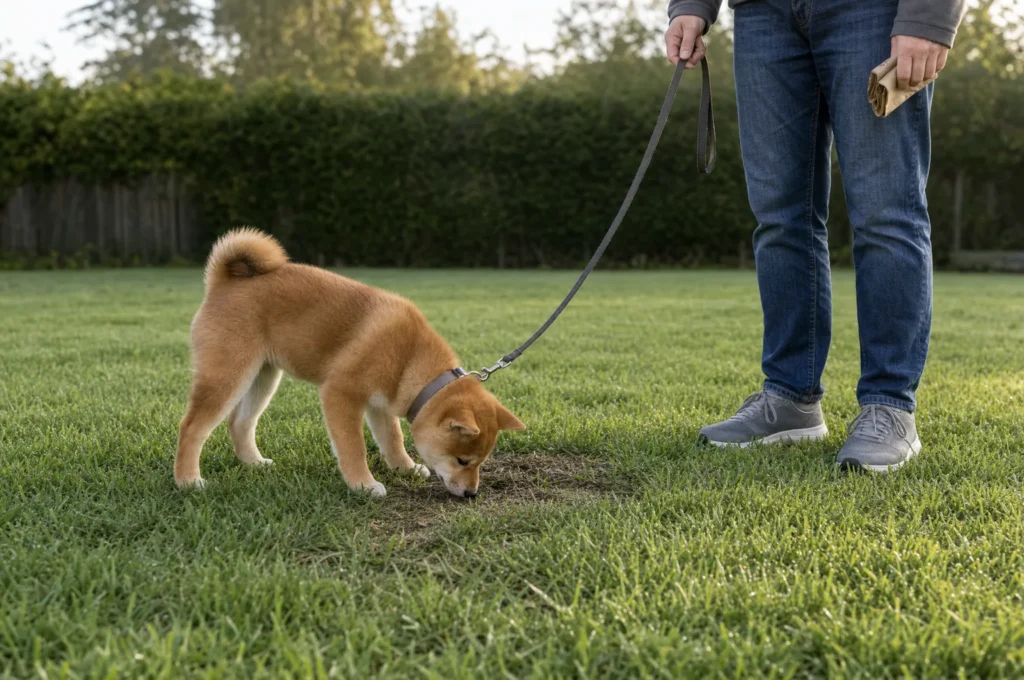
- Wait a few minutes, then head out. Same door, same spot, on a leash.
- Stand quietly. Say a short cue such as “go potty” as she starts.
- Stay out until she’s done. A rushed trip makes a poop just inside the door more likely.
- Praise her and treat her right there, once she goes. Then play outside for a few minutes before heading in.
When she sniffs the floor, circles or wanders off, take her out now. Our how to potty train a puppy guide covers the rest of the routine.
What if she poops right after you come back inside?
Usually the trip ended too soon. Staying out until she’s pooped lowers the chance she’ll come in and go right away. If nothing happens, go inside and come back out in a few minutes. Use the same spot, too, and praise only after she goes. If she goes after her nap instead, plan the nap trip like a meal trip.
Why does my puppy poop hours after eating?
A gap of hours can be fine. Most dogs take 8 to 12 hours to fully digest a meal. Puppies digest faster, and small meals pass faster than big ones.
No vet page we read says how long a puppy can hold her poop.
Why does my puppy poop so much?
Food moves through a young gut quickly, and sometimes it isn’t fully digested. Vets at PetMD and The Dodo list a few causes:
- More meals mean more trips.
- High-fiber food, like wheat or corn.
- Walks and play, which move food along.
- Too many treats. So keep them to 10% or less of her daily food.
- Worms. Almost all puppies are born with intestinal parasites, so vets deworm them young.
- A sudden food change, which can bring diarrhea.
If her count jumps well past any answer to “how often should a puppy poop,” check color, texture and how she acts.
Tip: Put one name next to each meal on the fridge, so nobody feeds her twice.
When is puppy poop a reason to call the vet?
Call your vet today if she has diarrhea before all her shots. Parvovirus causes diarrhea in puppies and needs immediate vet care, the AKC warns. Also call right away for vomiting, bloody diarrhea or black, tarry stool. Keep fresh water out, since even mild diarrhea dehydrates.
An odd extra or missed poop is normally fine. A change lasting more than 24 hours should be checked.
| What you see | What to do | Why |
|---|---|---|
| Diarrhea in a puppy without all her shots | Call your vet today | Parvo causes diarrhea and needs immediate care |
| Red, black or purplish poop | Get her to the vet right away | It can be a sign of internal bleeding |
| Diarrhea with vomiting, fever, weakness or no appetite | Get care as soon as possible | These are signs of wider illness |
| Diarrhea lasting more than a day | Call your vet | Even mild diarrhea dehydrates a puppy |
| Straining or pain while pooping | Call your vet | It can mean constipation, or less often a blockage |
| No poop for more than 24 hours | Call your vet | She may be constipated |
Sources: AKC puppy diarrhea guide, VCA, PetMD and The Dodo.
Veterinarian Joanne Fernandez suggests keeping a log of when your puppy eats, drinks and goes, to spot trends. Over time, that log answers “how often should a puppy poop” for your own puppy. It helps most when the whole house writes in one place.
How do you switch puppy food without an upset stomach?
Mix the new food in slowly. Diet changes are one of the common causes of diarrhea in dogs. The AKC’s plan spreads the change over 5 to 7 days:
- Day 1: 25% new food, 75% old.
- By day 3: half new, half old.
- Day 5: 75% new food, 25% old.
- Day 7: all new food.
A sensitive stomach may need longer. So slow down if she gets upset, and call your vet if it doesn’t settle.
What happens if you switch her food overnight?
A story from Michael Northcutt, our founder: We ran out of her food on a Saturday night, and the store only had a different brand. I didn’t think much of it. I poured the new kibble into her bowl the next morning, and she gobbled it up.
By Monday, I was cleaning the rug for the third time, and not from pee. I felt terrible. She’d gone from one food to a totally different one overnight, and her little stomach was not happy about it.
We went back to the old food as soon as I could find it, and I called our vet. They said to watch her and call back if it didn’t settle down. It did, in a couple of days.
Then I made a little calendar and taped it to the food bin. Day 1 and 2: mostly old, a little new. Days 3 and 4: half and half. Each day got a checkmark. At the bottom I wrote: “Upset tummy? Slow down. Still bad? Call the vet.”
The next time we changed foods, she didn’t even notice.
Tape the AKC day plan to the food bin, the way Michael did, so whoever feeds her sees it.
Her bladder has its own clock. About 1 hour per month of age is a normal stretch between pee breaks, while months plus one hour is the outer limit. Water counts like a meal, so take her out soon after she drinks.
For her whole day, our puppy potty training schedule lays out trip times by age.
Puppy poop FAQ
How often do 8-week-old puppies poop?
Rover’s age chart puts 2-month-olds at 3 to 5 times a day. PetMD’s 5 to 6 a day isn’t uncommon either. By 12 weeks, she may be down to about 4.
How do I stop my puppy pooping at night?
Feed her at the same times each day, and take her out right before bed (Rover). End the night with a potty trip. A crate near your bed lets you hear her.
How we made this guide: In October 2026 we read PetMD, VCA, The Dodo, Rover and the AKC. Where they disagree, we show each one. Nobody at LoveMyPuppy is a veterinarian. If her poop worries you, call your vet.
Sources
- PetMD: How Often Do Puppies Poop?, by Sandra C. Mitchell, DVM, DABVP, plus her How Often Do Dogs Poop?
- American Kennel Club: Puppy Potty Training Timeline and Tips, by Harriet Meyers, plus Puppy Diarrhea, by Anna Burke, The Right Way to Switch Dog Foods and How to Potty Train a Puppy
- VCA Animal Hospitals: Diarrhea in Dogs, by Courtney Barnes, DVM, and colleagues
- The Dodo: How Often Should My Puppy Poop?, by Lauren Taylor, with veterinarian Michelle Bourjaily of Small Door Veterinary
- Rover: Puppy Poop, by Kelsey Graham, with Joanne Fernandez, DVM, of ABCs Puppy Zs