

Short answer: A puppy who won’t pee outside may be distracted, cold, scared, or used to a different surface. Short, leashed trips to the same spot come first, and the 5-minute reset below has the steps.
If she strains, seems sore, or keeps refusing for days on a steady routine, call your vet.
You’ve been standing in the yard for twenty minutes. She sniffed, sat down, and stared at you. Then you came in, and she squatted by the couch.
Maybe it was raining. Maybe a truck went by and she froze. Maybe she’ll only go on the pad. You’re starting to wonder if she’s doing it to spite you.
A potty refusal is a puppy who holds it outdoors and goes indoors, because something outside keeps her from relaxing. Find that something and you know where to start. Left alone, every indoor pee is practice in the wrong spot. Soon the rug smells like her bathroom.
We sell a printable puppy schedule kit and a puppy corner odor device, and we link to them below.
✓ Built on guidance from VCA Animal Hospitals, the AKC, Humane World and Preventive Vet.
If she just refused and you’re back inside, keep her tethered to you or in her pen, not loose. Then go to the 5-minute reset.
Why won’t my puppy pee outside?
Match what you see outside to a row, then start with the fix in that row.
VCA’s veterinary behaviorists say puppies left outside alone become distracted and do not eliminate until they are back indoors. That’s the first row. The rest cover weather, surfaces, fear, walks, marking and health.
| What she does outside | Likely cause | Try this first |
|---|---|---|
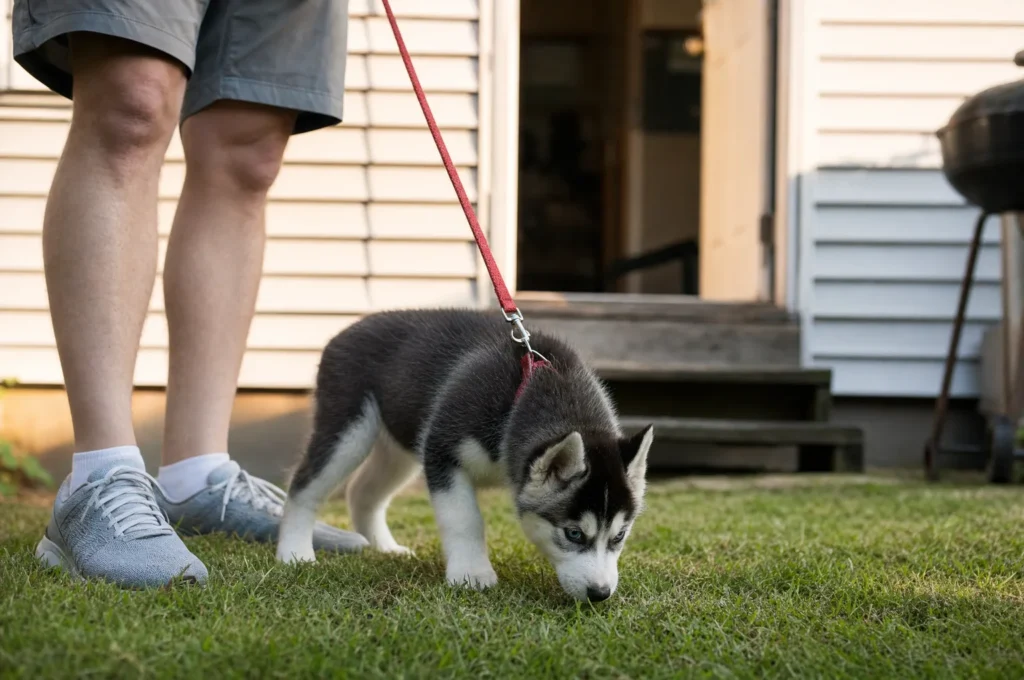
| Sniffs everything, chases leaves, never squats | Distraction | Leash on, one boring spot, you standing still. See the reset. |
| Pees a little outside, then more minutes after coming in | Didn’t finish, or got free roam too soon | No free roam after a trip until she’s fully gone. See below. |
| Stands on the step in rain or snow and won’t move | Weather and cold feet | A covered or shoveled spot right by the door. See weather. |
| Seems scared outside, or you just moved | Fear, or a new home | A quiet spot close to the door, at quiet times. See fear. |
| Holds it the whole walk, goes the moment she’s home | Walk is play, home is the bathroom | Potty spot first, walk after. See walks. |
| Won’t go on grass, goes on pads, carpet or concrete | Surface preference | Move the familiar surface outside, then fade it. See surfaces. |
| Leaves small squirts on chair legs or corners inside | Marking | Vet check, then calm supervision. See marking. |
| Strains, seems sore, or was doing well and slipped | Possible medical cause, or a change at home | Vet visit before more training. See when to call. |
What do I do when she won’t go? The 5-minute reset
This loop is built on VCA’s house training guide. Use the same potty area every time, whatever the cause.
- Clip the leash on at the door. Carry a small puppy to the spot, so nothing happens on the way. Preventive Vet trainer Cathy Madson suggests carrying her down the hall and in the elevator too.
- Go with her and stand still. Let her sniff a small circle.
- Give it about 5 minutes. If nothing happens, take her back inside and supervise closely. Tethered to you, or in the crate or pen, not loose.
- Out again at the first fidget. Restlessness, sniffing the floor or circling all mean straight back out.
- Reward outside, right there. Humane World says wait until she’s completely finished, then praise and treat before you move.
- Play comes after. Hold yard play and off-leash time until she’s gone, so going first opens the fun.
“Do not send puppies outside alone to toilet.”
Ellen Lindell, VMD, DACVB, board-certified veterinary behaviorist, and Monique Feyrecilde, LVT, VTS (Behavior), writing for VCA Animal Hospitals
Add a potty cue word, and maybe a door bell
A potty cue is a word like “go potty” that she links with emptying out. The same guide says to wait until she’s in position and about to go, then say it calmly once. A door bell comes later, once she can hold her bladder reliably. Some dogs ring it just for yard time, so answer every ring with a plain, leashed potty trip.
Why does she pee the second she comes back in?
She got distracted outside, didn’t empty all the way, and came in to a calm, familiar rug.
VCA’s behaviorists note that puppies can get distracted mid-pee and not fully empty their bladder.
Treat a short trip as unfinished, and keep her tethered or penned until the next try. If you catch her squatting inside, the AKC says calmly carry her straight out. Reward her if she finishes there. Our potty guide walks through the full pees-right-after-coming-in routine, including the retry timing.
What if she won’t pee in the rain, snow or cold?
Make the trip shorter and the spot easier to reach.
Puppy won’t pee in the rain
Go first to one covered spot a few steps from the door. Keep it short, and reward her before you both dry off.
Puppy won’t pee outside in the snow or cold
Shovel a doormat-sized patch by the door and keep it clear for cold paws. For very small dogs, the AKC says pads can help in severe winter weather. It adds they can slow the move outdoors, so keep the outdoor trips going.
Tip: Put her harness or coat on in the kitchen, with a treat, before you open the door. Then nothing new happens at the doorway itself.
A story from Michael Northcutt, our founder: She looked at the rain. Then she looked at me. Then she peed on the kitchen mat.
It was pouring, cold and sideways. The puppy stood in the doorway like I’d asked her to jump into a lake. We went out anyway, and she wouldn’t go. We came back in, both of us dripping and grumpy. Three minutes later, there it was.
So we built a rainy-day plan. One covered spot by the wall where we always go first, leash on, me standing still. A washable towel on a hook right inside, and a treat ready the second she goes.
I started writing “rain” on the log. After a couple of weeks, I could see rain days needed one extra trip.
What if she’s scared to pee outside?
If she seems scared, make the trip smaller and calmer first.
- Use the quietest spot close to the door. A side yard beats the sidewalk.
- Pick quiet times. Early morning and later evening, before the leaf blowers and school buses start.
- Carry her out and stay calm. No coaxing, no “go potty” on repeat. Stand still and let her settle.
Never scold a scared puppy for going inside. Humane World says punishment makes puppies fearful and slows progress.
Rescue or kennel-raised puppy won’t go outside
A puppy raised in a pen may never have used grass as a toilet. The same guide says puppy mill rescues may need more potty breaks. Treat her as day one, with quiet trips and the reset loop.
New home or new yard, and she won’t go
Preventive Vet’s Cathy Madson calls the settling-in time after a change the adjustment period. Moving or rehoming can set potty habits back, and many dogs bounce back once they learn the new routine. Give her lots of outdoor breaks and reward her at the new spot. If a pet lived there before, its old accident smells can draw her to mark. Enzyme clean those spots.
What if she holds it on walks and goes at home?
To her, the walk is the fun part and your hallway is the bathroom. Put the potty spot before the walk.
VCA’s guide starts every trip at the elimination area, and postpones play and freedom to run until she’s finished. So start at her potty spot, on a short leash. Once she goes, the real walk begins. If she doesn’t, run the reset.
Puppy won’t poop outside
Poop usually follows meals. Preventive Vet suggests a trip within about 5 to 10 minutes after eating, drinking or playing. Feeding at the same times each day makes potty times predictable, Humane World adds. Save the “good girl” until she’s done, or she may stop midway.
What if she’ll only pee on pads, carpet or one spot inside?
Bring the surface she knows outside, then shrink it away.
Madson says puppies can imprint on what surface is okay to potty on. A puppy raised on pads or a kennel floor may not read grass as a bathroom.
Puppy only pees on pads
Humane World warns that indoor potty training can make outdoor housebreaking take longer, so expect a slower move. Put a used pad at the outdoor spot for the first trips, then cut it smaller every few days. Our guide on potty training a puppy with puppy pads covers the full pad-to-outside move.
Puppy won’t pee on grass
Scent helps. The same guide suggests a soiled paper towel at the right spot, so she links that smell with the bathroom. For an indoor spot in the meantime, Madson prefers real grass over plastic, since it eases the later move outdoors.
Puppy keeps peeing on the carpet or the same spot inside
Roll the rug up for a few weeks and enzyme clean the floor under it. The AKC says dogs return to spots that still smell like previous accidents. Our enzyme cleaner guide covers what to look for.
Is she marking, or does she need to go?
Marking is a small squirt on something upright, like a chair leg or a couch corner. VCA’s marking guide says most marks hold only a little urine, while a full bladder empties a lot. It can start around puberty or after a change like a new person at home, in males or females. Rule out illness with your vet first. Then supervise and calmly distract her, because punishment can make marking worse.
How long can she hold it before this becomes a problem?
Each age has a normal stretch and an outer limit.
How long a puppy can hold it, by age
Light bar: the normal stretch, about 1 hour per month of age. Dark bar: the outer limit, age in months plus one hour.
Those are resting numbers, and awake and playing she needs out far sooner. An 8-week-old who refuses at hour two is close to her limit, so shorten the gaps.
Where the experts split, and what to do
One real disagreement, and a decision rule for it.
How often to go out. Humane World says at least every two hours, plus after waking, play, eating and drinking. VCA goes tighter, with every 1 to 2 hours awake and every 30 minutes during high-energy play. Rule: while she’s refusing outside, use VCA’s tighter gaps, for more chances to catch her ready.
When should you call the vet or a trainer?
The AKC’s Dr. Mary Burch says dogs who stay hard to house train despite consistent training should get a veterinary evaluation. Once health is ruled out, a trainer or behaviorist is next. Don’t wait if she’s straining to pee. The VCA marking guide says that could be an emergency.
If fear isn’t easing, find a reward-based trainer.
She was doing well for weeks, then started slipping
This is a housebreaking regression. The AKC says one cause is more freedom too fast, so shrink her space and add rooms slowly. Madson ties regression to changes in routine, like a new work schedule, and to missed breaks. Her medical list includes a urinary tract infection (UTI), so see the vet first after a sudden change.
What to do this week
- Tonight: pick one spot by the door, covered if you can, with leash, treats and towel beside it.
- Every trip: run the 5-minute reset, start to finish.
- Write down each refusal with the weather, the time and what was going on.
- Still refusing after a week, or straining at any point: book the vet.
Our free Puppy Week Check-In asks six quick questions and gives one next step. No email needed.
Puppy won’t pee outside FAQ
What is the 10-10-10 rule for potty training puppies?
Pad maker Earth Rated describes it as a memory aid. Offer a potty break about 10 minutes after waking and 10 minutes after eating. Add one after about 10 minutes of active play. VCA’s list of potty times covers the same three moments.
How long should I stand outside with my puppy?
About 5 minutes, according to VCA’s behaviorists. If she hasn’t gone by then, the 5-minute reset above covers what to do next.
Why does my puppy only pee inside when no one is looking?
Scolding can cause it. Preventive Vet says scolding teaches a puppy to hide where she goes. Stop all correction and go back to supervised trips with rewards outside.
Why won’t my puppy pee outside at night?
Keep night trips short and boring, to a lit spot by the door and straight back. Some puppies need overnight outings until about 5 months old, by VCA’s count. Our guide to potty training a puppy at night covers the full night routine.
My older dog won’t pee outside anymore. What’s wrong?
A trained dog who starts refusing or going inside needs a vet visit first. Pain can make squatting or lifting a leg hurt, Preventive Vet notes. If she’s healthy, go back to the reset until she’s steady.
How we put this together: In October 2026 we read eight source pages in full. That’s two each from VCA, the AKC, Humane World and Preventive Vet. We also read page one of Google, owner threads on Reddit and forums, and Earth Rated’s 10-10-10 page. Nobody at LoveMyPuppy is a veterinarian.
Sources
- VCA Animal Hospitals: house training puppies, by veterinary behaviorists (plus the marking page)
- AKC: potty training a puppy and preventing accidents
- AKC: dog pees in crate, the months-plus-one rule
- Humane World for Animals: housebreaking tips (plus Crate Training 101)
- Preventive Vet: apartment potty training, by trainer Cathy Madson (plus her adult-dog guide)