

Short answer: Most washing machine smells come from damp soap residue in the door seal, detergent drawer or drain filter. Wipe them, run one hot clean cycle, and leave the door open.
A rotten egg or sewer smell that stays after cleaning usually starts in the drain or the water. That’s a job for a plumber.
We sell washer cleaner tablets and a printable puppy schedule kit, and we link to them below.
You pulled the crate pad out of the wash and it smelled worse than when it went in. The towels smell like a wet basement. You can smell the washer from the hallway.
A new puppy brings a lot of laundry. Pee mats, blankets and accident loads go through one drum, day after day. The washer starts to smell, and so does everything you put in it.
Match the smell in the table below, then fix that one spot first.
✓ Built on guidance from Consumer Reports, the Minnesota Department of Health, Health Canada, Maytag and AppliancePartsPros.
Smelly load sitting in the drum right now? Do this.
- Take the wet load out and rewash it, or dry it right away.
- Pull back the rubber door seal. Look for black gunk, hair or a lost sock.
- Smell the hot and the cold tap. If either smells like eggs, the source is your water or water heater.
- Never pour bleach on top of vinegar or ammonia. Health Canada warns it makes toxic gas.
Why does my washing machine smell?
Usually damp residue where mold can grow. The type of smell points to the spot.
| The smell | Likely cause | Fix first | Call a pro if |
|---|---|---|---|
| Musty or mildew | Wet residue in the door seal, drum or drawer | Wipe the seal, run a hot clean cycle, leave the door open | It keeps draining slowly or leaving water behind |
| Sour clothes | Too much detergent, softener film, a packed drum, loads left wet | Use less HE detergent, skip softener, wash smaller loads, unload right away | Rarely needed |
| Rotten eggs | The water heater, the water supply, or gunk in the washer | Smell the hot and cold taps to find the source | Only the hot water smells |
| Sewer | A dry drain trap, a deep drain hose, or the sewer line | Run a rinse cycle and check the hose depth | Other drains in the house smell too |
| Pee or wet dog | Urine left in fabric, hair in the seal and filter | Enzyme treat before washing, get fur off dry | The filter won’t open or the drum won’t drain |
| Burning | A possible part or electrical fault | Stop the cycle and unplug the washer | Right away, before the next load |
Why does my washing machine smell like mildew?
Residue feeds mold, and a closed, wet drum lets it grow. Front loaders have a long history of it.
In a Consumer Reports survey, 16 percent of front-load washer owners reported mold, mildew and odor issues. Fabric softener and extra detergent leave a film. Mold feeds on it.
“The excess builds up, and eventually you’ll see a film.”
Daryl Shuler, a technician for Appliance Doctor in New York City, on extra detergent, quoted by Consumer Reports
Moisture is the other half. Consumer Reports measured how wet a drum stays after you unload it.
Humidity inside a front-load drum after unloading
Whirlpool WFW5720RR, tested with and without its Dry Drum cycle. Bar length shows humidity.
No drying cycle? Consumer Reports says the drum would likely dry out eventually with the door left open.
Black spots in the door seal? Our black mold step-by-step covers the scrub, the clean cycle and when to ask about the seal.
How do you get rid of the smell in a washing machine?
Clean the seal, drawer and filter by hand, run one hot clean cycle, then keep the drum dry.
Check your manual first, since some steps differ by brand.
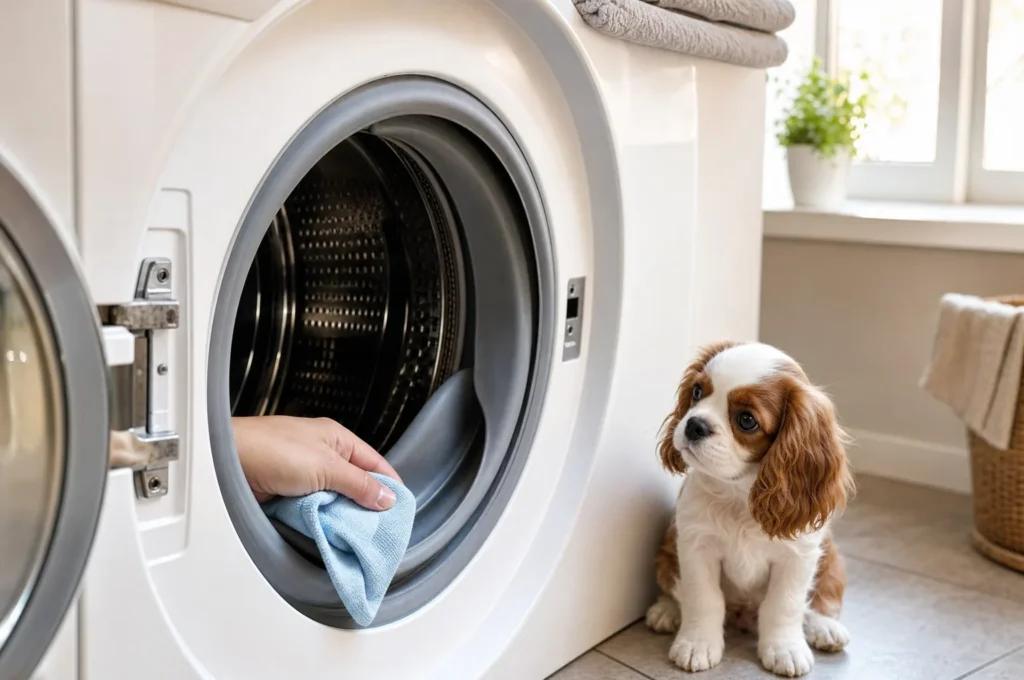
1. Pull back the rubber door seal and wipe it
On a front loader, Consumer Reports says to gently pull back the gasket, wipe it clean, then dry. Work around the whole fold with a damp cloth. Pick out hair, lint and socks as you go.
2. Rinse the detergent drawer
Pull it out, rinse off the soap film, and let it dry. Leave it open between loads.
3. Clear the drain pump filter
Many front loaders have a small filter behind a panel near the bottom. It catches hair, lint and small debris. Check your manual before you open it. Keep a towel and a shallow pan handy, since water can spill out.
4. Run one hot clean cycle
Use the clean washer setting, or the hottest, longest cycle with an empty drum. Add one cleaner your manual allows. Maytag says to clean it once every 30 wash cycles. Consumer Reports notes some brands say monthly, or every 50 loads.
5. Keep it dry between loads
Move wet laundry to the dryer as soon as it finishes. Leave the washer door open. If your puppy roams, close the laundry room door instead.
Top load washer smells? Start here
- Wipe the upper rim of the tub and the agitator. Consumer Reports suggests doing it now and then.
- Clean under the inside lip of the lid. Home Depot says old soap and lint get trapped there.
- Run one hot clean cycle with the tub empty.
- Leave the lid up between loads until the tub is dry.
Our full how to clean a washing machine guide covers both types step by step.
Why does my washer smell like rotten eggs?
It’s often hydrogen sulfide gas. Your taps tell you if the water is the source.
Minnesota’s health department says hydrogen sulfide gas can give water a “rotten egg” taste or odor. It can come from the ground, from sulfur bacteria, or from inside a water heater.
- Find the source. After a few hours away, smell the hot and cold taps. The department suggests checking which faucets smell.
- Only the hot water smells? The department explains a water heater can produce the gas itself. It says a plumber should do that work, unless you know water heaters well.
- Only the washer smells? It’s usually gunk in the seal, drawer or filter. Start with the cleaning steps above.
Why does my washer smell like sewer?
Usually a dry drain trap, a drain hose pushed in too far, or a sewer line problem.
The drain’s U-shaped trap holds water that blocks sewer gas. AppliancePartsPros says if the P-trap dries out due to infrequent use, sewer gas can escape. Running a rinse cycle refills it.
Check the hose too. Consumer Reports says it should sit only 6 to 8 inches into the drain pipe. Deeper, and it can siphon foul-smelling water back into the washing machine.
When to call a plumber: sniff your sinks, tub and floor drains. If several smell or drain slowly, AppliancePartsPros points to the main sewer line, and a plumber for severe blockages. A washer cleaner won’t fix any of this. If the washer itself won’t drain, call an appliance tech.
Smell burning instead? Stop the cycle, unplug the washer, and call an appliance tech before the next load.
Why do my clothes still smell bad after washing?
The washer is passing its smell on, or the load sat wet too long.
- Clothes smell like mildew after washing. Often they sat wet in the drum. Rewash, then dry them right away.
- Clothes smell sour after washing. Often detergent film. Consumer Reports says to use only HE detergent in HE washers, and not too much.
- Towels smell musty even when clean. Skip fabric softener for a while. Consumer Reports says it may leave residue.
- Everything smells the same. The washer is the source. Clean it first, then rewash.
How do you wash puppy pee mats and accident loads without a smelly washer?
Treat the pee before it goes in, get the fur off dry, and clean the washer more often.
Pre-treat the pee spot with an enzyme cleaner at full strength, then wash as usual. Enzymes break down the urine your puppy can still smell. Our enzyme cleaner guide covers what to look for.
Shake, vacuum or roll the fur off first. Wet hair clumps in the seal and filter, where it stays damp. Our dog bed washing guide walks through the order.
A story from Michael Northcutt, our founder: When our puppy first came home, I bought pee pads in a box the size of a suitcase. By week two, I’d bought another one.
Every pad got used once, rolled up, and thrown away. The trash smelled. The pads slid around the floor, and some of them leaked through onto the tile.
So I bought two washable pen mats. One on the floor, one in the wash. Swap, wash, repeat.
I’ve probably washed those mats forty times. They’re a little faded, but they still work, and they never slid around.
I’m not going to tell you how much waste that saved, because I didn’t count. But I stopped buying those big boxes of pads. And I stopped dragging a smelly bag to the curb every day.
Sometimes the eco choice is just the one you can use again.
Forty pee mat washes is forty loads of urine through one drum. That’s why a puppy home’s washer needs its own cleaning day.
Should you put vinegar or bleach in your washing machine?
Experts split on vinegar, so follow your manual. Bleach goes in alone, never mixed.
AppliancePartsPros suggests an empty hot cycle with two cups of white vinegar. Maytag disagrees. It says you should not pour vinegar in your washing machine drum. The acid can wear down seals and hoses. Your manual settles it for your machine.
Health Canada says bleach will react with any cleaning product containing ammonia or an acid, including vinegar. That includes any ammonia-based cleaner you might use on blankets. Run one cleaner at a time, with a rinse in between.
Puppy safety: Keep bleach, pods and cleaner tablets closed and up high. Health Canada also says to open windows and run a fan while you clean. Comparing cleaners? See our best washing machine cleaner guide.
Washing machine smell FAQ
Is mold in a washing machine dangerous?
For the washer, yes. Consumer Reports says mold and mildew can damage rubber gaskets. For health questions, especially asthma or allergies, ask your doctor.
Why do front load washers smell more than top loaders?
The rubber gasket folds trap water, and a shut door keeps it in. Consumer Reports says front loaders have a history of mold and odor problems. Leaving the door open helps.
What can I put through my washing machine to stop it from smelling?
One cleaner your manual allows, on the hottest empty cycle. That might be a washer cleaner tablet or bleach. Never combine them. Our tablets contain citric acid, and Health Canada warns bleach reacts with acids.
Why does my laundry room smell like mildew?
Often it’s the washer, or wet laundry left sitting. Clean the seal and drum, move loads out fast, and keep the door open. Then check the hoses for leaks.
How we put this together: We read Consumer Reports, the Minnesota Department of Health, Health Canada, Maytag and AppliancePartsPros. We also read what pet owners say about smelly washers and pee-soaked blankets on Reddit.
Sources
- Consumer Reports: How to Minimize Mold in Your Washing Machine, by Keith Flamer
- Minnesota Department of Health: Why Does My Water Smell Like Rotten Eggs?
- AppliancePartsPros: Why Does My Washing Machine Drain Pipe Smell?
- Maytag: Stop Using Vinegar to Clean Your Washing Machine
- Health Canada: Never Mix Bleach With Other Cleaning Products