

Short answer: You need five supplies: a crate with a divider, enzyme cleaner, tiny treats, a leash and poop bags.
Add one plan everyone in the house follows. Pads, bells and pens depend on your home. Sprays and gadgets can wait.
We sell a printable puppy schedule kit and a puppy corner odor device, and we link to them below. We don’t sell any of the supplies on this list.
You’re in the pet aisle, shopping for puppy potty training supplies, with a new puppy at home. Every shelf promises faster house training.
Sprays, smart pads, bells, grass trays, three kinds of gates. It’s easy to spend a lot and still find a puddle by the couch.
Your day-one shopping list (screenshot this for the store)
- Crate with a divider, sized for her adult size
- Enzyme cleaner made for pet messes, one bottle per room she uses
- Small, soft training treats
- Leash and a hook by the door
- A big roll of poop bags
- Paper towels for blotting
- Only if you need them: pads, a bell, a pen or gate
What supplies do you actually need to potty train a puppy?
Five things do most of the work: a crate, an enzyme cleaner, treats, a leash and bags. Everything else depends on your home or can wait a few weeks.
| Supply | What it does | Do you need it? |
|---|---|---|
| Crate with a divider | Gives her a small den she won’t want to soil | Must-have |
| Enzyme cleaner | Removes the smell that pulls her back to the same spot | Must-have |
| Tiny, soft treats | Rewards her the second she goes outside | Must-have |
| Leash, kept by the door | Gets you out fast and keeps her on the potty spot | Must-have |
| Poop bags | Lets you clean up and keep the yard or sidewalk clear | Must-have |
| One shared schedule | Keeps everyone’s trips on the same clock | Must-have (free if you write your own) |
| Puppy pads or a potty tray | An indoor spot for long days, high floors or no yard | Depends on your home |
| Potty bell | A way for her to tell you she needs out | Depends on your home |
| Pen or baby gate | Limits her space when you can’t watch her | Depends on your home |
| Attractant spray, smart pads | Marketed to speed things up | Can wait |
Which potty training supplies are must-haves?
Buy these five before she comes home. They cover the den, the cleanup, the reward and the trip outside. They’re also the only day-one spend that matters. Add the rest only if your home needs it.
1. A crate that fits her now, with a divider
Puppies generally avoid soiling where they sleep. A crate uses that instinct, but only if it’s the right size.
The AKC says the crate should let her stand, turn around and lie down. Too big, and she can potty in one corner and nap in another.
If the crate comes with a divider, buy it for her adult size and shrink it with the divider. Move the divider back as she grows.
Crate time has a limit. VCA vets say short stays in a crate work for puppies left alone no more than 3 hours.
2. An enzyme cleaner, bought before the first accident
Soap and paper towels make a spot look clean. To her nose, it can still smell like a bathroom.
VCA vets explain that leftover smell is a cue to use the location again in the future. An enzyme cleaner breaks that smell down.
3. Tiny, soft treats in a pocket or pouch
Timing matters more than the treat. The AKC says to reward her immediately when she finishes in the right spot.
VCA says to give the reward outside, near the spot, not after you’re back in the kitchen.
Pick pea-sized, soft treats she can eat fast. Broken-up bits work too.
4. A leash and a hook by the door
A leash can help keep her focused on the potty spot. Humane World for Animals suggests one bathroom spot outside and always take your puppy there on a leash.
A story from Michael Northcutt, our founder: The accident wasn’t her fault. It happened while I was digging for the leash.
She woke up and sniffed. I spent forty-five seconds pawing through jackets, then hunting for bags, then hopping into a shoe.
Forty-five seconds is a long time for a tiny bladder. I heard it before I saw it.
The next morning I put a hook by the back door. Leash, bags, a small treat pouch and a little flashlight for dark trips. Shoes lined up underneath.
Now I’m out the door in five seconds, not fifty. One rule: nothing on the hook gets borrowed.
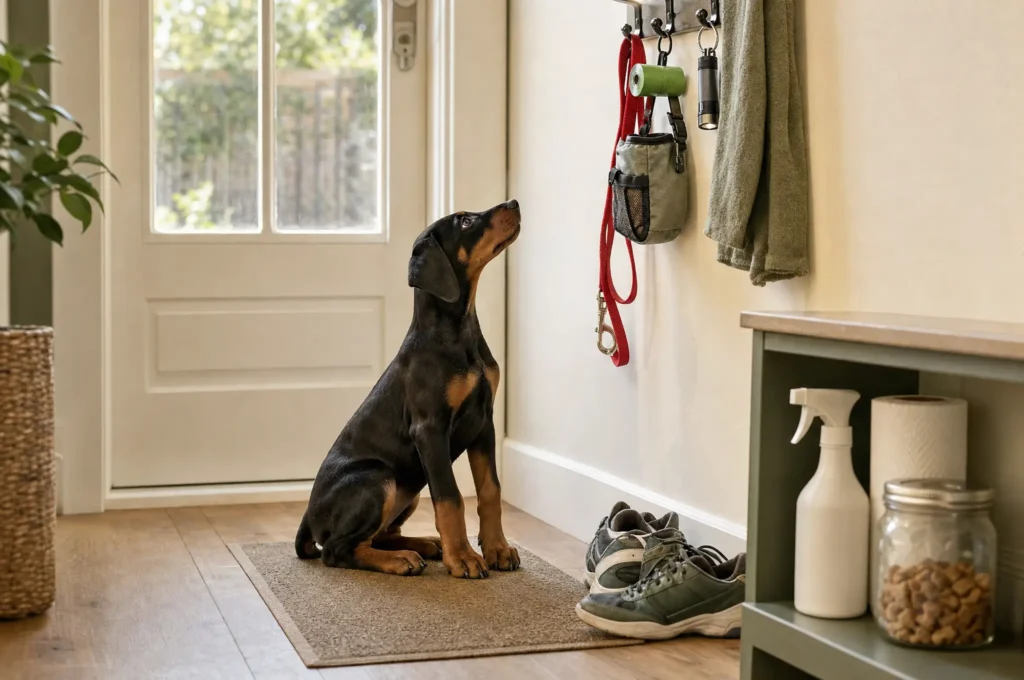
For rain and cold, hang a towel on the same hook. A covered spot near the door keeps bad-weather trips short. For night trips, a small flashlight on the hook saves you hunting in the dark.
5. Poop bags, more than you think
Puppies go often. The AKC says puppies can hold it about the same number of hours as their age in months. A 2-month-old needs a lot of trips.
Keep a roll on the hook, one in your coat and one in the car.
One schedule everyone follows
You can own every item above and still have accidents. That usually happens when several people share the puppy and nobody knows who took her out last.
The AKC calls a steady schedule essential. It also advises one cue phrase each time your puppy begins to go. That only works if everyone uses the same one.
Want the timing by age? Our puppy potty training schedule walks through it.
Which supplies depend on your home?
Pads, bells and pens help in some homes and slow things down in others. Decide based on your floor plan, your work hours and your weather.
Puppy pads: useful for some homes, a detour for others
The AKC says pads can help owners who cannot return home frequently during the day. They also help very small dogs in hard winters.
The catch is that pads teach a second “right” place to go. Mary Burch, Ph.D., of the AKC:
“You’re reinforcing two different options for the puppy.”
Mary Burch, Ph.D., director of the AKC Canine Good Citizen and S.T.A.R. Puppy programs, quoted by the American Kennel Club
The AKC adds that pads can sometimes slow the transition to outdoor elimination. If you use them, plan the exit before day one. Here’s the full guide to potty training a puppy with puppy pads.
A story from Michael Northcutt, our founder: We started with pee pads by the back door. She was tiny and it was cold.
She learned, all right. She learned that soft things on the floor are for peeing. The bath mat, a throw rug, a towel by the laundry basket.
So we made a plan to switch. We moved the pad a little closer to the door each day. Then right outside the door. Then onto the grass.
We took her out much more often and gave her a treat every time she went outside. I picked up the rugs and towels for a few weeks too.
It took a couple of weeks. The day she walked past the bath mat and waited at the back door, I almost cheered.
Washable or disposable pads?
Both catch pee. Disposable pads go in the trash after each use. Washable pads go in the laundry and come back out.
With washable pads, keep a spare for laundry day. If she chews or shreds pads, take them away and talk to your vet or a trainer.
A potty bell: handy, with one warning
A bell on the door gives her a clear way to ask. An AKC trainer notes a bell can be particularly helpful while potty training.
VCA warns that some dogs ring it just to play outside. Keep bell trips boring: leash on, straight to the spot, back in if nothing happens.
A pen or baby gate
A pen helps when she’s too awake for the crate but can’t be loose yet. If the crate covers it and you’re home, wait on this one.
What changes in an apartment or with a tiny breed?
High floors and tiny bladders make the trip outside longer than she can wait. That’s where pads or an indoor potty tray earn their place.
- Keep the door kit ready. Leash, bags and shoes right by the door, so the elevator ride starts sooner.
- Carry a young puppy out. It stops a hallway accident on the way down.
- Pick one indoor spot, not three. A pad or tray in the same place every time, away from her bed and bowls.
- Toy breeds: the AKC names very small dogs in hard winters as a good fit for pads.
What can you skip at first?
Start without the extras. None of the vet and trainer sources we used list them as needed.
- Attractant sprays. Sold to draw her to the pad. The AKC and VCA stress a consistent spot and quick rewards instead.
- Smart or tracking pads. Still pads, just with extras. If you skip pads, you skip these.
- A second crate, a pen and two gates at once. Pick one way to limit her space, then add only if you need it.
- Ammonia or vinegar cleaners. Humane World warns these strong smells can encourage your pet to reinforce the urine mark.
How do you stop the pee smell from coming back?
Blot, soak with an enzyme cleaner, and let it sit as long as the label says. Skip ammonia and vinegar, which can draw her back to the same spot.
- Blot up as much as you can with paper towels. Don’t rub it in.
- Soak the spot with an enzyme cleaner, past the edges of the stain.
- Leave it as long as the label says, then let it air dry.
- Keep her away from that spot until it’s fully dry.
The AKC says dogs frequently return to areas that still smell like past accidents. Bedding holds smell too. Here’s how to wash a dog bed so the pee smell doesn’t come back.
Enzyme cleaner fixes the spot. It does nothing for the corner where pads, the crate blanket and her bedding sit all day. That air can smell between cleanups, even in a clean house.
Who is this list for?
It’s for anyone bringing home a puppy soon, or a week in and already tired. It isn’t a plan for an adult dog who suddenly started having accidents.
When should you call your vet?
Call your vet if a puppy who was doing well starts having accidents again. Call too if anything about her peeing seems off. New supplies won’t fix a medical problem. A few days of notes on when accidents happen will help your vet.
What should you do this week?
- Buy the five must-haves on the shopping list above.
- Pick one potty spot and one cue word, and tell everyone.
- Decide on pads now. If you use them, write down how you’ll move them outside.
Puppy potty training supplies FAQ
What do I need to potty train a puppy?
A crate with a divider, an enzyme cleaner, small treats, a leash and poop bags. Add pads, a bell or a pen only if your home calls for them.
Do I need puppy pads to potty train?
Not always. Many puppies learn to go outside without ever using pads. Pads help if you work long hours, or for very small dogs in hard winters.
Are washable pee pads better than disposable ones?
Both catch pee. Disposable pads go in the trash. Washable pads go in the laundry, so keep a spare for wash day.
What is the best cleaner for puppy pee?
Use an enzyme cleaner made for pet messes. It breaks down the smell that draws her back. Avoid ammonia and vinegar.
Do potty training sprays work?
None of the vet sources we used list them as needed. A consistent spot, a leash and a treat right after she goes do most of the work.
Do potty bells work for puppies?
They can. An AKC trainer says bells can help during potty training. Keep bell trips short and boring so she doesn’t ring it to play.
Sources
- American Kennel Club (AKC): How to Potty Train a Puppy, by Mara Bovsun, with Mary Burch, Ph.D.
- VCA Animal Hospitals: House Training for Puppies and Dogs. Authors: Ellen Lindell, VMD, DACVB, and Monique Feyrecilde, BA, LVT, VTS (Behavior)
- Humane World for Animals: How to Potty Train a Puppy, housebreaking tips
- Humane World for Animals: How to Remove Pet Stains and Odors
- American Kennel Club (AKC): How to Teach Your Dog to Ring a Bell to Go Outside, by Sassafras Patterdale, CPDT-KA